Are Chinese cars putting SA drivers at risk?
Explain | 11.06.2026 20:49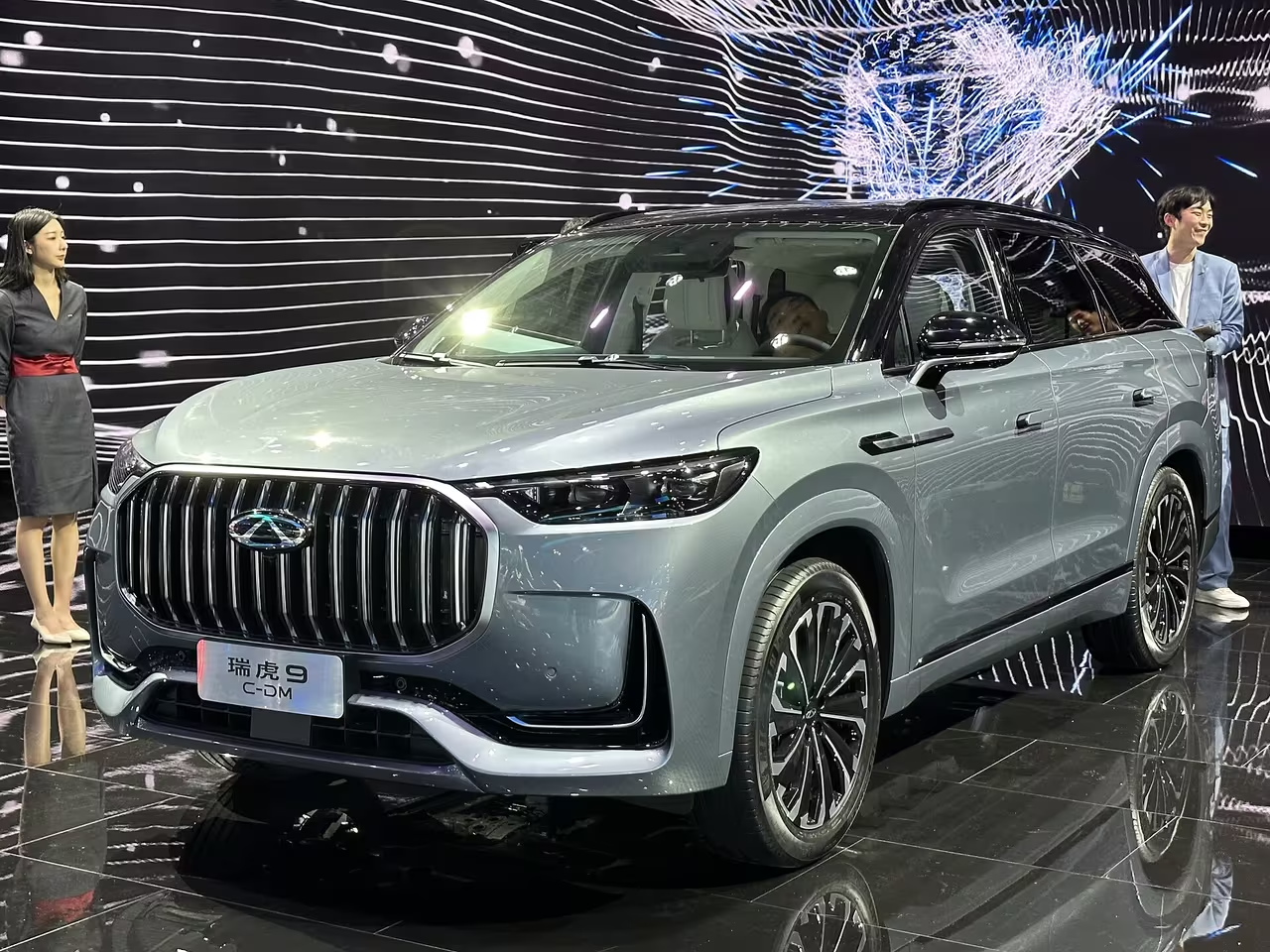
Affordable Chinese cars are rapidly changing South Africa’s roads. Walk into almost any dealership and you will see them: shiny SUVs, big touchscreens, reverse cameras, leather-looking seats, long warranties, and prices that make established brands sweat a little.
Chinese car brands currently sold in South Africa feature a growing mix of mainstream and new entrants. Major established brands include Chery, Great Wall Motors, BYD, and MG Motor. Then there’s a bevy of fast-growing newer brands: Jetour, Omoda, Jaecoo, BAIC, Changan, JAC Motors, Foton, and GAC Motor.
For cash-strapped South Africans, it isn’t hard to understand the appeal. When food, fuel, school fees, and bond repayments are already fighting for first place in your bank account, a cheaper car with more features feels like a win.
But experts are sounding a serious warning. Are buyers getting a bargain or are they being asked to compromise on safety?
Chinese vehicle brands have moved from niche players to mainstream competitors in South Africa’s car market. The National Association of Automobile Manufacturers of South Africa (Naamsa) said new vehicle sales rose 15.7% in 2025, reaching 597 338 units, helped by lower interest rates, low vehicle-price inflation, and greater choice. It also described the rise of imported Chinese brands as “meteoric”, with modern technology, competitive pricing, and long warranties helping them to break into the mainstream.
Reuters reported a similar shift: South Africans are increasingly choosing value over badge prestige as the cost of living bites. Naamsa president Billy Tom said vehicle sales in the first half of 2025 were up 14% year on year, whereas imports rose 30.2%, driven largely by affordable models from China.
This is the basic deal Chinese brands are offering: more car for less money. For first-time buyers, that matters. A touchscreen, a camera, and an SUV body shape can make a budget car feel premium.
A comparison between Volkswagen’s compact SUVs and Chinese rivals such as Chery shows a significant price gap. A VW T-Cross typically costs between R400 000 and R480 000, whereas the Chery Tiggo 4 Pro starts closer to R270 000. Despite their lower prices, Chinese models often include features such as a 360-degree camera, digital instrument cluster, and larger infotainment screens as standard. These are frequently optional extras in models manufactured by European competitors.
But the problem is that safety is not always as visible as shiny tech.
The Automobile Association of South Africa (AA) has raised concerns about whether vehicles sold locally offer the same level of safety as models sold in other markets.
The AA and the Global New Car Assessment Programme (NCAP) run the Safer Cars for Africa campaign, which crash-tests vehicles available in South Africa and rates them based on how well they protect occupants. The campaign was launched in 2017 to promote safer vehicles across Africa.
Earlier in 2026, Global NCAP gave the Chery Tiggo 7 Pro sold in South Africa a two-star adult occupant safety rating and a three-star child occupant rating. It also found that the bodyshell and footwell were unstable, and said the model did not offer standard side head protection for front and rear rows.
AA chief executive Bobby Ramagwede said the result showed a “continuing pattern” in which vehicles sold in Africa do not meet the same safety standards as those sold in other regions. He also criticised the use of safety ratings from other markets to promote cars locally, saying South African consumers need market-specific information.
That point matters. A five-star rating in Europe does not automatically mean the South African version of a vehicle has the same safety equipment or structure. Global NCAP has also warned against using crash-test results from other markets to give local buyers the false impression of safety.
South Africa does not currently require a minimum Global NCAP, Euro NCAP, or Australasian NCAP star rating before a vehicle can be sold. Instead, vehicles must comply with safety regulations administered by the National Regulator for Compulsory Specifications (NRCS). This means a vehicle can be legally sold in South Africa even if it has never been independently crash-tested. As a result, consumer organisations often use NCAP ratings as an additional measure of safety performance beyond the minimum legal requirements.
Independent crash-test organisations use a five-star rating system, with five stars representing the highest level of occupant protection and crash-avoidance technology. Although there is no universally accepted threshold at which a vehicle becomes “unsafe”, experts generally regard vehicles that receive zero, one, or two stars as providing significantly lower levels of protection. These lower-rated vehicles often lack advanced safety technologies such as autonomous emergency braking, lane-keep assist, side-curtain airbags, and other systems designed to prevent crashes or reduce injuries.
The National Regulator for Compulsory Specifications (NRCS) sees the issue differently.
The NRCS told /explain/ it shares the AA’s objective of road safety and preventing deaths, but that there is a difference between independent consumer-safety ratings and the minimum legal standards it is required to enforce.
That is a key distinction. NCAP ratings test how well cars perform beyond minimum legal requirements. The NRCS checks whether a vehicle meets South Africa’s compulsory specifications before it can be legally sold.
According to the South African government, all motor vehicles, whether imported or locally manufactured, must comply with the National Road Traffic Act. Importers must also submit proof of conformity to the South African Bureau of Standards requirements.
The NRCS told /explain/ every legally imported vehicle model must go through a homologation process before entering the market. “Homologation” is basically the official approval process that checks whether a vehicle meets local legal requirements. Not a sexy word, but an important one.
The regulator also said it is country-neutral: whether a vehicle is made in Asia, Europe, or South Africa, the same rules apply.
This is where the debate becomes complex.
On paper, the NRCS is right: cars legally sold in South Africa must meet local compulsory standards. That means they aren’t simply entering the market without any checks at all.
But the AA argues that South Africa’s minimum standards may not be strong enough, particularly when compared with what consumers in other markets receive. In its statement on the Chery crash test, the AA said that Africa urgently needs stronger vehicle safety regulations and greater manufacturer accountability.
So the question isn’t just: “Is this car legal?” It’s also: “How safe is it compared with what buyers could get elsewhere?”
Those are not the same thing. A car can meet South Africa’s minimum legal standard and still perform poorly in an independent crash test, an important distinction for buyers to understand.
For most consumers, safety information is difficult to compare. Price is obvious. The touchscreen is obvious. The reverse camera is obvious. A weak crash-test rating? Missing side airbags? No electronic stability control? Not so obvious.
That makes affordability powerful. A cheaper car with loads of features can look like a smarter buy than a more expensive car with fewer visible extras. But some of the most important safety features, like a reinforced passenger-safety cell and a strong cabin structure, as well as crumple zones designed to absorb crash energy before it reaches passengers, are the ones you need only when something has already gone very wrong.
There is also a broader market shift happening. Reuters reported that Chinese brands see South Africa as a key gateway into Africa, with companies such as BYD, Chery, and GWM challenging established brands with lower-priced, tech-heavy vehicles. Nearly 20 Chinese automotive brands now operate in South Africa, with several new entrants arriving in 2025 and 2026 – and more expected to follow.
That means South African buyers are getting more choice. That’s good, but only helps if consumers also receive clear, honest safety information.
Chinese cars are not automatically unsafe. Established brands are not automatically safe either. Global NCAP Africa results include poor ratings for vehicles from several non-Chinese brands, such as the Renault Kwid (France), Suzuki (Japan), and Hyundai (South Korea), among others. That shows this is a broader affordability-and-regulation problem, not just a China problem.
But the rise of cheaper, feature-packed imports has made the safety question more urgent.
South Africans should not have to choose between affordability and survival. A good deal should not come with hidden compromises that become clear only in a crash.
For now, the safest advice is simple: before buying, check whether the exact model sold in South Africa has a Safer Cars for Africa or market-specific NCAP rating. Ask about airbags, electronic stability control, side-impact protection, and structural safety, not just screens, cameras, and leather seats.
Because a car can look expensive inside and still be cheap where it matters most.