We Are All Africans: Dlamini-Zuma Reminds Nation That Borders Were Forced By Colonial Powers
iReport South Africa | 26.05.2026 14:25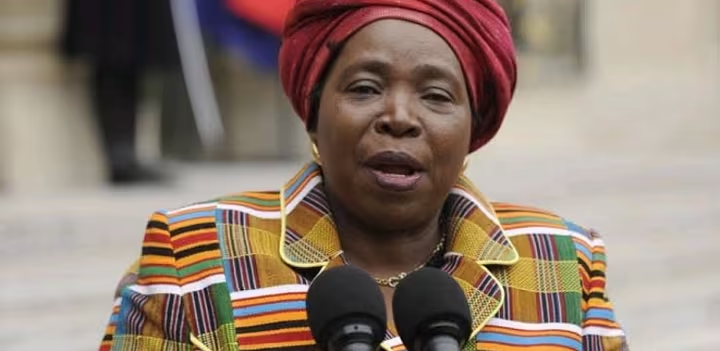
The veteran South African statesman and former chairperson of the African Union Commission, Dr. Nkosazana Dlamini-Zuma, has strongly condemned the modern artificial borders that fragment the African continent. He has also reminded the people of Africa that their primary identity is rooted in a shared African heritage rather than colonial dividing lines.
The ideological intervention that Dlamini-Zuma carried out took place during a national speech that was broadcast on television, and it came at a particularly precarious time for the diplomatic relations in the area.
As a result of weeks of intense anti-immigration demonstrations, citizen audits at the street level, and a series of emergency evacuations that were funded by the state and organised by West African governments in order to rescue hundreds of vulnerable foreign professionals and traders, the subcontinent is currently dealing with severe geopolitical friction.
In his remarks, the former minister encouraged people all around South Africa to actively reject the emergence of localised xenophobic attitude. He characterised the internal antagonism between sister nations as an echo of previous exploitation.
She framed the fractured shape of the continent as a planned outcome of the Berlin Conference that took place between 1884 and 1885. During this conference, European imperialist powers drew out and broke apart sovereign African regions in order to serve Western economic objectives without consulting the local populace.
Tweet
Dlamini-Zuma stated that the colonial aim of separation, which extends back hundreds of years, is actively validated when current economic worries are allowed to foster animosity against fellow Africans on the continent.
To permanently reverse this fragmentation, she pleaded with political leaders, civic institutions, and the general public to look past the current legal visa disputes and work together in a methodical manner to construct a prosperous and integrated continent that is in line with the visionary framework of Agenda 2063, which was developed by the African Union. “We are all Africans,” she said. That is the first identity that we have. The convention that took place in Berlin resulted in the division of Africa among the colonisers, which is the reason why we are distinct nations. We were not the ones who drew those lines; rather, they were created in order to divide us and take advantage of our riches. It would be irresponsible of us to let ourselves be hampered by that past. It is imperative that we all collaborate in order to bring about the Africa that we envision: a continent that is completely unified, peaceful, and affluent, and in which we see each other as brothers and sisters rather than strangers. Dr. Nkosazana Dlamini-Zuma made the following statement: “Our strength lies not in our divisions but in our unity, and we must defend that pan-African solidarity at any cost.”
Her comments provide an important new dimension to a national discourse that is already very polarised.
Dlamini-Zuma’s message is similar to recent warnings issued by former President Thabo Mbeki against using migrants as economic scapegoats. This is despite the fact that populist political movements continue to call for strict border enforcement, immigration sweeps led by the military, and the prioritisation of domestic labour for citizens who were born in the country.
The former head of the (AU) urged South Africa to regain its historic post-apartheid identity of Ubuntu by recasting migration in the region not as a danger to national security but rather as a chance for common progress.
She argued that the continent in question is capable of effectively neutralising artificial differences and securing a stable and cohesive future for all of its people provided bureaucratic impediments are removed, free commerce is encouraged, and pan-African solidarity is practiced.