Can Rise Mzansi turn a small seat count into real influence?
Explain | 05.06.2026 14:27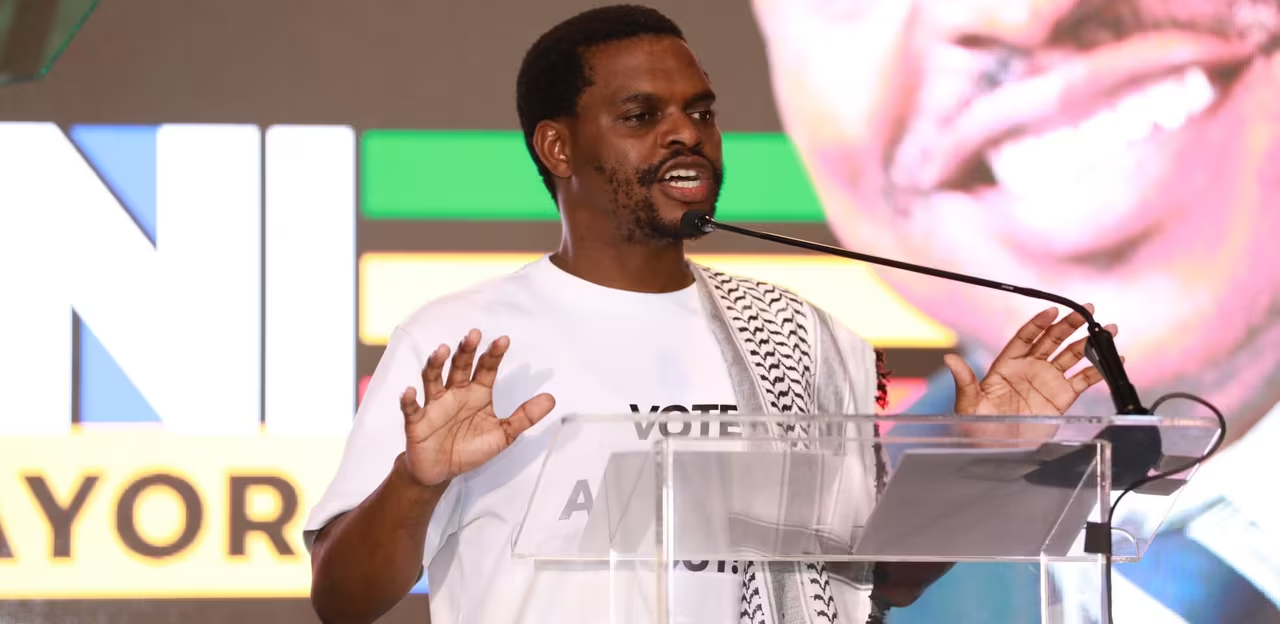
Lukhona Mnguni is selling himself as Joburg’s fresh start, a new face who doesn’t belong to the familiar cast of politicians who have tried – and often failed – to fix the metro.
Lukhano Mnguni’s promise of freshness is a useful message in a city battered by unstable leadership, service failures, and public frustration. But “new” is not the same as “ready”.
And Mnguni is not new to politics per se. He co-founded the Rivonia Circle with Rise Mzansi leader Songezo Zibi in 2021 and became a familiar voice in South African political analysis before leaving that role last month to become the party’s Joburg mayoral candidate.
At his 23 May launch, Mnguni said Joburg needed to be cleaned up and that “old instruments” were not suited to the task. He also took aim at ActionSA’s Herman Mashaba and the DA’s Helen Zille, casting them as recycled politicians from the past. Zibi echoed the point, suggesting Joburgers may have feared their future was in the hands of people “way past retirement age”.
The strategy is to make Mnguni the face of renewal and his opponents the face of the old cycle. It may resonate with voters tired of coalition chaos. But Mashaba has governed Joburg before and Zille remains an experienced political operator. Dismissing them as relics does not prove Mnguni can run South Africa’s most complex metro.
His strength is that he has no coalition baggage. His weakness is that he has no record of governing. Joburg may want something new. The question is whether Mnguni is offering a governing plan or just an “anyone but them” alternative.
After his announcement, Mnguni told /explain/ he does not see Zille or Mashaba as his toughest competition.
“We are on different paths,” he said. “They represent the past, I represent the future.”
Mnguni argues that Zille and Mashaba’s ongoing clashes over Mashaba’s time in the DA show they are stuck in old political battles. “Herman feels Helen did him dirty by not backing him when a motion of no confidence was brought up and I have nothing to do with all of that,” he said.
It is a sharp line, but also a risky one. Zille and Mashaba are backed by larger parties with deeper campaign machinery, whereas Rise Mzansi is still a relatively new and small player.
Mnguni also doubled down on his claim that Zille is anti-transformation, pointing to her opposition to affirmative-action policies. He argued that Johannesburg’s growth in the early 2000s until about 2010 was closely tied to transformation policies and a growing economy.
“If you are anti-transformation, you do not belong here,” he said.
His pitch is that Zille and Mashaba are yesterday’s fight: he is tomorrow’s plan. The challenge is that voters may want less framing and more proof, particularly in a city where vision statements have a habit of collapsing somewhere between a burst pipe and a council meeting.
The big question behind Mnguni’s Joburg mayoral bid is not only whether he can sell himself as the future. It is whether Rise Mzansi has enough muscle to make that pitch matter.
The party was formed in 2023 and ran a lively national campaign in the 2024 elections, but its results were modest: two seats in Parliament and one in the Gauteng legislature.
Mnguni rejects the idea that this makes Rise Mzansi small. He argues the party has used its limited representation well: leader Zibi chairs Parliament’s Standing Committee on Public Accounts; Makashule Gana is the whip of smaller parties; and Vuyiswa Ramokgopa is Gauteng’s MEC for economic development, agriculture, and rural development.
For Mnguni, this proves Rise Mzansi can be trusted with influence. “Even with one or two seats, there’s something compelling about Rise Mzansi to voters,” he said.
But local government is a different beast. Mnguni says Rise Mzansi is the seventh-largest party in Johannesburg, where more than 50 parties are expected on the ballot.
He believes winning even 15 seats in the 270-seat council would be “making magic”.
That ambition sits at the heart of the party’s challenge. Rise Mzansi wants voters to see it as a serious governing partner, not just another small party in a crowded coalition market.
Zille has warned that voting for smaller parties can help to keep the ANC dominant and create unstable coalitions. Mnguni called that framing “unconstitutional”, but declined to expand on this comment.
That argument will matter. Joburg’s next mayor is unlikely to govern alone. So Rise Mzansi’s test is not just whether it can win voters over, but whether it can turn a small seat count into real leverage without becoming part of the same coalition chaos it says it wants to fix.
Local government elections will take place on 4 November. In the lead-up,/explain/ will interview as many mayoral candidates as possible to help South Africans gain a better sense of the people vying to become the city of gold’s first resident. Next up: part two of our interview with Lukhona Mnguni.
Prashalan Govender is a journalist who was shortlisted for the Vodacom Young Journalist of the Year Award twice. He is focused on reporting the stories that shape everyday life in South Africa, with a particular interest in politics, economics, and social issues.