NASA Discovers a New Earth-Like Planet in the Galaxy
Medium | 28.01.2026 19:12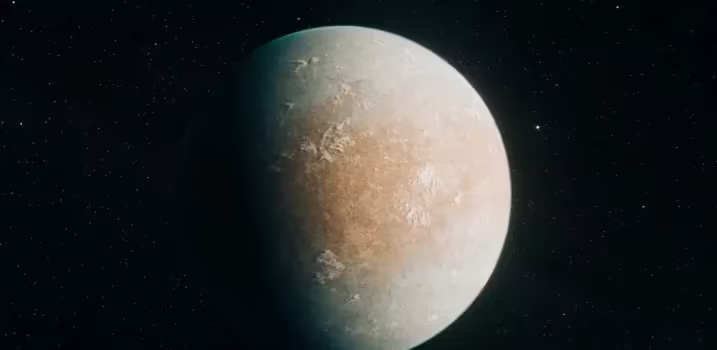
NASA Discovers a New Earth-Like Planet in the Galaxy
4 min read
·
1 hour ago
--
Listen
Share
NASA Discovers a New Earth-Like Planet in the Galaxy
The search for habitable worlds beyond our solar system has taken a monumental leap forward with NASA’s recent discovery of an Earth-like exoplanet. Located within the habitable zone of its star, this newfound planet exhibits conditions that could potentially support liquid water—a critical ingredient for life as we know it. The discovery has reignited excitement in the scientific community and among space enthusiasts, raising profound questions about the possibility of extraterrestrial life and humanity’s future in interstellar exploration.
The Discovery and Its Significance
NASA’s Transiting Exoplanet Survey Satellite (TESS) identified the planet, designated TOI-700 e, orbiting a red dwarf star approximately 100 light-years away in the constellation Dorado. What makes this finding extraordinary is the planet’s size and position relative to its star—factors that place it within the so-called "Goldilocks zone," where temperatures are neither too hot nor too cold for liquid water to exist.
TOI-700 e is roughly 95% the size of Earth and completes an orbit around its star every 28 days. Its sibling planet, TOI-700 d, discovered earlier, also resides in the habitable zone, making this system one of the few known to host multiple potentially life-sustaining worlds. Scientists believe that TOI-700 e is likely rocky, further increasing its resemblance to Earth.
The Role of Advanced Technology
The detection of such distant planets relies on cutting-edge technology. TESS, launched in 2018, scans the sky for minute dips in starlight caused by planets passing in front of their host stars—a method known as the transit technique. Follow-up observations using ground-based telescopes and NASA’s James Webb Space Telescope (JWST) provide additional data on the planet’s atmosphere, composition, and potential habitability.
The JWST, with its unprecedented infrared capabilities, has been instrumental in analyzing the chemical signatures of exoplanet atmospheres. By studying molecules like carbon dioxide, methane, and water vapor, scientists can infer whether these worlds possess conditions conducive to life. While TOI-700 e’s atmosphere remains uncharacterized, future observations could reveal groundbreaking insights.
Implications for the Search for Life
The discovery of Earth-like planets fuels the age-old question: Are we alone in the universe? While TOI-700 e’s habitability is still theoretical, its existence underscores the likelihood that similar planets are abundant in the galaxy. NASA’s ongoing missions, alongside international collaborations, aim to identify biosignatures—chemical markers indicative of life—on such worlds.
Astrobiologists emphasize that even if life exists on TOI-700 e, it may not resemble Earth’s biology. Extreme environments on Earth, such as deep-sea hydrothermal vents, demonstrate that life can thrive in unexpected conditions. This broadens the scope of what scientists consider habitable, encouraging exploration of diverse exoplanetary environments.
Elon Musk and the Private Space Industry’s Role
While NASA leads the charge in exoplanet discovery, private entities like SpaceX, founded by Elon Musk, are revolutionizing space exploration. SpaceX’s Starship, designed for deep-space missions, could eventually facilitate human travel to Mars and beyond. Musk’s vision of a multiplanetary species aligns with the long-term goal of colonizing habitable worlds, though interstellar travel remains a formidable challenge.
The synergy between government agencies and private companies accelerates technological advancements. Innovations in propulsion, life-support systems, and sustainable habitats are critical for future manned missions to exoplanets. While TOI-700 e is currently unreachable with existing technology, the rapid pace of development in the tech industry offers hope for breakthroughs in the coming decades.
The Future of Exoplanet Exploration
NASA’s upcoming missions, such as the Habitable Worlds Observatory (HWO), aim to directly image Earth-like exoplanets and analyze their atmospheres for signs of life. Scheduled for launch in the 2030s, HWO will build on the legacy of TESS and JWST, providing even clearer glimpses of distant worlds.
Public interest in exoplanets continues to grow, driven by discoveries that blur the line between science fiction and reality. Educational initiatives and media coverage play a vital role in engaging the general audience, fostering a deeper appreciation for space science.
Conclusion