Correctional Services Minister Dr Pieter Groenewald Plans to Deport 26,000 Foreign Prisoners
iReport South Africa | 25.03.2026 21:59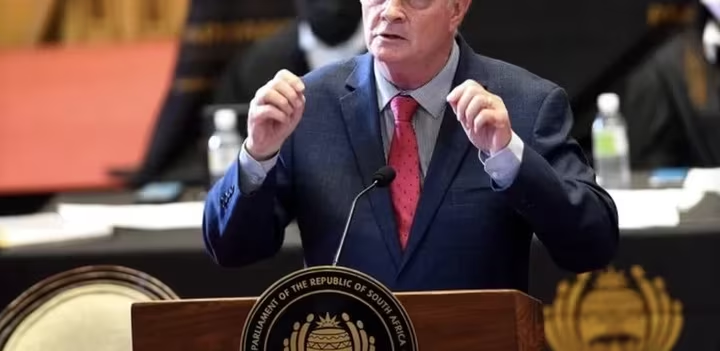
South Africa’s Correctional Services Minister Pieter Groenewald has announced plans to deport thousands of foreign nationals currently held in the country’s prisons, as part of efforts to address overcrowding and reduce costs. The Department of Correctional Services estimates that around 26,000 foreign nationals are currently in custody, including both sentenced offenders and individuals awaiting trial.
ImageAccording to the minister, each inmate costs the state approximately R463 per day, covering expenses such as food, accommodation, healthcare, and security. This translates to more than R11 million spent daily on foreign inmates alone. Groenewald said the figures highlight the financial pressure on the correctional system and the need for long-term solutions.
The proposed plan involves repatriating foreign nationals to their countries of origin where possible. However, the process is subject to legal and administrative requirements. Groenewald confirmed that current legislation, including aspects of the Correctional Services framework, limits how quickly deportations can be carried out. As a result, the department is working on legislative amendments and engaging with foreign governments to facilitate the process. He indicated that progress is expected over the next year as these measures are implemented.
South Africa’s correctional facilities have long faced challenges related to overcrowding, with inmate populations often exceeding available capacity. Officials believe that reducing the number of foreign inmates could help ease pressure on the system. The initiative forms part of broader efforts to manage prison populations and improve conditions within facilities.
Authorities are expected to continue consultations with relevant stakeholders, including international partners, to ensure that deportations comply with legal standards and bilateral agreements. Further details on timelines and implementation are likely to be released as the process develops.
The Economic Freedom Fighters (EFF) are experiencing issues inside their organization as a result of members of the group announcing their intention to have a meeting and discuss the possibility of taking disciplinary action against their president in response to contentious remarks made against General Mkhwanazi. At the same time as members of the party are emphasising the importance of maintaining organisational integrity and discipline, this new development represents a rare public hint of dissent inside the ranks of the party.
In a statement that was written in a straightforward manner, members of the party reaffirmed their dedication to preserving order and emphasised that no individual, regardless of their position, is superior to the ideas that the movement upholds. They issued a warning against what they referred to as any kind of “anarchy” within the party, indicating that the recent comments made by the leadership may have crossed beyond the borders of the party’s internal structure.
It would appear that the words made regarding General Mkhwanazi have caused members to express concern, as they do believe that the utterances have the potential to undermine the image and values of the party. The reaction indicates that the president’s words were serious enough to provoke talks about responsibility at the highest level, despite the fact that the substance of the president’s comments were not clearly articulated.
Respect for the EFF’s seven cardinal pillars, which serve as a framework for the party’s ideology and behaviour, is of the utmost importance to the members of the organization. The declaration indicates that none of these principles are in favour of providing protection or defence to persons who are involved in illegal behaviour. The party’s members reaffirmed that the party has often warned its leadership to avoid developing or sustaining connections with persons whose moral character is under question.
Political observers believe that the situation may put the EFF’s internal governance systems to the test, as well as the organization’s capacity to remain united while effectively managing dissent. Such calls for disciplinary action against a sitting president are extremely rare and have the potential to have wider-reaching ramifications for the stability of the party as well as the public’s image of it.
At the same time, the move may also be interpreted as an effort by members to strengthen accountability and demonstrate that the organization is devoted to the ideas that it was founded on. It is possible that the EFF is striving to prevent more damage to its reputation and to maintain its credibility among its followers by addressing the matter internally.