Princess Magogo broke royal rules to make music history
Scrolla | 13.08.2026 22:47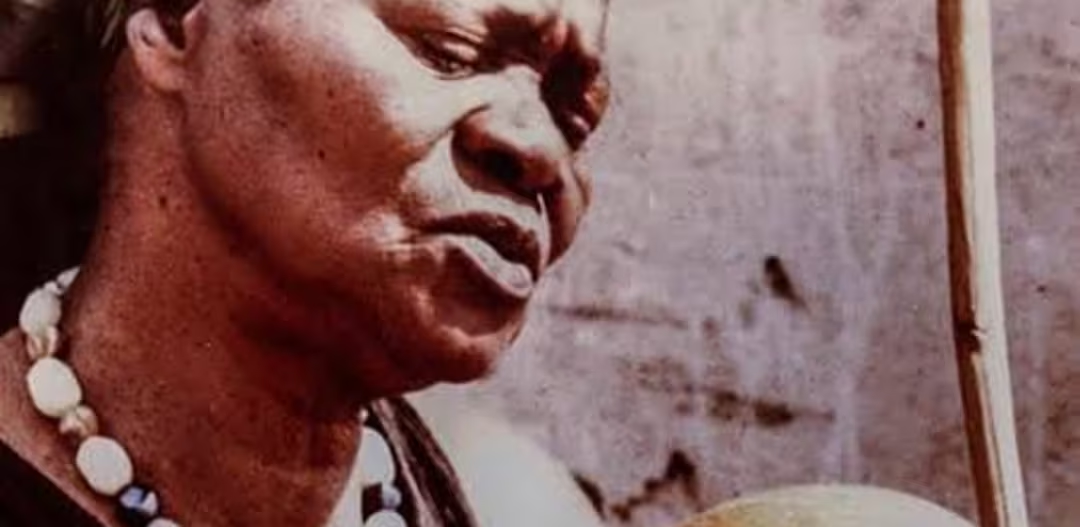
By Celani Sikhakhane
• Princess Magogo challenged expectations placed on royal women and became a respected composer, singer, poet and player of traditional Zulu musical instruments.
• Her performances were recorded from 1939 and later reached international audiences, helping preserve traditional Zulu songs, history, folklore and musical knowledge.
Princess Magogo kaDinuzulu kaCetshwayo was born into one of the most powerful royal families in Zulu history, but she refused to allow royal tradition to silence her musical talent.
Born in 1900, Princess Magogo was a granddaughter of King Cetshwayo kaMpande and a daughter of King Dinuzulu kaCetshwayo.
She was also the sister of King Solomon kaDinuzulu and later became the mother of longtime Zulu traditional prime minister Prince Mangosuthu Buthelezi.
But Princess Magogo created a powerful name of her own.
At a time when royal women were expected to follow strict traditions, she became known as a singer, composer, musician and poet.
Poetry was largely dominated by men in Zulu society, but Princess Magogo stepped into that space and became respected for her knowledge and talent.
She played traditional instruments including the ugubhu, a musical bow connected to a calabash, and the isithontolo, another form of musical bow.
Her music drew strongly from existing Zulu songs and folktales.
She developed these traditions into performances accompanied by the ugubhu, helping keep important parts of Zulu musical culture alive.
Her contribution went far beyond performing.
Princess Magogo trained young singers and became an important source of knowledge about Zulu music, traditions, history and folklore.
Her knowledge attracted researchers and music experts from South Africa and other parts of the world.
Among those who consulted her were David Rycroft from the School of Oriental and African Studies in London and Henry Weman, an organist at Uppsala Cathedral in Sweden.
Hugh Tracey, who headed the International Library of African Music, also regularly consulted Princess Magogo and recorded her performances.
In 1939, recordings of some of her music helped take her work to a wider audience.
By the 1950s, more of her performances were being recorded and broadcast.
The South African Broadcasting Corporation, Rycroft and West German Radio were among those who recorded or played her work.
Those recordings helped Princess Magogo’s voice and music travel far beyond the Zulu royal court.
Her contribution also helped preserve traditional music for generations who came after her.
Princess Magogo died in 1984, but recognition of her work continued.
In 2003, President Thabo Mbeki posthumously awarded her the Order of Ikhamanga for her contribution to music and the preservation of Zulu culture.
Her name also continues to be celebrated through choral music events in northern KwaZulu-Natal.
Princess Magogo’s story stands out because she built her musical legacy at a time when women, particularly royal women, faced strict expectations about how they should behave.
Instead of allowing those expectations to stop her, she used her voice, poetry and traditional instruments to take Zulu music to audiences around the world.
Decades after her death, recordings of her work remain part of the story of traditional South African music.
Her legacy also lives on through generations of African women who have built successful careers in music and challenged old ideas about where women belong.
Princess Magogo did not need to leave her culture behind to break barriers.
She used that culture to make history.
Pictured above: Princess Magogo Constance kaDinuzulu kaCetshwayo, the celebrated Zulu royal musician, composer and poet whose performances reached international audiences.
Image source: Facebook.