How to see Thursday's full Cold Moon, the last supermoon of 2025
BBC | 03.12.2025 15:45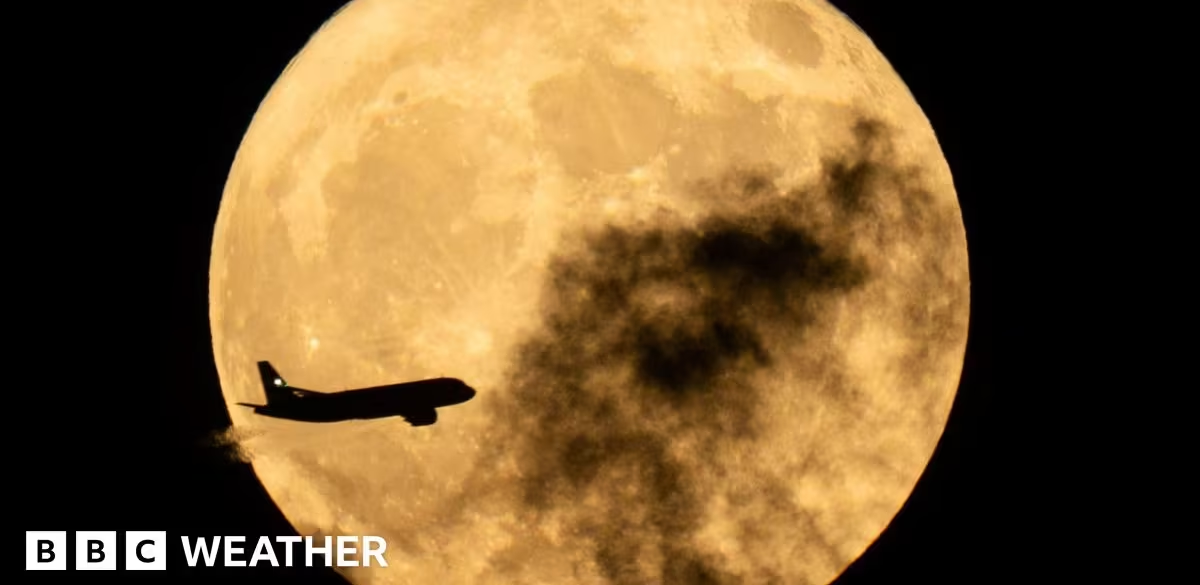
The full Cold Moon will be visible on Thursday 4 December.
It is another supermoon, the third of 2025 and the last.
Supermoons are not that rare, there are usually three or four a year, but it is unusual to have three of them in a row - four if you count the first full Moon of 2026 too.
They occur when the Moon is "in perigee". That's to say the full Moon coincides with it being at its closest point to Earth in its orbit, appearing larger and brighter in the night sky.
A full Moon happens when the Sun and Moon are on opposite sides of Earth - in alignment, known as 'syzygy' - so the whole side that is facing us is illuminated.
When will the Cold Moon rise?
The full Moon will rise in the north-eastern skies on the afternoon of the December 4 at 14:52GMT in London, 14:29 in Edinburgh, 14:52 in Belfast and 15:05 in Cardiff.
It will then set again between 08:00 and 09:00 the following morning so there will be plenty of hours of darkness to view it. Check the Sunrise and Sunset times where you are.
As the Moon rises it will form a triangle with the Pleiades star cluster and the bright star Aldebaran.
Jupiter will appear in the night sky close to the Moon, as well as the winter constellation of Orion the Hunter.
A band of cloud and rain is expected to move eastwards across the UK on Thursday and this may linger into the evening across northern and eastern Scotland and eastern England.
As it moves away, clear skies are set to develop in many areas overnight, however widespread mist and fog could form, reducing visibility in some locations.
It will be a fairly cold night with temperatures dropping close to freezing and a touch of frost in places.
Check the full forecast for your local area here.
Why is it called a Cold Moon?
Each full Moon in a year has a name - a practice that dates back to ancient traditions centuries before the Gregorian calendar existed.
Full Moons were historically named as a way of keeping track of the change of seasons and often influenced the timing of activities like hunting, harvesting and planting, where the bright moonlight could come in handy.
December's full Moon is known as the Cold Moon and marks the start of winter as it occurs near the solstice. It has also been known as the Long Night Moon and the Moon before Yule.
The next full Moon, on Saturday 3 January 2026 is the Wolf Moon and this will be yet another supermoon.