AmaXhosa king calls on academics to end centuries of sidelining customary law
Scrolla | 17.09.2026 14:07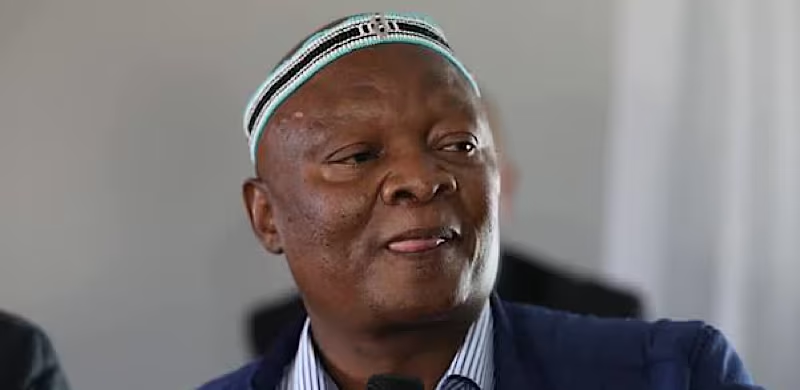
By Celani Sikhakhane
- King Vulikhaya Sigcawu called on academics to help protect and develop African customary law, at a University of Fort Hare gathering this month.
- Chief Mwelo Nonkonyana called for the rejuvenation of Jongilizwe College to train traditional leaders, and greater government support for the initiative.
AmaXhosa King Vulikhaya Sigcawu is calling on academics to play a vital role in consolidating African customary law, which he says has long been marginalised by colonial legal systems rooted in Roman-Dutch and British law.
The King was addressing the University of Fort Hare’s Customary Law Assembly, held at the Miriam Makeba Arts Centre on the university’s East London campus earlier this month, in partnership with the AmaXhosa Kingdom and recognised kingships across the Eastern Cape.
The King acknowledged that consolidating and codifying customary law would be a long process, and pledged his support for the initiative, championed by the university’s Faculty of Law. He described customary law as central to the way of life of African communities, saying its treatment as subordinate to Roman-Dutch law reinforces a colonial mindset that Africans’ own practices are backward. He called on academics to contribute to protecting and developing customary law through research, and urged the initiative be expanded beyond the Eastern Cape to include other kingdoms and traditional leadership structures nationally.
Chief Mwelo Nonkonyana, Contralesa’s provincial chair and a High Court advocate and MP, delivered the keynote address on behalf of the Eastern Cape House of Traditional Leaders, saying customary law had historically been marginalised within the country’s legal system. He called for traditional and Khoisan leaders to be properly capacitated, and recommended reviving Jongilizwe College to train royals and provide ongoing training for traditional and Khoisan leaders. He also called for government support for infrastructure and research, and urged higher education institutions to promote customary law.
This comes as many traditional leaders across South Africa call for the development of customary law and traditional courts to handle royal disputes directly. Prof Mathole Motshekga of the Balobedu Kingdom recently argued that royal disputes are instead being decided in courts rooted in colonial legal traditions that have little to do with African custom.
Discussions at the Assembly examined the historical marginalisation of customary law, including the legacy of colonial legislation and its effect on the recognition of indigenous legal systems, as well as the challenge of developing customary law within South Africa’s constitutional framework. Participants also considered the need for greater recognition of living customary law
Pictured above: AmaXhosa King Vulikhaya Sigcawu, who has called on academics to help advance customary law.
Image source: ANC Eastern Cape