Premier Soccer League Standards Blamed for Bafana Bafana’s Struggles After Mexico World Cup Defeat
Diski 365 | 15.06.2026 14:56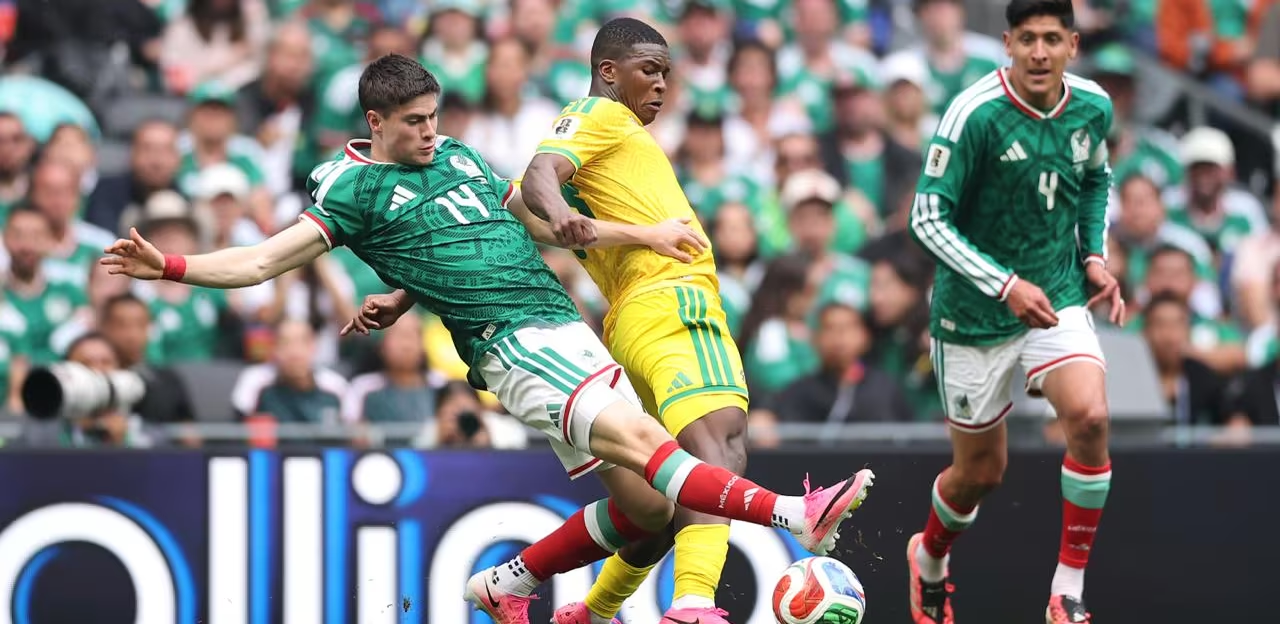
South Africa’s 2-0 loss to Mexico at the Estadio Azteca has triggered a deep debate about the state of domestic football and its impact on Bafana Bafana’s World Cup performance. The defeat exposed clear gaps in intensity, structure and decision making, with critics now turning their attention to the Premier Soccer League (PSL). Many believe the domestic competition is not producing enough high-pressure matches to prepare players for elite international football. The conversation has grown louder as South Africa attempts to stay competitive in a demanding World Cup group. The performance against Mexico has therefore become more than a single result, it has become a reflection point for the entire football system.
The criticism has largely focused on the gap between the top PSL clubs and the rest of the league. Only a few sides such as Mamelodi Sundowns FC and Orlando Pirates are seen as consistently playing at a high tempo with strong tactical structure. The remaining clubs are accused of offering limited resistance, which reduces the level of weekly competition for national team players. This imbalance creates a situation where top players do not face enough demanding matches before international duty. Critics argue that this weakens overall readiness when South Africa faces teams from stronger leagues.
Football figure Walter Rautmann has been one of the most outspoken voices in this debate. He has argued that the PSL’s structural decisions over the years have contributed to the current decline in competitiveness. His comments highlight concerns about club ownership changes that removed historically strong teams from the top flight. He referenced the loss of traditional clubs that once developed top local talent and built strong fan bases. According to him, these changes have reduced both match intensity and development pathways for emerging players. His criticism has intensified pressure on league administrators to address long standing issues.
Rautmann also pointed to the widening gap between the top clubs and the rest of the league. He argued that only a small group of teams consistently provide a high level of competition. The rest of the league, in his view, struggles to match that standard, leading to predictable matches with limited tactical challenge. This situation, he believes, prevents players from developing the sharpness required at international level. He stated that the problem has been visible for some time and should not have been ignored. His comments reflect a growing sentiment among analysts who see structural imbalance as a core issue.
The concerns come at a time when Bafana Bafana are under pressure to perform on the global stage. The loss to Mexico raised questions about tactical discipline, fitness levels and decision making under pressure. Critics argue that these weaknesses are directly linked to the domestic environment, where players are not consistently exposed to high intensity football. In contrast, opponents like Mexico operate in more demanding leagues with faster tempo and stronger tactical demands. This difference becomes clear during international matches where South Africa struggles to maintain control.
The coaching staff led by Hugo Broos now faces the challenge of bridging that gap within limited international windows. With only short camps to prepare, there is little time to correct weaknesses that should be addressed at club level. This puts additional pressure on players to adapt quickly to higher standards. The issue is not only tactical but also physical, as players often struggle to sustain intensity across 90 minutes against elite opposition. The result is a team that shows moments of quality but lacks consistency.
Attention is also shifting to the development pipeline and how young players transition into senior football. Players such as Oswin Appollis and Relebohile Mofokeng are seen as part of a new generation carrying expectations for improvement. However, analysts warn that talent alone is not enough without a strong competitive environment. If the domestic league does not challenge them regularly, their growth could stall at international level. This concern is driving calls for reform in coaching standards, club structures and league competitiveness.
Bafana Bafana still have matches ahead in their World Cup group, including tough fixtures against South Korea and Czechia. These games will test whether the team can respond to criticism and improve quickly under pressure. South Korea’s ability to compete against African opposition and Czechia’s European qualification path underline the level of challenge South Africa faces. Every remaining match now carries added importance as the team aims to progress beyond the group stage for the first time in its history. The performance against Mexico has therefore set a difficult tone for what comes next.
The debate around the PSL and its influence on national team performance is unlikely to fade soon. The defeat has exposed deeper questions about development, competitiveness and long term planning in South African football. While individual players continue to show potential, the system around them is being questioned more than ever. Reform discussions are expected to intensify as stakeholders look for solutions that can close the gap between domestic football and international demands. For Bafana Bafana, the challenge now is to prove that they can rise above those limitations in the remaining World Cup fixtures.