Real Politics: Smaller parties could choose Gauteng’s next mayors
Scrolla | 26.10.2026 16:40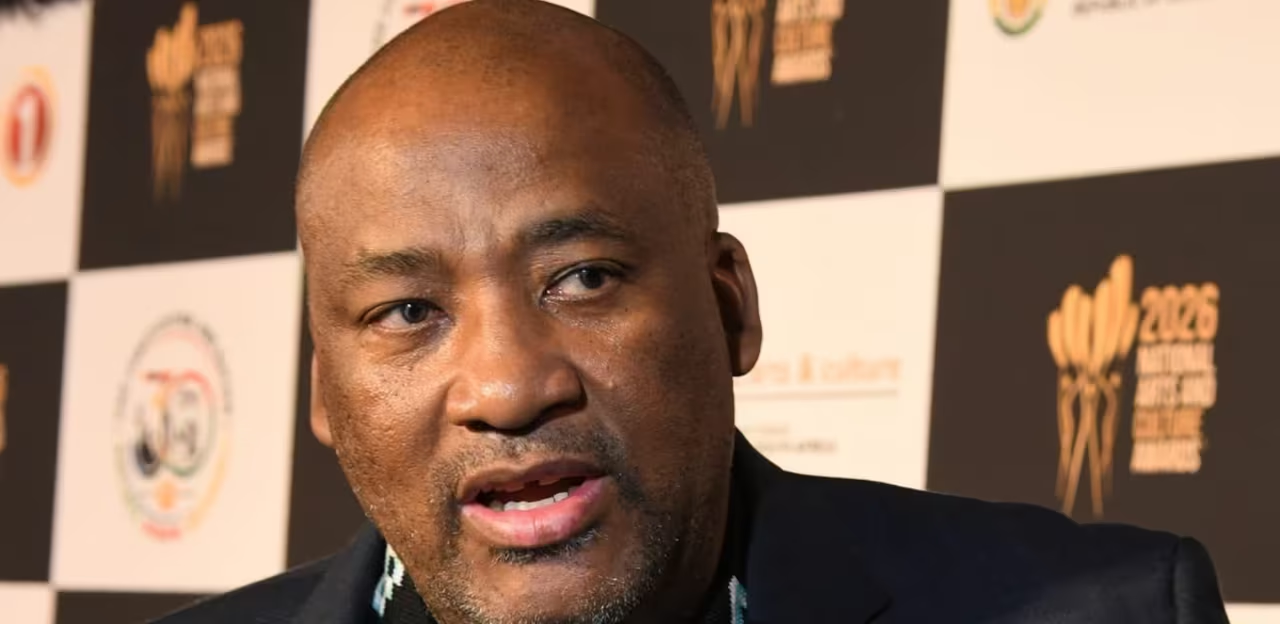
Smaller parties could use their bargaining power to secure leading roles in Gauteng’s cities, even if they finish well behind the biggest parties, writes Zukile Majova in Real Politics.
Gayton McKenzie sounded remarkably confident when he named the parties he expects to block a coalition led by the DA in Johannesburg.
“I can tell you now how the coalitions will look in Gauteng. Don’t listen to the excitement of Helen Zille. Let me give you the Joburg coalition and come back to me with this: ANC, EFF, IFP, PA and MK. That is the Joburg coalition.”
The Patriotic Alliance leader left ActionSA off his list, despite its existing coalition with the ANC in Tshwane. Herman Mashaba’s party is polling at around 10% in Johannesburg, making it another potentially significant partner for anyone seeking to keep Zille, the DA’s mayoral candidate, out of office.
Four parties approach the November 4 local elections with an opportunity to wield far more power than their individual electoral fortunes suggest.
MK, ActionSA, the Economic Freedom Fighters and the Patriotic Alliance could decide who becomes mayor of Johannesburg, Tshwane and Ekurhuleni.
The ANC and DA may dominate the ballot, but neither can assume that smaller parties will accept its leadership. Councillors elect the mayor, making support from other parties decisive in a fragmented council.
The largest party does not necessarily get the mayoralty. It gets an invitation to negotiate.
The ANC has an advantage because it has shown a willingness to accommodate smaller parties, even when that means surrendering mayoralties or important executive positions.
The four potential kingmakers have reasons to believe they could get more from an agreement with the ANC than from one led by the DA.
This is the politics of the tail wagging the dog.
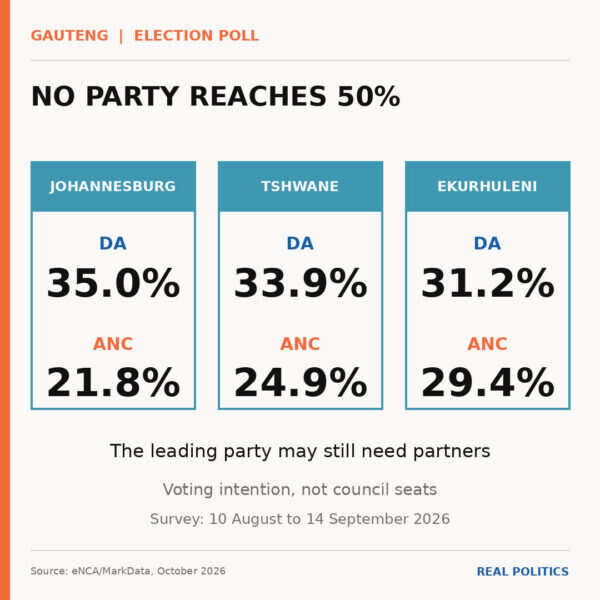
The eNCA/MarkData poll puts the DA at 35% in Johannesburg, against 21.8% for the ANC. MK has 12.5%, the EFF 11.9%, ActionSA 10.3% and the PA 3.7%.
Ekurhuleni is more competitive, with the DA on 31.2% and the ANC on 29.4%. MK polls at 11.5%, the EFF at 9.2%, ActionSA at 6.1% and the PA at 2.5%.
The interviews took place between August 10 and September 14. These are snapshots of voting intention, not projected council seats.
But they show why the smaller parties matter. In Johannesburg, the ANC, MK, EFF, PA and IFP together account for 50.6% of voting intention. In Ekurhuleni, the same combination reaches 55.4%.
Those totals include the IFP’s 0.7% in Johannesburg and 2.8% in Ekurhuleni.
They are not confirmed coalitions, and the actual seat totals could differ. Nevertheless, they illustrate a possible route to power for the ANC without the DA.
The question is what the kingmakers will demand in return.
For Jacob Zuma’s MK Party, negotiations extend beyond Gauteng. It wants to consolidate its influence in KwaZulu Natal and strengthen its national position.
An agreement with the ANC could offer executive posts in Gauteng and greater leverage over its former political home. MK may also see an opportunity to pursue national office, although municipal cooperation would not guarantee entry into the Government of National Unity, the coalition formed after the 2024 election.
ActionSA’s support could influence who governs both Johannesburg and Tshwane. The latter matters particularly to Mashaba because it is the only metro his party currently leads.
The ANC supported ActionSA’s Nasiphi Moya for mayor in October 2024, after the removal of DA mayor Cilliers Brink. A renewed agreement could help ActionSA retain the city and demonstrate that its policies can produce effective municipal government.
For Mashaba, this is about more than keeping Zille out. It is an opportunity to build ActionSA’s national profile through a record in office.
The ANC, meanwhile, could retain influence in the capital without insisting on the mayoralty. That may be a price worth paying to prevent the DA from controlling Tshwane.
The EFF’s relationship with the ANC has swung between cooperation and confrontation.
In Ekurhuleni, it held executive positions in an arrangement with the ANC before withdrawing in February after two of its mayoral committee members were removed. Those committees oversee municipal departments, making their portfolios important sources of governing influence.
The EFF’s support could again prove decisive in the city.
Julius Malema also wants to turn electoral support into national executive power. He has indicated that the EFF would consider joining the GNU if the DA and Freedom Front Plus left.
The ANC cannot guarantee him a ministerial position or give the EFF everything it wants in Ekurhuleni. But it remains a more plausible partner than the DA, which has ruled out coalition agreements with the EFF.
The PA has the smallest polling share of the four parties in Gauteng. McKenzie nevertheless understands that a few councillors can become decisive when the bigger parties cannot secure a majority.
His party is already in the GNU and has developed working relationships with the ANC in municipal politics. In Johannesburg, Kenny Kunene’s restoration to the transport portfolio demonstrated the importance of that relationship.
A new agreement could offer the PA further opportunities, potentially including the deputy mayoralty, speakership or influential mayoral committee positions.
McKenzie also sees the ANC as a partner in Western Cape councils. Together, they hope to reduce the DA’s dominance in Cape Town and force it into coalition negotiations.
“I am saying the PA will work with anybody that gives us power…the political space is a terrain of power. We will work in the PA with anybody. We will even work with this gogo,” McKenzie said, referring to Zille.
His willingness to contemplate working with her is revealing. The negotiating position can change when the rewards change.
The ANC’s readiness to support smaller party mayors and distribute executive positions could give it an advantage after November 4.
The DA has potential partners, and its insistence on clear agreements and shared governing principles has merit. But refusing to work with the EFF and MK narrows its options.
If it also expects smaller partners to accept its leadership and surrender strategic portfolios, it risks making agreements harder to achieve.
For the kingmakers, negotiations will concern mayoralties, executive posts, policy concessions and influence over municipal budgets.
The ANC may surrender some authority to retain a larger share of power. Smaller parties must decide whether the rewards justify the compromises with partners whose policies and ambitions may differ sharply from their own.
Their electoral support may be modest, but their bargaining power could be substantial.
In Gauteng’s metros, parties with fewer votes could end up setting the price of power.
Subscribe free