“Impeaching President Ramaphosa Will Destabilise the Country” – Firoz Cachalia
iReport South Africa | 18.05.2026 13:08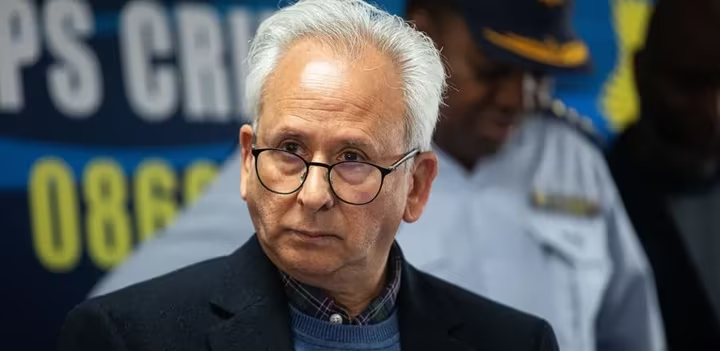
Firoz Cachalia has warned that any move to impeach Cyril Ramaphosa could have serious consequences for political stability and governance in South Africa.Speaking during a public engagement, Cachalia said the country is already facing significant economic and social challenges, and that attempts to remove the president through impeachment could deepen uncertainty at a sensitive time. He stressed that South Africa needs stability, continuity, and strong leadership to deal with pressing issues such as crime, unemployment, corruption, and investor confidence.
The Acting Police Minister argued that political battles should not overshadow the work of government institutions, especially as law enforcement agencies continue efforts to tackle organized crime and public safety concerns across the country.Cachalia’s remarks come as opposition parties, including the Economic Freedom Fighters (EFF), continue to push for stronger action against Ramaphosa over ongoing controversies surrounding his administration. Calls for impeachment have intensified in recent weeks, with critics arguing that the president must be held accountable.
However, supporters of Ramaphosa maintain that removing him from office could trigger divisions within the governing ANC and create instability in both government and financial markets. Some analysts have also warned that prolonged political uncertainty may negatively affect economic recovery efforts and public trust in state institutions. The debate over impeachment has become one of the country’s most heated political discussions, with leaders from different parties sharply divided on the issue.
While opposition groups insist accountability must come first, ANC leaders and government allies continue to defend the president and urge political parties to focus on national priorities instead of leadership battles.Cachalia emphasized that democratic institutions must be respected, but warned that political actions should always consider the broader impact on the country and its citizens.
South Africa’s parliamentary caucus leader, Dr. John Hlophe, has delivered a stern warning that has the potential to escalate tensions even further. He made it clear that his party would not be working with President Cyril Ramaphosa anymore and that they want to prevent him from making public appearances in parliament. According to Hlophe, the MK Party is taking a combative stance in an effort to derail the president’s parliamentary commitments right up until the conclusion of his tenure.
According to the former judge, who is now the head of the opposition in Parliament, “We will bar him from speaking until he leaves office.” This means that the MK Party would not provide Ramaphosa a platform during sessions. His remarks are indicative of the party’s more aggressive posture in its ongoing criticism of the ruling ANC over matters of leadership and governance.
As a result of these comments, the MK Party’s relationship with the ANC-led government is likely to become even more strained. When it comes to criticising Ramaphosa’s leadership and authority, the MK Party is among the most vocal. Opposition parties are moving away from formal protests and procedural techniques, according to Hlophe’s statement, and toward more disruptive and direct approaches.
According to political experts, this type of speech has the potential to exacerbate tensions in the National Assembly, especially during important legislative events like question sessions and big policy discussions. A potential disruption of parliamentary procedures and a widening of political differences could result from the MK Party’s actions, they warn.
Hlophe has made remarks, and the presidency has not addressed them. However, in order for constitutional processes to go unimpeded, legislative rules typically demand order. Opposition parties have been critical of Ramaphosa’s leadership and economic policies for some time, and the MK Party seems to be taking a stance that aims to increase the pressure by being more aggressive.
The increasing animosity in Parliament, according to experts, could hinder legislative effectiveness by making it harder for parties to cooperate. We will now watch the next sittings to see if the MK Party follows through on its threat and how the leadership of the parliament reacts to the increasing tensions.