Leadership Beyond the Dream: The Courage to Carry It Forward
Medium | 16.01.2026 04:23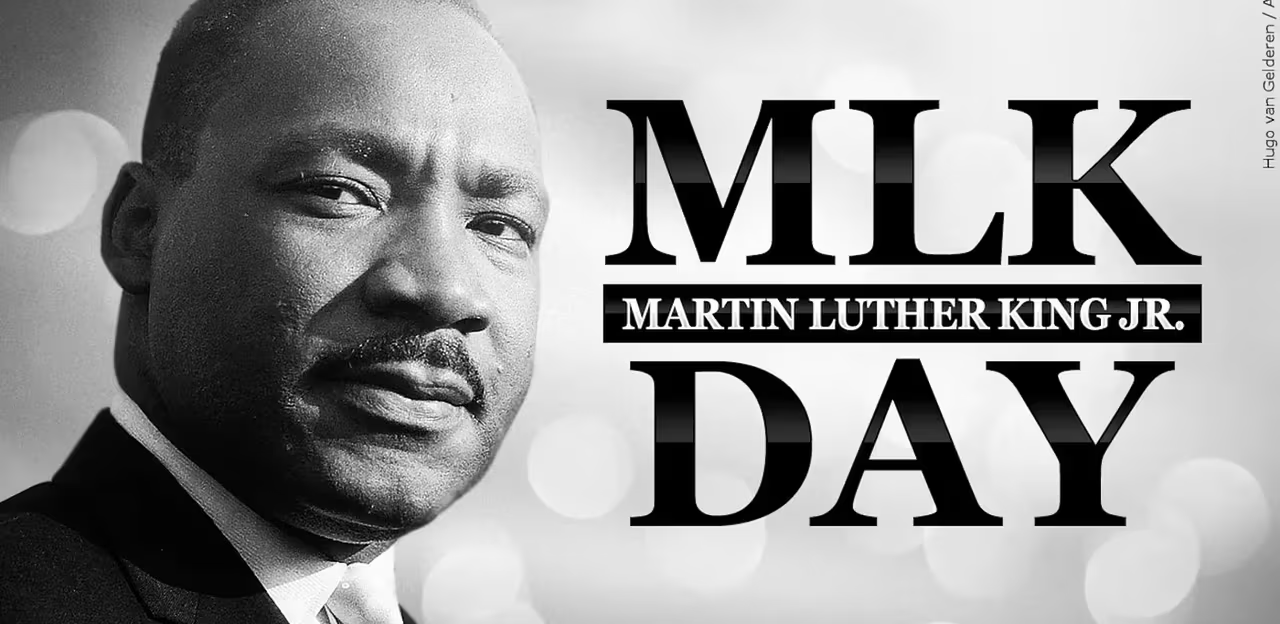
Leadership Beyond the Dream: The Courage to Carry It Forward
5 min read
·
1 hour ago
--
Listen
Share
Each January, America pauses to honor Dr. Martin Luther King Jr.. We quote him. We post his words. We celebrate the idea of the Dream.
But the Dream was never meant to be a seasonal slogan. It was a summons. An assignment. A responsibility passed from one generation to the next.
Here in Colorado, we know this because Martin Luther King Jr. Day did not arrive through symbolism. It arrived through persistence, through political courage, and through leaders who refused to let rejection become the final word.
Long before the holiday became law, the work was attempted again and again inside the Colorado House of Representatives. State Representative Wellington Webb introduced legislation in the 1970s to establish a holiday honoring Dr. King. Those early efforts were postponed indefinitely. Then the work was carried forward by State Representative Hiawatha Davis, who also introduced legislation that met resistance and rejection.
This is the part of the story that matters.
This was not a one-time attempt. This was years of rejection met with renewed resolve. It was leader upon leader, shoulder upon shoulder. It was continuity in action.
Then came State Representative Wilma Webb. And she did what real leaders do when the needs of the people remain unmet. She refused to quit.
Beginning in the early 1980s, Representative Webb introduced legislation to establish Martin Luther King Jr. Day in Colorado. When it failed, she brought it back again. And again. And again. Year after year she returned to the House with the same moral clarity and the same conviction, engaging community, building support, educating colleagues, and refusing to allow delay to become denial.
In 1984, after nearly a decade of collective effort, the Colorado General Assembly passed legislation officially establishing Martin Luther King Jr. Day. The bill was signed into law by the Governor Dick Lamb on April 4, 1984, the anniversary of Dr. King’s assassination.
That is how policy is made. Not by comfort, but by conviction.
And yet, we must ask ourselves a hard question.
Where did that continuity go?
Somehow, we have divested from this kind of sustained leadership. We have normalized retreat. We have made peace with silence. We have allowed fear to replace responsibility. Too many people who know better choose not to do better because they are afraid of losing access, influence, or contracts.
That is a leadership problem.
It is a problem when we are more afraid of losing comfort than we are committed to freedom. Do we not remember Malcolm X, Mahatma Gandhi, Harriett Tubman, Nelson Mandela, Kwame Nkrumah, Claudette Colvin, and Dr. King himself? They sacrificed safety, reputation, and in some cases their lives. They were not more afraid of consequences than they were committed to justice.
We also face a dangerous rewriting of our national story. There is growing pressure for America to tell only stories of triumph while ignoring its tragedies. To celebrate progress while erasing pain. To sanitize history in schools, public discourse, and even institutions like the Smithsonian Institution, whose purpose is to tell the full truth.
But there can be no real story if it is only half told.
Would we excuse domestic violence or murder because someone did a few nice things as well? Of course not. So how could we accept that same logic when applied to our nation’s history?
Real leadership requires authenticity, not fantasy. Accountability, not cowardice. Love, not hate. Grace, not selfishness.
Leadership is action. We lead through political engagement. We lead by coming together. Greed and crumbs cannot continue to divide us.
Black and Brown communities must unite. The White community must stop being afraid of the sins of America’s past and understand that acknowledging truth is not an indictment of today, but an invitation to lead with integrity, humility, and courage.
All people of the African Diaspora must stand together. The idea of African versus African American is diabolical thinking, designed to fracture what history and spirit have already bound. As Kwame shared, we are African not simply because of where we were born, but because Africa is in us!
That skill you possess. That gift God placed within you. That access, influence, or privilege you carry. It is time to use it; not just for personal advancement, but for collective thriving. The relationships you have must be leveraged for the good of our neighbors. The privilege we all carry, some far more than others, must be activated so this nation can finally pivot toward what it has always promised to be: A land of liberty and justice for all.
Each January, we speak of a Dream articulated more than sixty years ago; a Dream we have deferred more than student loans! Perhaps it is time to realize the Dream.
The Dream was never the destination, it was the blueprint. Isn’t it about time to wake up and get the job done?
For Your Information below: General Timeline for Colorado’s Journey to establishing Martin Luther King Jr. Day
Mid 1970s
State Representative Wellington Webb introduces legislation in the Colorado House of Representatives to establish a holiday honoring Dr. King. The effort is postponed indefinitely.
Late 1970s
State Representative Hiawatha Davis continues the work by introducing similar legislation. The bill again fails to advance.
Early 1980s
State Representative Wilma Webb begins introducing MLK Day legislation. The bill is rejected multiple times over several years.
March 26, 1984
After sustained advocacy and coalition building, the Colorado General Assembly passes the MLK Day legislation.
April 4, 1984
The bill is signed into law, marking a major victory born of persistence and collective leadership.
Written by Dr. Ryan E. Ross
President & CEO, Urban Leadership Foundation of Colorado
Founder, Ryan Ross Speaks, Ltd.