Princess Elizabeth broke barriers and defied a dictator
Scrolla | 12.08.2026 22:25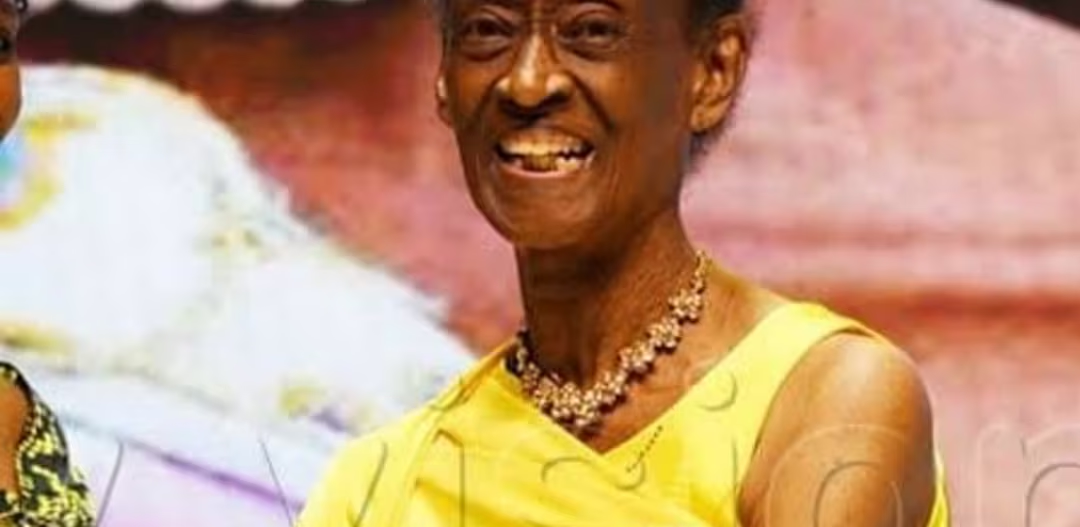
By Celani Sikhakhane
• Princess Elizabeth Bagaaya served in Idi Amin’s government but later fell out with the Ugandan dictator and faced public humiliation and political punishment.
• The Tooro royal became a pioneering lawyer, diplomat and international model before later helping guide the kingdom during her young nephew’s reign.
Ugandan Princess Elizabeth Bagaaya Akiiki has spent much of her life breaking barriers.
She became a lawyer, diplomat, politician and international model.
But one of the most dramatic chapters of her life came when she crossed paths with feared Ugandan dictator Idi Amin.
Princess Elizabeth, a senior royal of the Tooro Kingdom, celebrated her 90th birthday on 9 February this year.
Her story forms part of a long history of African royal women who challenged powerful men, colonial forces and traditions that tried to limit women’s influence.
Princess Elizabeth served as Uganda’s Foreign Minister under Amin.
But their relationship later fell apart.
According to accounts of her experience, Amin wanted a personal relationship with the princess, which she rejected.
She was later removed from her government position and publicly humiliated by Amin.
She also faced restrictions under his government.
The confrontation was particularly dangerous because Amin’s government had become known for brutal repression and killings.
But Princess Elizabeth survived the political turmoil and continued building a remarkable life.
Long before her clash with Amin, she had already broken barriers for African women.
Princess Elizabeth became a pioneering lawyer at a time when very few African women had opportunities to enter the profession.
She was the first woman from East Africa to be admitted to the English Bar.
Her education also took her to Britain, where she attended Sherborne School for Girls before studying at the University of Cambridge.
But the courtroom was not the only place where she made her mark.
Princess Elizabeth entered international modelling and became one of the most recognisable African women in fashion during her time.
She appeared in major international publications, including Vogue, helping open doors for black African women in an industry where they had little representation.
Her career would eventually stretch across law, diplomacy, politics, fashion and royal duties.
Princess Elizabeth later played an important role in the Tooro Kingdom.
She became an important royal guardian and adviser to her nephew, King Oyo Rukidi IV, who became king while still a child.
Her long life is also an example of the influence African women have held within royal families and communities.
Dr Nokuzola Mndende of the Icamagu Institute said women have been at the centre of African society for centuries, even while living under patriarchal systems.
“You know, as we talk about Princess Bagaaya, actually African women have been the pillar of society and our kingdoms,” Mndende said.
She said women have historically played important roles in royal succession, families and traditional decision making.
“So African women, it is in their veins to fight and win,” she said.
Princess Elizabeth is not the only royal woman remembered for standing against powerful forces.
Queen Nzinga of Ndongo and Matamba, in present day Angola, resisted Portuguese expansion and the slave trade during the 1600s.
South Africa also has its own complicated history of influential women connected to royal power and resistance.
Princess Mkabayi kaJama became one of the most powerful figures in early Zulu history and wielded major political influence.
Nongqawuse, the young Xhosa prophet whose prophecies led to the devastating cattle killing movement of the 1850s, also remains one of the most discussed women in South African history, although her story and role were very different from those of royal political leaders.
Princess Elizabeth’s own journey crossed continents and professions.
She moved from royal life to education, law and fashion before entering diplomacy and surviving one of Uganda’s most dangerous political periods.
At 90, her story remains one of an African princess who refused to be defined only by her royal title.
She became a woman who broke barriers and survived a confrontation with one of Africa’s most feared dictators.
Pictured above: Tooro Kingdom Princess Elizabeth Bagaaya Akiiki, who celebrated her 90th birthday this year and built a career in law, diplomacy, politics and fashion.
Image source: Facebook.