Harriet Tubman Didn’t Perform Courage So Why Are We?
Medium | 27.01.2026 15:37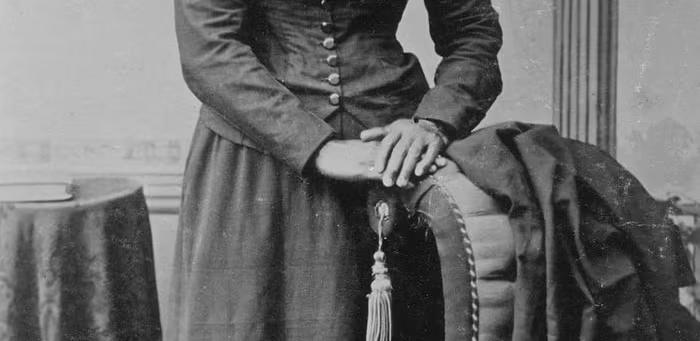
Harriet Tubman Didn’t Perform Courage So Why Are We?
The uncomfortable truth about performative bravery in the age of applause
4 min read
·
1 hour ago
--
1
Listen
Share
Most people don’t actually want the truth. They want a version of it that feels good, looks noble, and earns approval.
That’s why courage today often looks like a performance,Loud, Shareable, and Carefully framed Harriet Tubman never did that.
She didn’t narrate her bravery. She didn’t turn suffering into content. She acted and disappeared back into the shadows.
If this already makes you uneasy, that’s normal, Questioning moral displays feels risky, You might be thinking, Why stir this up? Isn’t intention enough? I get that instinct.
We all want to be on the right side of history without being dragged through discomfort.
But here’s the problem: when courage becomes theater, truth gets diluted, and nobody wins.
We live in a strange era where appearing brave is safer and more profitable than actually being brave.
Harriet Tubman didn’t have the luxury of optics, Every decision carried consequence, Every step risked death, Today we inherit her image without inheriting her cost and the internet encourages it.
Loud virtue gets rewarded, Quiet integrity gets ignored.
If you’ve ever felt a knot in your stomach watching people wrap themselves in historical courage, that feeling matters.
It’s the gap between signal and substance. Between doing something hard and looking like you did.
Here’s why that gap exists and why it keeps growing:
1. Performing Courage Is Safer Than Living It:
Real courage demands sacrifice, Performative courage demands confidence.
One requires skin in the game the other requires a platform, Harriet Tubman lived in the first category.
Many today choose the second because it’s survivable,No real loss, No isolation,No danger.
That doesn’t make people evil It makes them human, We’re wired to avoid pain but when bravery is reduced to appearance, the word loses meaning.
Courage isn’t something you claim It’s something that costs you.
2. Borrowing Harriet Tubman’s Image Creates Instant Moral Authority:
Suffering creates credibility. Especially historical suffering that’s already been validated.
Aligning yourself with Harriet Tubman’s legacy gives you moral gravity without earning it, the story does the heavy lifting, the past becomes a shortcut to authority.
But suffering isn’t transferable, You can honor it, Study it ,Learn from it, You can’t wear it like a jacket and expect it to fit the same.
Get Ibrahim Yusuf’s stories in your inbox
Join Medium for free to get updates from this writer.
Subscribe
Subscribe
When pain becomes a prop, history becomes decoration.
3. The Internet Rewards Appearances, Not Sacrifice:
Algorithms don’t care about truth they care about reaction.Nuance doesn’t spread, Performance does.
A careful explanation dies quietly, dramatic stance explodes across feeds, Over time, people learn what gets attention and repeat it.
This is how symbolism replaces substance not because people are dishonest, but because incentives quietly reshape behaviors.
The internet doesn’t turn people into frauds it conditions them to amplify parts of themselves until those parts no longer reflect reality.
4. Symbolism Feels Like Action Until It Isn’t
Symbols matters, that is why they’re dangerous. Harriet Tubman didn’t become a symbol first, She became effective.
The symbolism followed the work and Today, many reverse the order They adopt the symbol and skip the responsibility, It feels productive, It feels meaningful, But nothing changes beneath the surface.
Leadership isn’t aesthetic. It’s operational.
5. Performative Morality Protects Social Standing:
Real courage isolates you, It costs relationships, It invites uncertainty. Performative morality does the opposite It gathers applause and shields you from criticism, It lets you stand for something without standing alone.
Harriet Tubman didn’t know who would support her, She knew who might betray her, That’s the difference. One path builds character, the other builds comfort.
Why This Matters More Than We Admit:
You might be thinking: Isn’t some awareness better than none? Sometimes. But when performance replaces principle, movements hollow out.
Courage becomes cosplay. History becomes a mood board, and the people who paid the real price fade into simplified myths we use to decorate opinions.
Calling this out isn’t disrespect, It’s the opposite. It’s refusing to cheapen sacrifice by turning it into content.
The Quiet Truth:
You don’t need to look brave to live with integrity.
You don’t need borrowed suffering to stand for justice.
And you don’t need applause to do what’s right.
Harriet Tubman didn’t perform courage, She practiced it quietly, relentlessly, and without witnesses.
The real question isn’t who gets to invoke her name.
It’s who’s willing to live by her standard when no one is watching.
That choice won’t trend.
It won’t feel safe.
And it’s exactly why it still matters.
Conclusion
Here’s the part that doesn’t go viral: courage without an audience feels pointless until you realize that’s the point.
Harriet Tubman didn’t leave behind a performance. She left behind a standard. And standards are uncomfortable because they ask more of us than slogans ever will.
If this piece unsettled you, pay attention to that feeling. Discomfort is usually the first sign that something true just brushed past your ego. It’s easier to borrow bravery than to build it. Easier to signal values than to live them when it costs you status, safety, or certainty.
History doesn’t need more interpreters dressed as heroes. It needs fewer spectators and more participants.
You don’t honor courage by reenacting it online.
You honor it by choosing the harder path when no one’s clapping.
That choice won’t be visible.
But it will be real.