Maya Angelou Didn’t Teach Strength — She Revealed It
Medium | 24.01.2026 00:07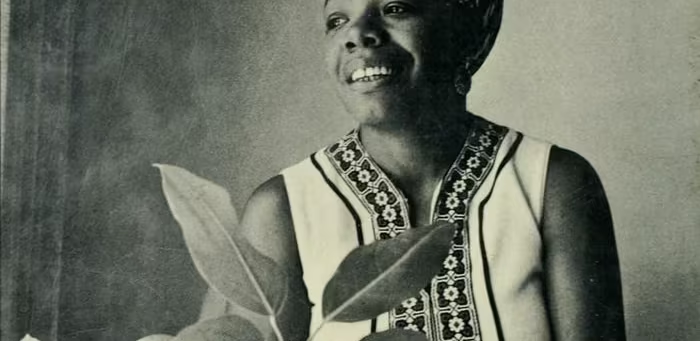
Maya Angelou Didn’t Teach Strength — She Revealed It
Follow
4 min read
·
1 hour ago
Listen
Share
(And Martin Luther King Jr. Recognized It When He Saw It)
Maya Angelou is often remembered for her strength.
Her voice.
Her presence.
Her refusal to shrink.
But that framing misses something essential.
Maya Angelou didn’t become strong in response to the world.
She revealed a strength that was already there — even when the world tried to deny it.
Martin Luther King Jr. recognized that kind of strength immediately.
Not the loud kind.
Not the combative kind.
But the kind that comes from someone who knows who they are — and doesn’t need permission to stand there.
They Didn’t Just Share a Moment in History — They Shared a Way of Seeing
Maya Angelou and Martin Luther King Jr. weren’t just contemporaries.
They worked together.
They organized together.
They spoke to the same underlying truth from different angles.
Angelou served as Northern Coordinator for the Southern Christian Leadership Conference (SCLC) at King’s request. She was deeply involved in the movement — not as a background figure, but as a strategist, communicator, and presence.
But what bound them wasn’t only politics.
It was orientation.
Both understood something that feels rare now:
Justice isn’t something you argue people into.
It’s something you embody until others can no longer look away.
Neither of Them Confused Force With Power
Martin Luther King Jr. is often misremembered as gentle in a way that implies softness.
He wasn’t.
He was precise.
Unyielding.
Rooted.
His nonviolence wasn’t passivity — it was clarity without distortion.
Maya Angelou carried that same quality.
She didn’t perform wisdom.
She didn’t posture.
She spoke from contact — with pain, with history, with her own nervous system.
That’s why her words don’t feel dated.
They weren’t written for a moment.
They were written from before moments — from the place where human dignity either gets honored or denied.
“When Someone Shows You Who They Are…”
One of Angelou’s most quoted lines:
“When someone shows you who they are, believe them the first time.”
It’s often shared as boundary advice.
But read it alongside King’s work, and something deeper emerges:
Reality is already honest.
The suffering comes from arguing with it.
King didn’t spend his life trying to convince America it was unjust.
He revealed what was already visible — and refused to look away.
Angelou did the same on the personal level.
This mirrors a core insight from Proof That You’re God: clarity doesn’t come from control or correction, but from seeing what’s already here without turning away.
They Both Refused the Smallness the World Offered
The world tried to define them both.
By race.
By role.
By what was “acceptable.”
Neither accepted the offer.
King didn’t reduce himself to protestor or preacher.
Angelou didn’t reduce herself to poet or survivor.
Get Dualistic Unity’s stories in your inbox
Join Medium for free to get updates from this writer.
Subscribe
Subscribe
They outgrew every label placed on them — not by denying identity, but by not mistaking labels for the whole.
That’s a subtle but radical distinction.
They spoke from identity without being confined to it.
Strength Without Domination
What made both of them dangerous to unjust systems was not aggression.
It was unshakeable dignity.
King’s moral authority didn’t come from overpowering opponents.
Angelou’s presence didn’t come from outperforming others.
They stood somewhere deeper than reaction.
In a world addicted to force, that kind of groundedness is destabilizing.
Joy Was Not Naivety for Either of Them
Both King and Angelou spoke of joy — not as denial, but as orientation.
Joy after grief.
Joy with memory.
They understood that suffering does not get the final word unless we hand it over.
That kind of joy doesn’t come from optimism.
It comes from no longer mistaking pain for identity.
What They Modeled Without Preaching
Neither of them told people to “find themselves.”
They showed what happens when someone stops abandoning themselves.
When you don’t shrink to be palatable.
When you don’t harden to survive.
When awareness stops turning against itself.
Their lives quietly pointed to the same truth:
You don’t need permission to take up space as you are.
Why This Matters in February — and Now
February invites remembrance.
But remembrance isn’t about freezing people in history.
It’s about recognizing what they were pointing to.
Maya Angelou and Martin Luther King Jr. weren’t asking us to become better people.
They were asking us to become more honest ones.
To stop pretending we don’t see what we see.
To stop negotiating with our own dignity.
To stop outsourcing our authority to systems that profit from our doubt.
A Closing Reflection
Maya Angelou didn’t teach strength.
Martin Luther King Jr. didn’t invent courage.
They revealed what strength and courage look like when they’re no longer trying to prove themselves.
That kind of power doesn’t come from becoming more.
It comes from remembering what was never missing.
And maybe that’s why their words still land — not as instruction, but as recognition.
Because when someone lives from that place, something in us relaxes.
And we remember ourselves too.
If this reflection on Maya Angelou resonated, it may be because her strength points to something quieter and more intimate than inspiration.
We recently published a longer, in-depth exploration on DualisticUnity.com that looks more closely at what Angelou embodied — strength without armor, dignity without defense, and identity held lightly enough to breathe. It weaves her life and work together with broader reflections on awareness, presence, and what it means to stop negotiating with our own humanity.
If you feel pulled to sit with this more deeply, that piece is waiting there — not as an explanation, but as an invitation to recognize something you may already know.
Sometimes the next step isn’t learning more.
It’s seeing more clearly.