Musk's SpaceX applies to launch 1m satellites into orbit
BBC | 31.01.2026 23:19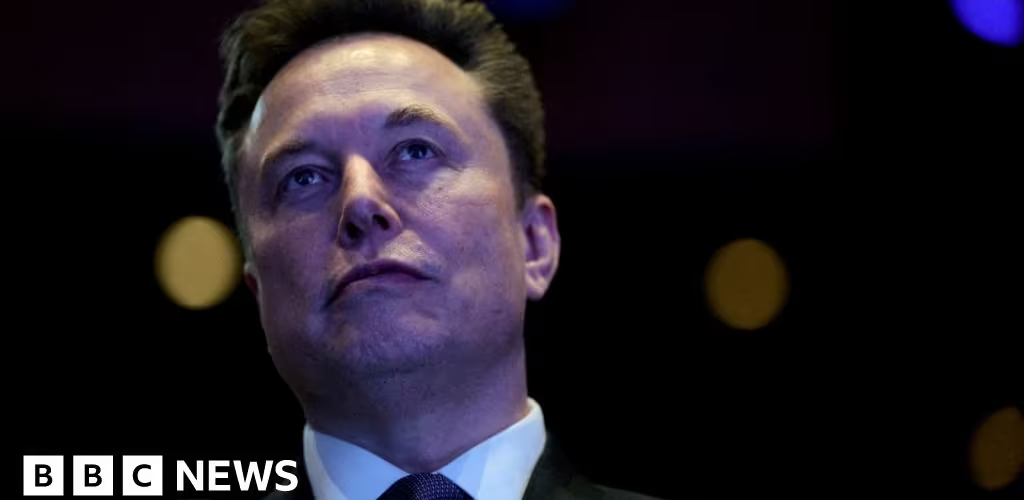
Elon Musk's SpaceX has applied to launch one million satellites into Earth's orbit to power artificial intelligence (AI).
The application claims that "orbital data centres" are the most cost and energy-efficient way to meet the growing demand for AI computing power.
Traditionally, such centres are large warehouses full of powerful computers which process and store data. But Musk's aerospace firm claims processing needs due to the expanding use of AI are already outpacing "terrestrial capabilities".
They would join its Starlink network in orbit, which provides high-speed internet via thousands of small satellites - and which have been accused of creating congestion in space, something Musk denies.
The new network could comprise up to one million solar-powered satellites, according to the application filed on Friday with the Federal Communications Commission - which does not specify a timeline for the plan.
SpaceX claims the system would deliver the computer capacity required to serve "billions of users globally".
It also says it would be the first step towards "becoming a Kardashev II-level civilisation - one that can harness the Sun's full power", referencing a scale of hypothetical alien societies proposed by an astronomer in the 1960s.
Musk wrote on his social media site X: "The satellites will actually be so far apart that it will be hard to see from one to another. Space is so vast as to be beyond comprehension."
Like the Starlink satellites, they would operate in low-Earth orbit at altitudes from 500-2,000km (310-1,242 miles).
SpaceX claims "orbital data centres" - a concept also being explored by other firms - would be a greener alternative to traditional centres, which require enormous amounts of power and water for cooling.
An expert previously told the BBC that launching hardware into orbit remains expensive and that the infrastructure to protect, cool and power them can be complex - while a growing quantity of space debris puts the physical hardware at risk.
Separately, another cautioned that the growing number of low-orbit craft increases the possibility of crashes between objects - which could damage machines or send materials falling back to earth.
Meanwhile, astronomers complained in 2024 that radio waves from the Starlink network were "blinding" their telescopes and hindering their research.
Musk has previously rejected claims that his satellites were taking up too much room and crowding out competitors.