Ramaphosa distances himself from Hangwani Maumela amid Tembisa Hospital corruption probe
iReport South Africa | 30.04.2026 20:25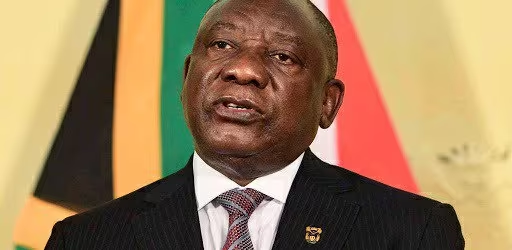
President Cyril Ramaphosa has unequivocally asserted his detachment from businessman Hangwani Maumela, who has become a focal point of the extensive corruption probe centered on Tembisa Hospital. This official declaration was issued as the Special Investigating Unit (SIU) deepens its examination into allegations that companies linked to Maumela secured hospital contracts exceeding R820 million within a mere two-year period. This investigation is not an isolated matter, but rather forms a part of a much wider network of alleged malfeasance, which some estimates place at over R2 billion, reigniting serious public apprehension regarding the integrity of government tender processes and oversight mechanisms.
The urgency of the President’s statement was driven by a video circulated widely on social media platforms, which purportedly showed Ramaphosa’s presence outside Maumela’s Sandton residence at the time investigators were conducting a raid. This public visibility immediately fueled widespread speculation and debate over the nature and depth of his relationship with the accused businessman. In his subsequent explanation, Ramaphosa clarified that the only connection between them is a distant familial relationship, specifically noting that Maumela’s aunt is married to one of the President’s relatives. Crucially, he stressed that there are no shared business interests or close personal ties beyond this tangential family link.
Evidence brought to light by the ongoing investigation has included the discovery of numerous high-value assets, such as luxury vehicles and properties, all owned by Maumela and subsequently subjected to seizure during the law enforcement actions. These revelations have sparked significant public outrage across South Africa. Citizens are deeply frustrated by the stark contrast between the excessive wealth displayed by individuals benefiting from alleged corruption and the chronic under-resourcing of public hospitals, which frequently lack essential equipment, medication, and adequate staffing to serve the general population.
Ramaphosa’s swift move to publicly address and rationalize his connection to Maumela is widely viewed as a strategic maneuver intended to safeguard the reputation of his administration and to reinforce his publicly stated commitment to clean governance. Despite this effort, a pervasive skepticism endures among many citizens who feel that systemic corruption within vital public institutions has been tolerated or inadequately addressed for too long. For these critics, merely establishing distance from an accused figure is insufficient; they demand tangible, decisive action to dismantle corrupt networks and genuinely restore dwindling public confidence in state affairs.
The Tembisa Hospital saga serves as yet another painful illustration of how financial misconduct in public procurement directly erodes the quality of life for ordinary citizens reliant on government services. For the President, navigating this issue is politically precarious, as it touches upon both the credibility of his anti-corruption mandate and the perception of his personal integrity. He now faces the formidable challenge of demonstrating beyond doubt that his administration is resolutely dedicated to prosecuting corruption, even when the complexities of family ties or political proximity are involved. As the rigorous investigations continue, the public remains keenly watchful, awaiting a clear outcome that will determine whether this case results in true accountability and systemic change, or if it will simply fade into history as another unaddressed scandal.
After addressing Panyaza Lesufi directly, controversial former Ukhozi FM host Ngizwe Mchunu called for illegal foreign nationals to leave the country, reigniting discussion.
During continuing public discussions related to immigration enforcement and demonstrations in certain areas of Johannesburg, Mchunu made the comments. Current enforcement tactics are inadequate, he argued, and the government must take firmer steps to remove illegal immigrants.
Mchunu told Lesufi in his message that community conflicts and service strains are both caused by the presence of unauthorised foreign nationals. According to him, the provincial government must give this matter immediate political attention.
These remarks are made in the midst of a public uproar in Gauteng, where organisations like the March and March Movement have been holding demonstrations to demand stronger immigration regulations. Unemployment, housing insecurity, and lack of access to public services have been the main points of discussion during these meetings.
Many people have posted Mchunu’s comments on social media, which has led to both praise and condemnation. His backers say he’s only expressing universal feelings of dissatisfaction, while his detractors say his divisive rhetoric will only serve to inflame xenophobic feelings.
As of this writing, Mchunu has not received a formal answer from the provincial government of Gauteng. On the other hand, authorities have repeatedly stressed that basic human rights should be accorded to all citizens regardless of their nationality and that immigration issues should be resolved in accordance with the law and the Constitution.
Authorities have also stressed time and again that communities should not resort to confrontation but rather report issues through official means; they have also advised against vigilante action and the targeting of foreign nationals.
Because it intersects with larger socioeconomic difficulties, immigration is still a very delicate subject in South Africa. According to experts, influential people have a big impact on public discourse, and they warn that provocative language can make communities that are already divided even more so.
Questions such as whether or not government, community, and civil society interaction can alleviate growing tensions in Gauteng and how the provincial leadership will react to renewed demands for stronger immigration enforcement are topics of ongoing debate.