REAL POLITICS: Tensions in ANC alliance present opportunities for SA
Scrolla | 11.04.2026 13:36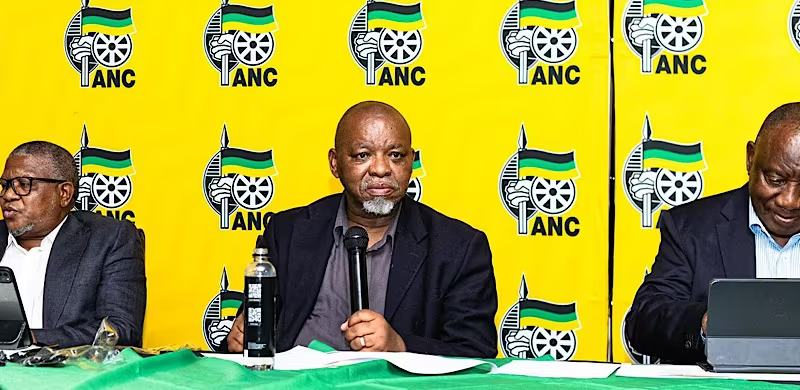
South Africa may be standing at a political turning point, and it is not coming from opposition benches but from within the ANC’s own house, writes Zukile Majova in Real Politics.
The growing tensions inside the tripartite alliance are often framed as a crisis. But they may also offer a rare chance to reset the country’s politics, rebuild investor confidence and move beyond the long shadow of state capture.
The alliance between the ANC, the South African Communist Party and the Congress of South African Trade Unions was forged in a different era. It played a crucial role in the fight against apartheid. But the conditions that shaped that unity have changed. Today, South Africa faces low growth, mass unemployment, weak state capacity and declining investor confidence.
The decision by the SACP to contest elections independently has brought these tensions into the open. What was once handled behind closed doors is now public. The ANC’s national executive committee meeting to review the relationship shows how serious the situation has become.
For years, the alliance has been both a support system and a constraint. It helped maintain unity, but also forced the ANC to balance competing ideologies. The result has often been policy paralysis or compromises that lack impact.
The formation of the government of national unity marked a major shift. By working with the Democratic Alliance and other parties, the ANC signalled a move towards a more pragmatic approach. But this has deepened tensions with its traditional allies, who see the GNU as a break from long held principles.
This is where the opportunity lies.
A formal or effective breakup of the alliance could give the ANC the policy space it has long lacked. Free from internal vetoes, the party would be better placed to negotiate and implement reforms within the GNU. This could mean faster progress on energy, infrastructure and anti corruption efforts.
Investors are not only interested in policy. They look for political stability and clarity. For years, South Africa has carried a political risk premium driven by uncertainty about whether the government can act decisively. A more stable GNU, without constant alliance conflict, could shift that perception.
If the ANC embraces its role as a coalition partner rather than a dominant liberation movement, it could help build a new political consensus focused on delivery. That kind of stability is what investors look for when making long term decisions. A more coherent GNU could unlock investment that shapes the economy for decades.
There is also a deeper political benefit. The alliance has often blurred accountability. Policies influenced by the SACP or Cosatu are implemented by the ANC, leaving voters unsure who to credit or blame. A split would force each party to stand on its own and defend its ideas directly to voters.
This could strengthen democracy. Voters would have clearer choices and better insight into who supports labour protections, who pushes for reform and who delivers results.
Labour policy sits at the centre of this debate. South Africa’s labour framework has been shaped by alliance politics. It protects organised workers, but it has also been criticised for making job creation harder, especially for young and unskilled people.
A post alliance ANC within the GNU could have more room to explore reforms. This does not mean removing worker protections. It means finding a better balance between protecting those in jobs and creating opportunities for those outside the labour market.
South Africa’s unemployment crisis will not be solved by ideology. It needs practical steps that support investment, grow small businesses and make hiring easier. Greater policy flexibility could allow targeted reforms that stimulate job creation while keeping basic protections in place.
A breakup is not without risks. The alliance has been a key organisational pillar for the ANC. Losing that support could weaken the party in the short term and fragment the centre left vote. It could also lead to stronger labour opposition if Cosatu moves fully outside the government.
But the current arrangement already carries risks. Ongoing internal conflict, public disputes and policy uncertainty undermine confidence and slow decision making. In many ways, the alliance is already fractured. The real question is whether the transition can produce something stronger.
The GNU itself reflects political reality. The ANC no longer commands a majority on its own. Coalition politics is now part of South Africa’s future. Completing a break from the alliance would align the ANC with this reality and allow it to function more effectively in a coalition setting.
Perhaps most importantly, a clear break could help South Africa turn the page on state capture. That era thrived in a system where accountability was weak and political loyalties were blurred. A more transparent political environment, combined with a stable GNU, would make it harder for such abuses to return.
This is not a moment for celebration. It is a moment for careful judgement. A breakup alone will not fix the economy or create jobs. But it could remove key obstacles that have held the country back.
If managed well, the end of the tripartite alliance could mark the start of a more stable, accountable and growth focused political era. That is an opportunity South Africa cannot afford to miss.
Pictured above: The ANC’s top leadership, Chairman Gwede Mantashe, President Cyril Ramaphosa and Secretary General Fikile Mbalula during a party event.
Image source: ANC