WOMEN IN LEADERSHIP: LESSONS FROM BENAZIR BHUTTO.
Medium | 20.01.2026 04:43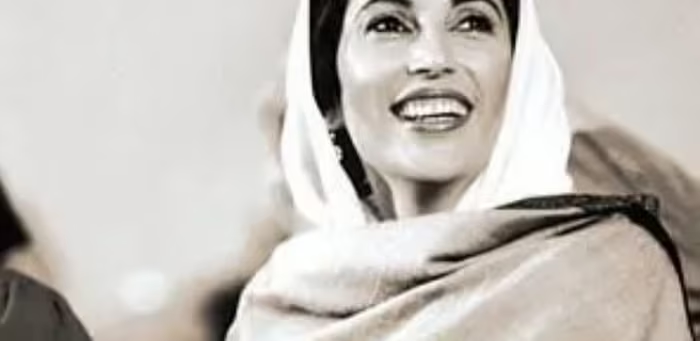
WOMEN IN LEADERSHIP: LESSONS FROM BENAZIR BHUTTO.
Women do not enter leadership on equal ground; they fight for every step they take.
Introduction
Women in leadership always have to fight harder much harder than anyone else to secure their positions while most men take theirs for granted. They’re constantly expected to prove that they deserve the post they hold , facing criticism that their male opponents rarely encounter.Before the 2000s, in countries like Pakistan , women were rarely seen in politics. Those who fought their way into politics often faced accusations, threats and criticism. One of the greatest examples of female leadership in Pakistan is Benazir Bhutto: a woman of remarkable strength who became the first female Prime Minister in the Muslim World.
Early life and entrance into politics
Benazir Bhutto witnessed her father assassination and imprisonment and lived through the tough era of martial law. Despite coming from a political family, she and her mother faced a lot of hardships including being confined to their own home. Even though she had an influential background, Benazir faced numerous challenges but she refused to abandon her father’s legacy and eventually emerged as a most influential political leader.
Get Amna Shahid’s stories in your inbox
Join Medium for free to get updates from this writer.
Subscribe
Subscribe
Struggle of benazir
Benazir opens her autobiography with this declaration: “I did not choose this life; it chose me.” At thirty-five, Bhutto became one of the youngest heads of state in the world and the first woman to lead, a Muslim nation. Achievement like this comes with heavy criticism and provokes jealousy among her male opponents. The constant intervention of the army , corruption allegations and behind the scenes political schemes were used to destabilize her government. Every move she made was questioned simply because she was a woman.
Achievement
After becoming Prime Minister, she placed people at the centre of her governance; she introduced a series of socio-economic reforms, policies focused on public welfare and women empowerment. Her government electrified over 21,000 rural villages and made education a priority by building 48,000 primary schools, recruited 53,000 teachers, 70 per cent of whom were women. She also strengthened health care by establishing hospitals and basic health units, set up women police stations, and launched nationwide anti-polio campaigns.
Lessons
Her story offers a powerful lesson for today’s youth, especially women: hardships are an undeniable part of life, and equal opportunities are not always given. In such moments, acceptance should not mean silence; it should mean creating opportunities where none exist. Equality must exist in every space. No role should be defined by gender. Men should not hesitate to enter fields labeled “women-dominated,” and women should never feel discouraged from pursuing positions traditionally seen as “male-dominated.”