Why Home Affairs reversed its asylum decision after violent protests
Scrolla | 11.10.2026 20:08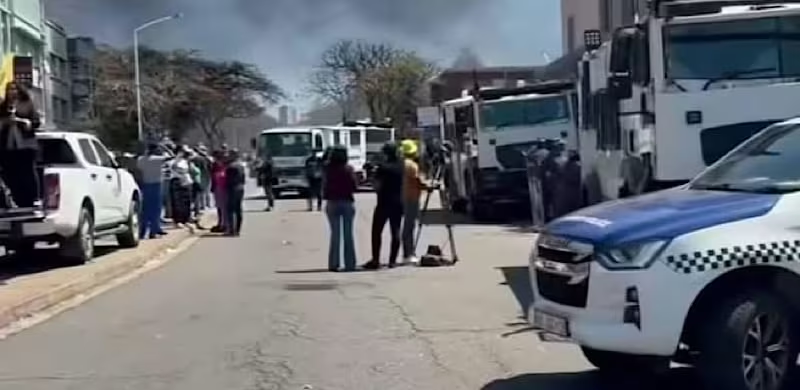
- The directive followed a Constitutional Court ruling that found parts of South Africa’s refugee laws unconstitutional.
- Protests broke out in Soweto and Durban, with reports of 24 vehicles being set alight.
South Africa’s Home Affairs Department has withdrawn a controversial directive on asylum applications following protests, violence and growing anger over immigration.
The directive, issued on 28 September, instructed refugee reception offices to accept applications from asylum seekers who might previously have been turned away because they entered South Africa illegally or failed to meet certain paperwork requirements.
But within days, long queues formed at refugee offices, protests broke out and the government faced pressure to explain the decision.
On Friday, 9 October, Home Affairs announced that the directive had been withdrawn.
So what happened, why was the directive introduced and what does it mean for South Africans and asylum seekers?
1. Why was the directive introduced?
On 7 July, the Constitutional Court ruled in a case involving the Scalabrini Centre of Cape Town and the Department of Home Affairs.
The Scalabrini Centre is a non-profit organisation that helps migrants, refugees and asylum seekers in South Africa.
The case challenged rules that prevented some people from applying for asylum because they entered South Africa through unauthorised border crossings or failed to report to a refugee office within five days.
The court found that certain parts of the Refugees Act were unconstitutional.
This meant people could not automatically be denied the opportunity to have their asylum claims considered simply because they failed to follow certain immigration procedures.
Following the ruling, Home Affairs issued a directive on 28 September instructing refugee reception offices to accept asylum applications from people reporting in person.
However, the ruling did not mean that everyone applying for asylum would automatically be granted refugee status or permission to remain in South Africa permanently.
Each application still has to be assessed under South African refugee law.
2. How does someone apply for asylum in South Africa?
An asylum seeker is someone who has left their home country and is asking another country for protection because they fear persecution or serious harm.
According to the United Nations High Commissioner for Refugees (UNHCR), people seeking asylum in South Africa must report to a refugee reception office to begin the application process.
South Africa has five refugee reception offices located in Cape Town, Durban, Pretoria, Musina and Gqeberha.
Applicants must provide their fingerprints, photographs and personal information.
They must also explain why they left their home country and why they are seeking protection in South Africa.
Home Affairs officials then assess their applications to determine whether they qualify for refugee status.
Those who are recognised as refugees are allowed to live legally in South Africa.
They can work, apply for refugee identity documents and access basic healthcare and education.
However, they must obey South African laws and keep their documents valid.
Recognised refugees may also qualify to apply for permanent residence after meeting the required legal conditions, including the applicable residence period.
Being granted refugee status does not automatically make someone a South African citizen.
3. Why did protests break out?
The directive was introduced at a time when tensions over illegal immigration were already high.
Some residents and anti-immigration groups feared the changes would allow more undocumented foreign nationals to remain in South Africa.
Protests broke out in Soweto and Durban on Thursday, 8 October.
In Soweto, demonstrators gathered near a Home Affairs office in Orlando West before violence erupted.
According to police reports, 10 vehicles were set alight in Soweto and another 14 in Durban.
Some shops, including businesses owned by foreign nationals, were reportedly looted.
Police also received reports of gunfire during the Soweto protests.
Three people were arrested in Durban in connection with an alleged assault on a protester.
Acting National Police Commissioner Lieutenant General Puleng Dimpane condemned the violence, warning that people had the right to protest but not to commit crimes.
The protests added pressure on Home Affairs to explain how the directive would affect immigration control and asylum applications.
4. Why did Home Affairs withdraw the directive?
Home Affairs said refugee reception offices became overwhelmed after the directive was introduced.
Officials struggled to deal with the number of people seeking assistance, while safety concerns and threats to public order increased.
The department explained that the directive had been issued by its director-general as an operational measure to implement the Constitutional Court ruling.
It also clarified that Home Affairs Minister Leon Schreiber and other political leaders had not been consulted before the directive was issued.
The department rejected claims that the decision was politically motivated.
On 9 October, the director-general withdrew the directive and announced that Home Affairs would develop a new approach to implementing the court ruling.
What happens now?
Although Home Affairs has withdrawn the directive, the Constitutional Court judgment remains in force.
The department must still find a lawful way to process asylum applications while managing the pressure on refugee reception offices.
The withdrawal does not mean that every undocumented foreign national is entitled to refugee status.
It also does not mean that asylum seekers can automatically be refused protection because they entered South Africa without the correct documents.
Each case must be considered according to the law.
Home Affairs has not yet announced when new arrangements will be introduced.
For asylum seekers, the uncertainty raises questions about how and when their applications will be processed.
For South Africans, the controversy has renewed debate about border control, immigration and the pressure on government services.