THE HIGH‑AROUSAL SOCIETY
Medium | 06.01.2026 10:23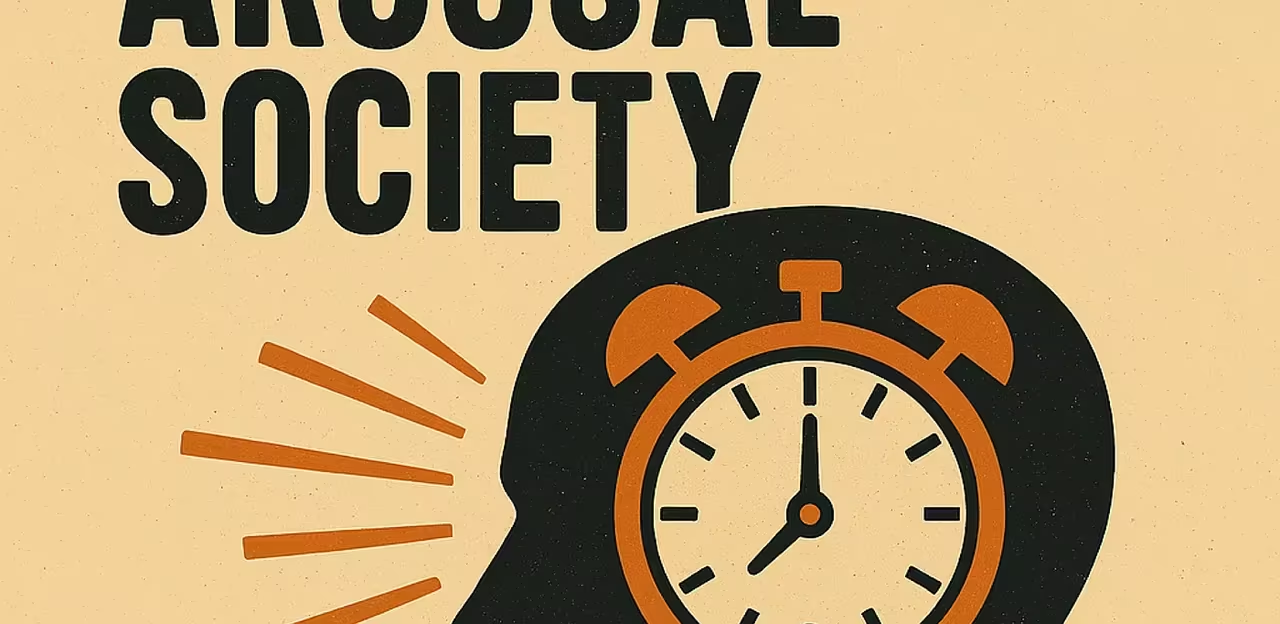
THE HIGH‑AROUSAL SOCIETY
5 min read
·
1 hour ago
--
Listen
Share
Modern life has a pulse – fast, relentless, and impossible to escape. The alarms, the deadlines, the notifications, the commutes, the collapsing boundaries between work and home – all of it forms an atmosphere of constant activation. People describe themselves as “burned out,” “fried,” “wired,” “on edge,” “unable to shut off.” But the deeper truth is this: burnout is not a personal failure. It is a structural condition.
This essay introduces the High‑Arousal Society, a modern infrastructure that keeps individuals in a state of continuous physiological and psychological activation. Medical and psychological research shows that chronic stress persistently activates the body’s stress‑response system, contributing to cognitive impairment, emotional strain, and long‑term health consequences (Mayo Clinic, 2025). Yet modern systems insist the exhaustion is your fault – a matter of discipline, resilience, or personal weakness.
Integrating Slow Harm, Exposure, and Systemic Erosion, this essay argues that chronic high arousal is not incidental. It is a governance mechanism – one that benefits existing infrastructures while eroding human capacity. The High‑Arousal Society is not a self‑help problem. It is a social issue.
- Defining High Arousal
High arousal is a persistent state of heightened physiological and psychological activation. Cleveland Clinic (2025) describes hyperarousal as the body remaining in fight‑or‑flight mode even without danger. Verywell Health (2025) adds that it involves constant vigilance, difficulty calming down, and a sense of being perpetually “on edge.”
In the High‑Arousal Society, this state is not episodic. It is engineered.
2. Chronic Activation as a Social Condition
Medical News Today (2025) reports that chronic stress keeps the sympathetic nervous system activated long after the triggering event has passed. The Mayo Clinic (2025) notes that chronic stress causes the body to treat everyday tasks as threats, creating a sense of being “always under attack.”
This is not a personal failure.
It is a structural outcome.
The High‑Arousal Society reframes chronic stress as a governance effect embedded in contemporary infrastructures.
3. The Architecture of Everyday Activation
Daily life functions as an activation sequence:
- alarms trigger immediate physiological arousal
- morning routines compress time
- commutes require constant scanning
- workplaces impose deadlines and pressure
- evenings become preparation for the next cycle
- sleep becomes maintenance, not restoration
UMMS Health (2025) emphasizes that long‑term stress affects sleep, cognition, and emotional regulation. This loop is not accidental. It is infrastructural.
4. Mechanisms: How the System Produces High Arousal
The High‑Arousal Society is produced by identifiable mechanisms:
Economic Acceleration
More output in less time. Urgency as culture.
Time Scarcity as Design
Schedules compressed. Rest treated as inefficiency.
Platform‑Driven Attention Fragmentation
Notifications and algorithmic urgency keep the mind activated.
Precarity as Governance
Economic insecurity forces constant vigilance.
Infrastructural Inefficiency
Traffic, commutes, bureaucratic friction – chronic micro‑stressors.
Boundary Collapse
Digital technologies dissolve the separation between work and home.
These mechanisms collectively produce continuous activation – not by accident, but by design.
5. When the High‑Arousal Society Emerged
This is a modern phenomenon shaped by:
- post‑industrial acceleration
- neoliberal restructuring
- digital platform emergence
- collapsing temporal boundaries
- rising precarity
Stress shifted from an episodic response to a structural condition engineered by modernity.
6. The System’s Denial of Responsibility
Despite producing chronic activation, the system reframes exhaustion as:
- poor time management
- lack of discipline
- insufficient resilience
SR (2025) identifies this as Quiet Governance: systems create pressure, deny responsibility, and blame individuals for experiencing the consequences.
The system produces the exhaustion.
The system denies the exhaustion.
The system benefits from the exhaustion.
7. High Arousal as a Social Issue
Chronic activation is produced by:
- economic precarity
- workplace acceleration
- time scarcity
- infrastructural inefficiency
- constant digital alerts
MentalHealth.com (2025) explains that chronic stress reshapes daily functioning and contributes to long‑term health deterioration.
People are not tired because they are weak.
They are tired because the system is designed to keep them tired.
8. Social Inequality: Who Suffers Most
The High‑Arousal Society is universal in reach but unequal in impact.
Low‑Income Workers
Less control, more precarity.
Racialized Communities
Additional vigilance burdens due to discrimination and surveillance.
Caregivers
Double activation: workplace + domestic labor.
Gig and Precarious Workers
Irregular hours, unstable income, algorithmic management.
Immigrants and Marginalized Groups
Higher exposure to bureaucratic friction and institutional scrutiny.
High arousal follows the contours of power.
9. Slow Harm: The System’s Preferred Pace of Damage
Slow Harm describes damage delivered gradually and quietly. Verywell Mind (2025) notes that chronic stress contributes to long‑term cognitive and emotional strain.
Chronic high arousal accumulates over years.
It feels normal rather than catastrophic.
It erodes capacity without announcing itself.
Slow harm is governance through exhaustion.
10. Exposure: Keeping Individuals Unprotected
Exposure describes how systems maintain individuals in a state of vulnerability.
Cognitive Exposure
Chronic stress impairs memory, attention, decision‑making (Medical News Today, 2025).
Emotional Exposure
Hyperarousal increases emotional reactivity (Cleveland Clinic, 2025).
Temporal Exposure
People lack time to recover or reorganize their lives.
Exposure is not incidental.
It is a structural advantage.
11. Systemic Erosion: The Long‑Term Outcome
Systemic Erosion describes the gradual wearing down of:
- attention
- energy
- emotional resilience
- social bonds
- political engagement
UMMS Health (2025) shows that long‑term stress affects multiple systems of the body.
Exhausted individuals comply more, question less, and accept harmful conditions.
Systemic erosion is not a side effect.
It is a governance mechanism.
12. Why the System Benefits
The High‑Arousal Society benefits the system in several ways:
- Exhausted people are easier to govern
- Exhausted people consume more
- Exhausted people blame themselves
- Exhausted people maintain throughput
- Exhausted people normalize exhaustion
This is the silent contract of modern life.
13. What Recognizing the High‑Arousal Society Changes
Recognizing high arousal as structural reframes:
- public health
- platform governance
- labor policy
- social cohesion
- personal identity
Naming the system is the first step toward transforming it.
14. Conclusion
Chronic high arousal is a systemic outcome produced by the architecture of modern life. Research across medicine, psychology, and public health confirms that persistent activation of the stress‑response system has profound consequences for mental and physical wellbeing.
Through Slow Harm, Exposure, and Systemic Erosion, this essay shows how the system quietly shapes human experience while disowning the consequences.
Recognizing the High‑Arousal Society as structural – not personal – opens the door to critique, accountability, and collective understanding.
If you’ve ever felt like modern life keeps you wired, tense, and unable to rest – not because of who you are, but because of how the world is built – then The High‑Arousal Society will resonate deeply. This essay maps how systems quietly produce chronic stress and then blame individuals for feeling it. It draws on medical research, infrastructural theory, and stylometric clarity to show that exhaustion is not a personal flaw – it’s a structural outcome. Read the full essay here: https://doi.org/10.5281/zenodo.18158771 and discover how naming the system changes everything.