Surviving in the Margins
Medium | 17.01.2026 05:13
Surviving in the Margins
Who is left to speak the truth when journalism is in exile?
Follow
3 min read
·
1 hour ago
50
Listen
Share
Someone once said to me, “Journalism is dead.” He wasn’t being dramatic for effect. He was pointing at the world as it is now – the wars that don’t make headlines, the corruption that never trends, the decisions made in quiet rooms by powerful people that never reach our living rooms.
And it made me think about the modern day history of South Africa.
I thought about journalism before 1994, before Africans we recognised as a free people. I thought about how newspapers, magazines, and broadcasts looked back then. How glossy they were. How beautiful everything seemed. Fashion spreads, smiling families, orderly cities, clean narratives. The country appeared well. Peaceful. Functional. Meanwhile, a whole nation was suffocating beneath that beauty.
Journalism back then did not disturb the powerful. It did not unsettle the system. It did not expose the machine. It polished it. It showed apartheid’s good side, if such a thing could ever exist. In that sense, what we called “journalism” did not challenge power – it served it.
And then I looked at today, in this so-called democratic era.
I turn on the news. I scroll. I read headlines. And again, I notice something familiar: the stories rarely bruise the rich. They rarely shake the powerful. They orbit the poor – crime here, protest there, tragedy in the margins. The spotlight still avoids the throne.
So I began to ask myself: If we say journalism is dead, was it ever alive?
And if it was, what did it look like in its truest form?
I imagined its origins – not the academic kind, but the human kind. Long ago, someone in power needed to speak to those he ruled over. He could not speak to them all, so he entrusted another to carry his message. That messenger became the voice of authority. As time moved, that voice became radio. It became newspapers. It became television. Power learned to speak through machines.
Get Bantu Chauke’s stories in your inbox
Join Medium for free to get updates from this writer.
Subscribe
Subscribe
But somewhere along that road, something else was born.
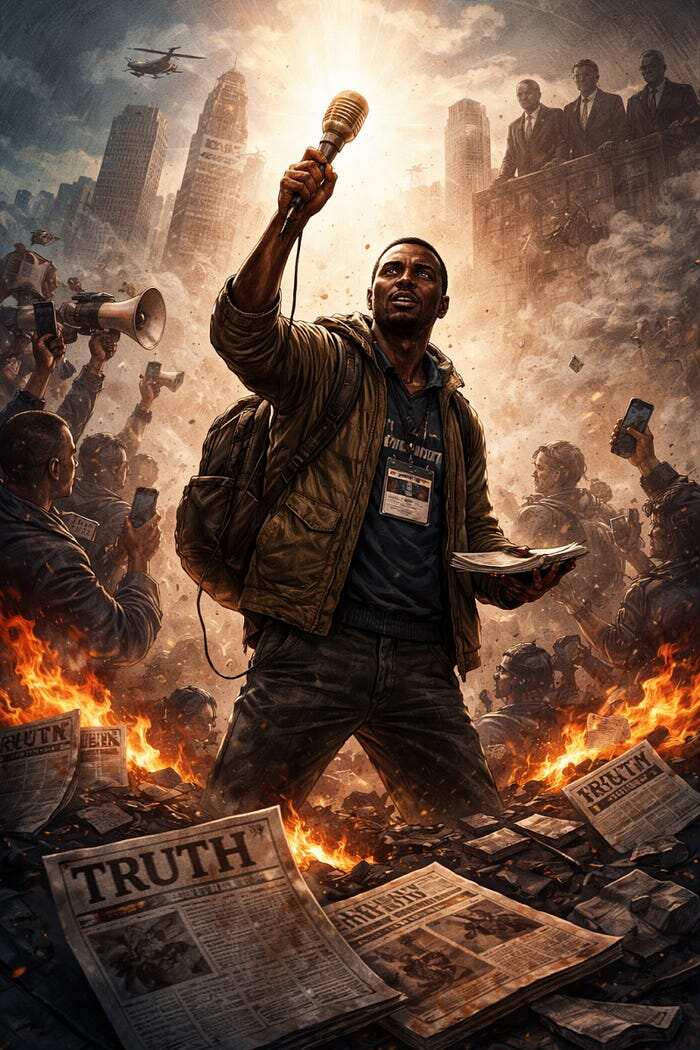
Because journalism, in its purest sense, is not the voice of power. It is the voice of the powerless. It is not the megaphone of kings; it is the whisper of those beneath them. Journalism is giving a voice to the voiceless. And the voiceless does not only mean people. It can mean a forgotten street. An unsung hero. A quiet act of kindness. Even a tree. The tree cannot speak, but journalism can speak for it.
So when people outside the mainstream began telling other stories – stories of suffering, of resistance, of truth – they confused the system. They were not welcomed. They were banned. In the 1950s, underground newspapers rose in South Africa, carrying the voices of the oppressed. The government outlawed them. The mainstream dismissed them. But they existed. They spoke. And in that speaking, journalism was alive.
Today, we have those voices again.
They are on podcasts. On timelines. In threads. In late-night uploads and early-morning tweets. They are people who document what the cameras won’t show. People who name what the anchors won’t say. They do not have studios. They do not have sponsors. They do not have prime-time slots. But they have ears to the ground and courage in their hearts.
They tell us what is being done in our name. They tell us what power would rather keep quiet.
So, is journalism dead?
Only if we refuse to call these voices journalism.
Only if we limit the word to those who sit behind polished desks.
Only if we confuse the failure of mainstream media with the death of truth.
Journalism is not dead. It has simply returned to the margins, where it has always done its best work.