‘Call me names,’ says Mashaba as he doubles down on immigration
Explain | 05.06.2026 14:49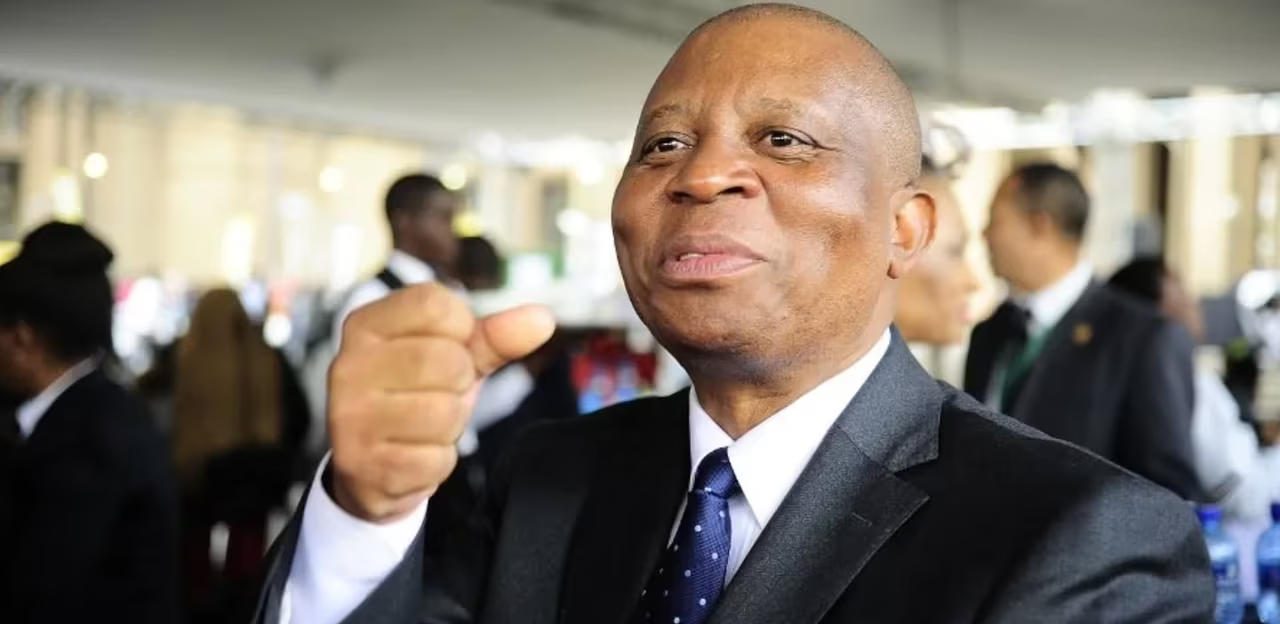
ActionSA’s Herman Mashaba is making immigration a red line in the Joburg race, and he is not softening his language.
Herman Mashaba arrives for our interview in ActionSA regalia, jeans, and sneakers, a far cry from the sharp-suited businessman image many South Africans still associate with him.
We’re sitting in his office at Fredman Towers in Sandton, where the former Johannesburg mayor is friendly, composed, and very much on message.
The topic is immigration, one of the most heated issues in South African politics and Mashaba is not trying to soften his position.
“I encourage people to call me names and criticise me if it helps bring the issue of immigration to the forefront of public discourse,” he tells /explain/.
Mashaba has had several political lives. He first became famous as the founder of Black Like Me, one of South Africa’s best-known haircare brands.
In 2016, he entered party politics as the DA’s Johannesburg mayoral candidate and served as mayor from 2016 to 2019.
He later resigned as mayor and left the DA, citing Helen Zille’s return to the party’s leadership as a key reason. In 2020, he launched ActionSA.
Now, he wants his old job back. And immigration is central to the campaign he is building.
Mashaba says South Africans have avoided talking honestly about immigration because they fear being labelled xenophobic.
“We have one of the highest sustained unemployment rates in the world, yet people want South Africa to be a home for all,” he says.
His argument is that South Africa has extended ubuntu too generously as citizens struggle with unemployment, housing backlogs, and failing services.
“People have abused our good nature as South Africans, so I am calling on South Africans to suspend ubuntu outside of our homes. When we enter the public, we must prioritise the rule of law above all else,” he says.
Mashaba says immigrants who enter the country legally and can support themselves should be welcomed. But he argues that those who are undocumented, rely on state resources, or seek to operate businesses in township economies should not be allowed to do so.
He points to housing as an example.
“We had hundreds of thousands of people on the housing registry when I was mayor of Johannesburg and hundreds of informal settlements, so it is incomprehensible for non-South Africans to expect me to provide housing for them,” he says.
It is a message that has become central to Mashaba’s politics. It is also one that has drawn sustained criticism from human-rights experts, who argue that migrants are being blamed for problems created by weak governance.
We put Mashaba’s comments to Sharon Ekambaram, head of Lawyers for Human Rights’ refugee and migrant rights programme. Her view is starkly different.
Ekambaram disputes the idea that migrants are the reason South Africa’s public services and job market are under pressure. She says the country’s high unemployment rate is rooted in poor policy choices, weak governance and slow economic growth, not immigration.
Studies by the Institute for Security Studies have similarly argued that South Africa’s high crime levels, unemployment and municipal failures are largely driven by governance failures, even though migrants are often blamed for them.
Ekambaram says hospitals are not overburdened by migrants, but by leadership failures, underfunding, and poor management.
“Just look at what has happened at Charlotte Maxeke Academic Hospital, which has taken five years to repair after a fire, and Life Esidimeni, and you will see that our healthcare system is compromised because of poor leadership, not immigrants,” she says.
Mashaba is not persuaded. If elected when Joburgers vote on 4 November, he says he would “root out” undocumented immigrants and hand them over to Home Affairs.
“When we find them, we will hand them over to Home Affairs and then that department can decide what it wants to do with them, but they are not welcome in Johannesburg or any municipality where ActionSA governs,” he says.
He also says an ActionSA-led city would reserve small-business licences in township economies such as Alexandra and Soweto for South Africans only.
Ekambaram says that the approach misunderstands how South Africa’s refugee system works. Unlike countries that keep refugees in camps, South Africa uses an urban integration model. That means recognised refugees and asylum seekers are expected to live in communities and support themselves.
“Immigrants are often entrepreneurial by necessity, having fled violence and discrimination in search of a better life,” she says. “Excluding them from the informal economy would strip them of an opportunity to earn a living and put food on the table.”
Mashaba acknowledges South Africa’s history of xenophobic violence, including the deadly attacks in 2008. But he says that history will not make him soften his language.
“Why must I exercise sensitivity when coming into the country without the necessary documentation is illegal? Why must I be sensitive to criminals?”
Ekambaram says this is exactly why caution matters. She argues that language which casts migrants as criminals or outsiders can fuel division and violence.
She says any form of “otherism” undermines people’s dignity by suggesting they are worth less than others.
Bodies such as the United Nations, Human Rights Watch and Amnesty International have also warned against anti-immigration rhetoric in South Africa because of its potential to incite violence.
Mashaba’s view that immigration worsens pressure on jobs and public resources is widely contested. But it also resonates with many South Africans and is shared, in different forms, by parties such as the Patriotic Alliance, the Inkatha Freedom Party. and the MK Party.
For Mashaba, the issue is non-negotiable. He says a crackdown on undocumented immigrants is one of ActionSA’s three red lines for any party wanting to govern with it in Johannesburg.
The other two are rooting out corruption and improving services for all residents, from Sandton to Soweto. Mashaba says corruption has plagued the city and that officials must be held accountable, regardless of which party they belong to.
Mashaba faces a crowded race to return to the mayor’s office. The DA has fielded Helen Zille, the Patriotic Alliance has unveiled Kenny Kunene, and the ANC is expected to put forward a senior candidate of its own.
To gain ground, Mashaba says his campaign will be heavily focused on communities. He plans to meet residents across the city and be present in places where ordinary people gather, including bus stations and taxi ranks.
It is a long road back to council, but Mashaba says he is motivated by unfinished business from his first term as mayor.
Johannesburg, he argues, is battered but not beyond repair. It needs political will, time, and leadership.
By the end of the interview, Mashaba is still calm, still friendly, and still unmoved on immigration. The controversy does not seem to bother him. In fact, he appears to see it as proof he is forcing a conversation others are too afraid to initiate.
Whether voters see that as courage or dangerous rhetoric may become one of the defining questions of Johannesburg’s mayoral race.
Local government elections will take place on 4 November. In the lead-up,/explain/ will interview as many mayoral candidates as possible to help South Africans gain a better sense of the people vying to become the city of gold’s first resident. Next up: part two of our interview with Herman Mashaba.
Prashalan Govender is a journalist who was shortlisted for the Vodacom Young Journalist of the Year Award twice. He is focused on reporting the stories that shape everyday life in South Africa, with a particular interest in politics, economics, and social issues.