When Courage Can Get You Killed, What Does Leadership Require?
Medium | 26.01.2026 00:11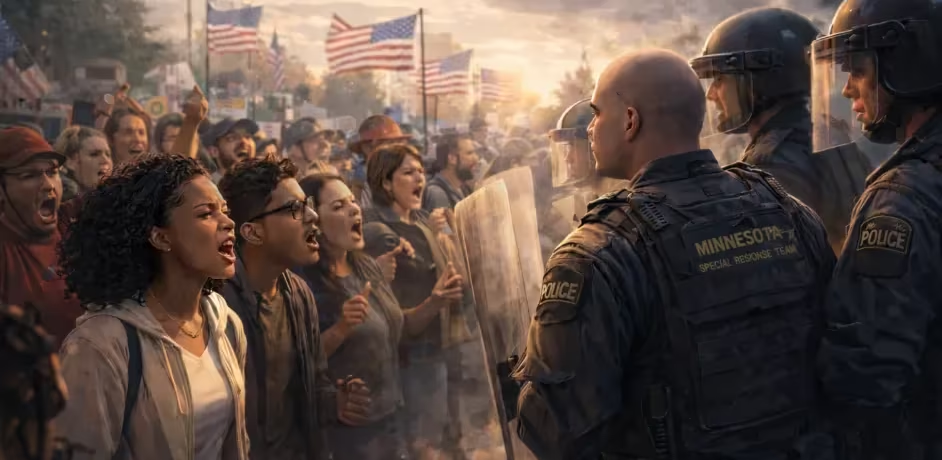
When Courage Can Get You Killed, What Does Leadership Require?
The World Feels Dangerous Again
5 min read
·
Just now
--
Listen
Share
Safety used to be assumed. Now it’s negotiated.
The world feels dangerous again. That isn’t a dramatic statement or a headline meant to provoke. It is the reality of waking up and realizing that safety is no longer something assumed. It is something calculated. And when the world feels unstable, identity stops being a personal detail and becomes a public label. Gender. Skin. Origin. Anything that makes you legible before you are understood. In times like these, it isn’t paranoia to feel alert. It is intelligence.
The Mirror Moment
The mirror doesn’t show you who you are. It shows you what the world sees first.
Some days, otherness doesn’t exist internally. Life moves forward. Work gets done. You stay focused on responsibilities, goals, and the shape of the day ahead. You forget you are different because you are busy being human. And then you walk past a mirror in a public place. A storefront window, a reflective elevator wall, a glass door you pass without thinking. The reflection hits like a reminder you didn’t ask for, not because you look unfamiliar, but because you see what the world sometimes sees first. The gender. The skin. The category. The other.
After two decades in the United States, after working, building, adapting, earning, there are still moments when belonging feels conditional. It is not always overt, and it is not always cruel, but it is present enough to leave a mark. The world does not need permission to decide what you are, and once you feel that, even briefly, it changes the way you move through space.
The Moral Collision
If courage can cost your life, is silence still a sin?
Once otherness becomes visible, guilt often follows. The guilt says do more. Go march. Show up. Raise your voice. Stand with the people refusing to stay quiet. It feels like responsibility. It feels like integrity. It feels like what a good person and especially a leader would do. Because if injustice is happening in public, it feels wrong to remain private.
But reality interrupts the ideal version of courage. People are being shot for raising their voice. People are being threatened for speaking. People are being punished for standing where they were told they belong. So the question stops being what do I believe and becomes what am I willing to risk. What if being brave does not just cost reputation. What if it costs your life. What if it costs your family their peace.
There is a particular kind of shame that comes with wanting to stay alive. It can feel cowardly to stay home while others are in the streets. It can feel irresponsible to protect yourself when history seems to demand proof of what you stand for. But the body does not care about symbolism. The body cares about survival. And fear does not mean you lack conviction. It means you understand the stakes.
What Leadership Actually Requires
When courage becomes lethal, does leadership require martyrdom?
It would be easy to end the story here. Guilt on one side, fear on the other. But leadership is rarely clean. Leadership is not bravery as a brand. It is not a loud moment repackaged as integrity. Leadership is responsibility under pressure. It is choosing an action when there are consequences either way.
A leader should do more outside of work, contribute beyond comfort, take risks for what is right. That is true. But the definition of leadership collapses if it only honors one kind of courage. If leadership only counts when it is loud, public, and dangerous, it quietly excludes the people who have the most to lose. That is not leadership. It is theatre.
Real leadership does not demand martyrdom. Real leadership demands impact. It asks a different question. What can be done that is meaningful, sustainable, and safe enough to continue.
The Third Path: Infrastructure Courage
When the streets feel unsafe, the living room becomes a leadership venue.
There is a third path between silence and the streets. A form of leadership that doesn’t require you to become a headline, but to build what lasts. It looks like third places and safe spaces where women, immigrants, and minorities can speak without punishment, name fear without shame, and regain clarity. It looks like mentorship that keeps women from carrying this alone and helps more of us stay in the room long enough to change what the room rewards. Not every fight for equality is loud. Some are quiet because they are intentional, sustainable, and designed to endure.
The world is scary, and it becomes scarier when you are reminded that belonging is still conditional. The guilt to be visible is real, but so is the responsibility to protect your life and your family. The answer cannot be silence disguised as safety, and it cannot be sacrifice disguised as virtue. It has to be leadership that builds protection, strengthens community, and refuses to confuse visibility with impact. Courage isn’t only what happens in the streets. Sometimes it happens behind closed doors, when a minority refuses to shrink and keeps building a world they can survive in.
The mirror used to remind me I didn’t belong. Now it reminds me belonging isn’t the point. Safety, truth, and impact are. The third path is how we protect all three.