REAL POLITICS: Time to review South Africa’s foreign policy under the unity government
Scrolla | 06.03.2026 21:16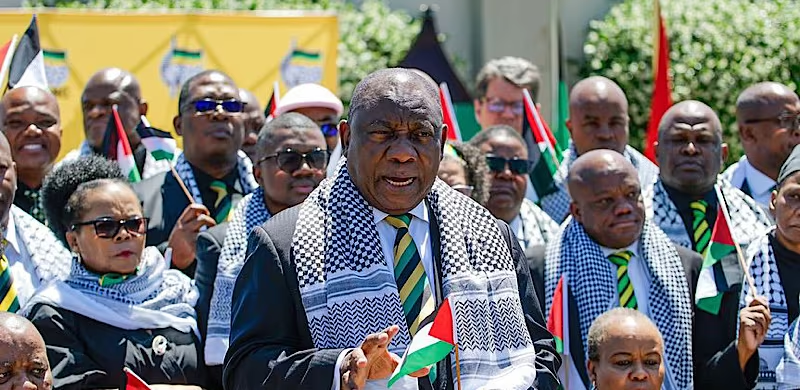
South Africa’s government of national unity should trigger a long overdue rethink of the country’s foreign policy, writes Zukile Majova in Real Politics.
For three decades, Pretoria’s international posture has largely reflected the worldview of the ANC. That approach was shaped by the liberation movement’s history and its alliances during the struggle against apartheid.
But South Africa now has a coalition government. That political shift should also influence how the country positions itself in global affairs.
The unity government, anchored by the ANC and the DA with support from smaller parties, represents voters with different political traditions and priorities. Yet on foreign policy, little appears to have changed.
Pretoria still largely speaks with the voice of the ANC.
For years, the ANC has framed its diplomacy around the ideals of the non aligned movement. The party often argues that South Africa should play a mediating role in global conflicts and promote dialogue over confrontation.
That vision draws on South Africa’s own transition from apartheid, which was achieved through negotiations rather than war.
However, critics say the country is no longer viewed as neutral in several international disputes.
South Africa’s close ties with countries such as Russia, China and Iran have raised concerns in Western capitals and among some domestic observers. These relationships are often justified through historical solidarity and a desire to challenge Western dominance in global politics.
But the world has changed dramatically since the early years of democracy.
South Africa’s economy remains deeply linked to Western markets, trade systems and investment flows. Access to programmes such as the African Growth and Opportunity Act remains vital for exports and employment.
Foreign policy choices that appear ideological could therefore carry economic consequences.
This is where the government of national unity should make a difference.
Coalition politics requires compromise and balance. The DA, for example, traditionally takes a more pro Western stance and has openly supported Israel in the Middle East conflict.
Yet the party’s voice has not been clearly reflected in the current foreign policy posture of the unity government.
Key diplomatic decisions continue to be driven mainly through the Department of International Relations and Cooperation and the presidency, both led by the ANC.
One example is South Africa’s decision to take Israel to the International Court of Justice in 2023 on accusations of genocide in Gaza.
Regardless of where one stands on that conflict, the question remains whether such a significant step reflected the collective position of the unity government partners.
The coalition agreement states that new initiatives should be pursued through consultation and consensus. That principle should also apply to foreign policy.
A more balanced approach could help reduce geopolitical risks while allowing South Africa to focus on its pressing domestic challenges.
The country faces stubborn unemployment, rising inequality and slow economic growth. Foreign policy should support efforts to attract investment, grow exports and strengthen economic partnerships.
Ideological alignment with distant geopolitical blocs does little to address these urgent problems.
The tensions surrounding Iran illustrate the complexity of the situation.
Few observers would defend the methods used by United States President Donald Trump in confronting Tehran’s regional ambitions. Yet it is equally clear that Iran’s expanding military influence has heightened instability across the Middle East.
Iran has been involved in military actions and proxy conflicts across several countries in the region. It has also been accused of backing militant organisations such as Hezbollah, Hamas and Palestinian Islamic Jihad.
These developments have intensified tensions between Iran, Israel and the United States.
Despite the scale of these confrontations, South Africa’s official response has largely focused on condemning the actions of Israel and the United States.
President Cyril Ramaphosa expressed concern about rising tensions following strikes that killed Iran’s supreme leader Ayatollah Ali Khamenei. Pretoria emphasised the need for diplomacy and warned against what it described as anticipatory self defence.
South Africa’s message was clear: dialogue must remain the path to peace.
But critics argue that Pretoria’s position often appears selective, particularly when it comes to condemning actions by countries with which the ANC has long standing political ties.
At the same time, there are signs that some within the ANC recognise the need for a more cautious approach.
Ramaphosa recently opposed South Africa’s participation in joint naval exercises that would have involved Iran alongside other Brics partners.
The exercises, known as Will for Peace 2026, took place off the coast near Cape Town and included Russia and China.
Iran was initially expected to participate with warships. However, Ramaphosa issued directives to exclude or downgrade Iran’s role because of concerns about damaging relations with the United States.
Those concerns were not trivial.
South Africa’s trade relationship with the United States remains critical, and tensions with Washington could affect economic arrangements such as the African Growth and Opportunity Act.
Yet reports later suggested that Iranian vessels still participated in the exercises, raising questions about whether elements within the South African National Defence Force ignored the president’s instructions.
The episode highlights the broader challenge facing South Africa’s foreign policy.
The country must navigate an increasingly polarised world while protecting its national interests.
That means prioritising the wellbeing of South Africans above historical loyalties or ideological symbolism.
The government of national unity provides an opportunity to reset the country’s diplomatic direction.
If coalition partners are serious about governing together, they should also shape a foreign policy that reflects the shared interests of the nation.
South Africa does not need to abandon its principles or its commitment to peace and dialogue.
But it does need a pragmatic strategy that puts the country’s economy, stability and global credibility first.
Thirty years into democracy, foreign policy should serve the future of South Africa, not the political instincts of the past.
Image Source: ANC