pretty privilege can only get you so far
Medium | 15.01.2026 08:03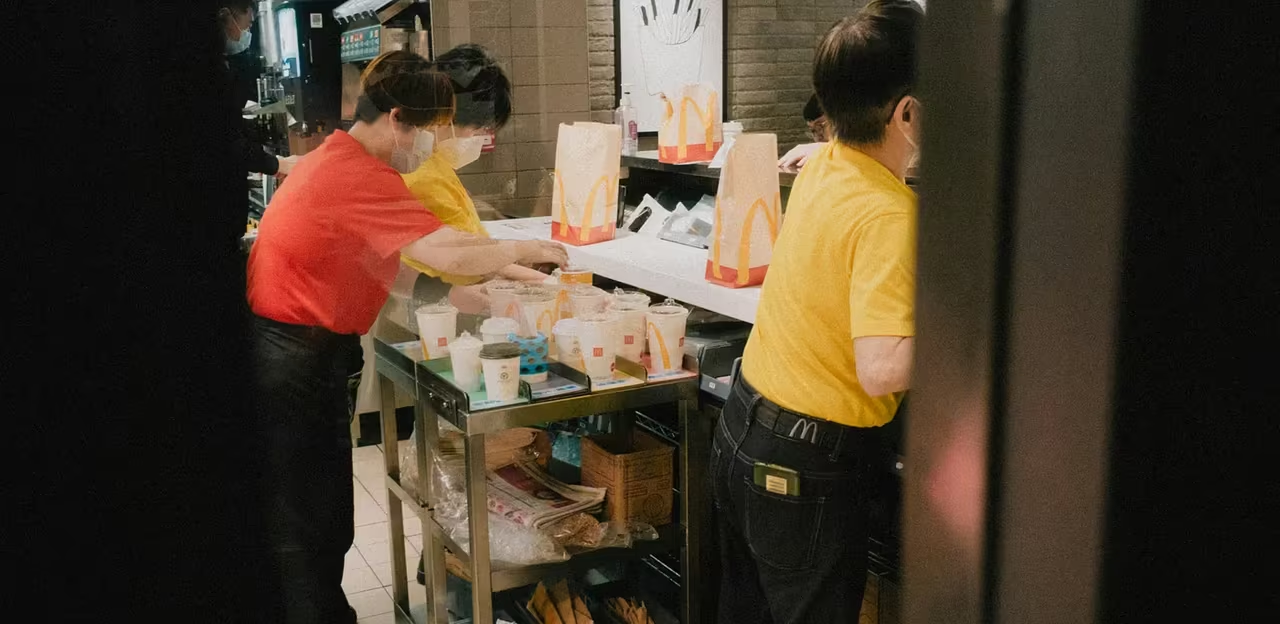
pretty privilege can only get you so far
8 min read
·
Just now
--
Listen
Share
In a multiverse of infinite possibilities, most versions of our favorite celebrities are asking if you want fries with that.
I spent an embarrassing amount of my teens believing that beauty was a kind of cosmic insurance policy.
Not my own beauty—I’ve always existed in that comfortable middle ground where you’re attractive enough to occasionally benefit from it but not so striking that it defines your social experience.
I believed in other people’s beauty as protection. Specifically, I believed that if you were beautiful enough, or famous enough, or both, you’d somehow bypassed the ordinary indignities of being human. You wouldn’t get your credit card declined at the grocery store. You wouldn’t sit in waiting rooms under fluorescent lights, filling out forms in triplicate. You wouldn’t know what it felt like to be ignored.
I'm not sure when I started unlearning this, but I think about it now—how we've collectively created a mythology around appearance and recognition that has almost nothing to do with how the world actually works.
In quantum mechanics, there’s this idea that infinite parallel universes exist, each containing different versions of our reality. It’s become a pop culture staple—think Everything Everywhere All At Once, where Michelle Yeoh’s character glimpses countless versions of herself across the multiverse. In most of those universes, she’s not a movie star. She’s ordinary. She’s struggling. And if we’re honest about probability and statistics, the same is true for every celebrity we’ve ever heard of. In most universes—in most possible iterations of reality—Zendaya is working a register. Timothée Chalamet is filing TPS reports. The odds of achieving fame are so astronomically small that the mathematical majority of alternate realities must contain versions of these people living completely unremarkable lives.
We want to believe in meritocracy because the alternative is terrifying. If we accept that fame and beauty don't correlate reliably with talent, effort, or virtue, then we have to accept that the universe is more random than we'd like. We have to sit with the possibility that we could do everything right and still not get what we want. That our favorite actors might not be the most talented people who auditioned—they might just be the ones whose parents knew someone, or who happened to look like what a particular casting director imagined when they read the script.
The nepotism conversation has finally broken through in recent years, largely because it became impossible to ignore. We watched Dakota Johnson explain how she got her start, mentioning almost casually that her grandmother was Tippi Hedren. We learned that seemingly every young actor in Hollywood has a parent or grandparent in the industry—because social media made it harder to hide. Maya Hawke, daughter of Uma Thurman and Ethan Hawke, has been refreshingly direct about this, acknowledging in interviews that her access to auditions came from her family connections. She’s talented, yes—but she’s also candid about the fact that talent alone wouldn’t have been enough.
And then there are the conventionally beautiful people, the ones who seem to glide through life on the strength of symmetrical features and good bone structure. We imagine them immune to rejection, to loneliness, to the small humiliations of daily life. But beauty, like fame, is a resource that opens certain doors while leaving others firmly locked. It might get you the audition, but it won't guarantee the callback. It might attract attention, but it won't determine what kind of attention, or from whom, or whether that attention will ultimately serve you or harm you.
I think of Marilyn Monroe, who remains our culture's ultimate symbol of feminine beauty, and how little that beauty protected her from exploitation, addiction, and despair. Or more recently, how we've watched beautiful celebrities speak publicly about their struggles with mental health, eating disorders, harassment. Beauty didn't insulate them from trauma. Sometimes it invited it.
Social media has amplified our obsession with appearance to a level that would have seemed dystopian even twenty years ago. We now have apps that rate our facial symmetry, filters that show us what we'd look like with different features, entire economies built around the pursuit of beauty that's been algorithmically optimized. We've gamified attractiveness and convinced ourselves that winning this game matters more than almost anything else.
Beauty is culturally specific, historically contingent, and individually interpreted. What’s considered beautiful in one context is unremarkable in another. The features that make someone striking in person might not photograph well, and vice versa. And even when beauty opens doors, those doors don’t lead anywhere guaranteed. They just lead to more rooms where you’ll still have to prove yourself, still have to navigate power dynamics and competition and the ordinary difficulties of being a person trying to make a living.
I've been thinking about this in relation to my own work lately—how much energy I've spent trying to be taken seriously, to be recognized, to be seen as successful by whatever metric we're using this week. And how that pursuit has sometimes distracted me from the actual work of doing things that matter to me. There's a particular kind of exhaustion that comes from performing competence and confidence for an imagined audience that may not even be paying attention.
When I was sick last year, I had time to notice what I actually cared about versus what I thought I should care about. The distinction was sharper than I expected. I realized I’d been chasing recognition partly because I’d convinced myself it would make everything easier. That if I could just achieve some threshold of visibility, the ordinary struggles would fall away. That success would function as a kind of force field against disappointment and difficulty.
But every interview I've read with famous or successful people suggests this isn't true. They still experience anxiety. They still deal with difficult family members and health problems and existential uncertainty. They still have to figure out how to be decent people in a world that doesn't always reward decency. Fame and beauty might change the specific contours of their struggles, but they don't eliminate struggle itself.
This is, I think, both depressing and weirdly liberating. Depressing because it means there's no escape hatch, no achievement that will exempt us from being human. But liberating because it means we can stop waiting for our lives to begin once we've achieved some imagined level of success or attractiveness. We can stop believing that other people have it fundamentally easier because they're beautiful or famous or both.
The myth of meritocracy is comforting because it suggests the universe is fair. Work hard enough, be talented enough, and you'll succeed. But merit alone doesn't explain why some people break through and others don't. It doesn't explain why actors from industry families get more opportunities than equally talented actors from working-class backgrounds. It doesn't explain why conventional beauty opens doors while unconventional beauty is often dismissed or fetishized or both.
What explains these things is a combination of luck, privilege, timing, and yes, sometimes talent and effort. But mostly it's randomness operating within systems designed to benefit people who already have advantages. And recognizing this doesn't mean we should stop trying or stop valuing excellence. It just means we should stop pretending that success is purely a function of merit, or that being beautiful or famous insulates anyone from the fundamental difficulties of being alive.
In The Bluest Eye, Toni Morrison writes about how the worship of a particular kind of beauty—specifically, white beauty—destroys the character Pecola Breedlove, who internalizes the message that her dark skin makes her unworthy of love. The novel is devastating partly because it shows how beauty standards aren’t neutral—they’re tools of oppression that tell us who matters and who doesn’t. We’ve made some progress since Morrison published that novel in 1970, but we’ve also found new ways to enforce narrow beauty standards, to make people feel inadequate, to suggest that appearance determines worth.
And fame operates similarly, though perhaps more subtly. We treat famous people as if they exist in a different category of human—as if their experiences are fundamentally unlike ours, as if they've transcended ordinary suffering. But they haven't. They're just navigating different versions of the same struggles, with different resources and different pressures.
My younger self, believing that beauty and fame were protective forces. I think I believed this partly because I wanted to believe in a version of the world that was more orderly than the actual world. A world where there were clear rules and rewards, where effort correlated with outcome, where being exceptional in some visible way meant you’d earned immunity from pain.
But that world doesn’t exist, not even for the beautiful or famous. And maybe accepting that is what allows us to stop performing for an imagined audience and start paying attention to what we’re actually paying attention to. To do work that matters to us rather than work we think will get us recognized. To value substance over image, even though image is easier to quantify and measure.
The multiverse theory suggests that somewhere, there’s a version of you living the life you think you want. But there’s also a version of you working at McDonald’s, and that version is no less human, no less deserving, no less complete. The same is true for everyone we’ve ever envied or admired. In most universes, they’re ordinary. And in this universe, underneath the fame and filters, so are they. So are we all.