Beyond the Cosy Story: From Stuck Equality to Creative Flow
Medium | 15.01.2026 04:12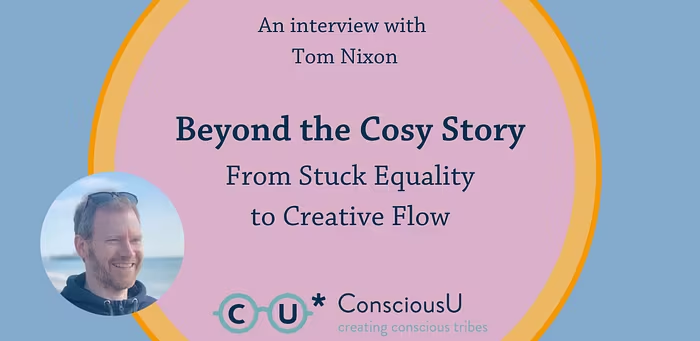
Beyond the Cosy Story: From Stuck Equality to Creative Flow
ConsciousU I creating conscious tribes
Follow
10 min read
·
1 hour ago
Listen
Share
An interview with author, adviser, and founder Tom Nixon
For our ConsciousU newsletter, we conduct a monthly interview. This is an excerpt, you can watch the complete interview with Tom Nixon here (60 mins). To access all interviews with change makers at the intersection of inner work and collective action, join our free Conscious Tribes Community!
There is a level at which co-founders, as creative human beings, are of completely equal value. And at the same time, in a particular context, there is a hierarchy.
Tom Nixon was the founder of one of Europe’s first dedicated social business consultancies where his team also launched the Meaning Conference for better 21st-century business in Brighton, UK. Today, Tom is an adviser to pioneering leaders, the author of Work with Source, and the founder of Maptio, an open source product to visualise initiatives operating without traditional management structures.
Tom, what are the most common stories about co-founding, and what is different about the perspective you bring?
There are two very prevalent stories regarding co-founders. The first is all about the formal artefacts — who is the CEO, who is holding which shares and directorships, etc. The second is about the relationship, the emotions, and the connection that the co-founders have with each other and with the initiative they are trying to bring to life.
But there actually is a third and more fundamental story that adds to the others. It brings in the source perspective, as introduced by Peter Koenig and explained in my book. This perspective suggests that underneath the dynamics I have described so far, there is some kind of creative process — an idea that is trying to come into the world. Seen this way, co-founding, fundamentally, is a creative endeavour. It is about one person inviting others to play, or create, with them and to make something happen together.
From the source perspective, we don’t see the co-founders as completely equal. The first person to invest themselves in realising an idea — to take some sort of vulnerable step or risk to actually make it happen — is called the global source. That person will have a different relationship to the creative process than anybody else who joins it. The role of that first mover, the global source, is absolutely key to holding the whole initiative, its values, and the understanding of what it is really all about — especially in times of transition or change of direction, where deeper, values-based judgments need to be made.
This may sound like as if it is all about that one person, but the other co-founder(s), as they say yes to the invitation and step into this creative field opened up by the global source, also take responsibility for part of the whole. This can be something really significant, such as actually building the thing you are going to create or taking on major responsibility for leadership within that field. It is incredibly important to acknowledge all of the sources, whether it is the global source or the source of something more specific. So, there is a level at which co-founders, as creative human beings, are of completely equal value. And at the same time, in a particular context, there is a hierarchy.
What do you think is behind the wish for equality among co-founders? And what are the hidden costs of avoiding a conversation about source?
We have certainly had way too much “me, me, me” and too many ego-driven initiatives. So it is absolutely right that this has been challenged and questioned. But what is often happening is such a strong reaction against anything that sounds individual that the bias flips to the opposite extreme and now it has to be all about “we”. However, the human condition actually involves an intricate interplay between the individual and the collective, in different ways and at different times.
A lot of initiatives that are very well-meaning are desperately trying not to be patriarchal, colonial, or top-down and power over people. Those are stands worth taking. But they go so far as to say, “therefore we cannot be any different; we all have to be equal at every level”. And in the end, this creates its own form of tyranny.
Sometimes, a global source — the originating founder — puts themselves down by saying, “I might have started this thing, but I’m not so important. It’s really about all of us. We created it together, and we hold it together.” This creates a quite nice, warm, fuzzy feeling, but then the energy slowly drains out of the initiative or project, because things fall between the cracks and the vision gets diluted to the lowest common denominator to please everybody. Sometimes this then leads to a flip-flop back to the other extreme, where the founder becomes really authoritarian, trying to get it back into shape.
What we actually want is to move past that and say: we don’t want power over people; we want power with. But that doesn’t mean that power is simply shared equally. It means seeing the power that all of us have in our different contexts — which depends on who we have invited in, or whose invitation we have accepted.
How does acknowledging this affect the flow of work within a system?
I am a big fan of more decentralised ways of working, much more self-organised, self-managing. But they can be unbelievably complicated. If you have ever been part of a sociocratic or holocratic initiative, you will know that some of them do run really well, but many spend vast amounts of time just in process — having meta conversations about how they are doing things, rather than getting on with the actual work of realising the vision.
Whereas, when people are willing to work from a place of acknowledging the specific source in themselves, as well as the global source who is holding the whole, what we find is that the need for formal organisation — structures, processes, policies, etc. — can be reduced by a dramatic margin. You can then cut down on a huge amount of bureaucracy, even if it is self-management bureaucracy, that gets in the way of the actual work.
Get ConsciousU I creating conscious tribes’s stories in your inbox
Join Medium for free to get updates from this writer.
Subscribe
Subscribe
That being said, the global source needs to tap into the collective intelligence of the other people in their field. The first thing a global source needs to do is listen. It is not about telling everybody that you have got the best idea and that they should follow it because you are the source. Often, the first thing a source says is, “I don’t know, I’m not clear”, because there are so many possibilities, so many risks, and so many different directions.
To sit with that not knowing, and to get the help from those around you, matters because they have their own vantage points through the work that they are doing, and they can probably see things the source can’t see. So it is about having a good process to tap into that collective intelligence and to help the source really listen, see the potential, and get clear.
As a specific source, how do you thrive within someone else’s field without feeling diminished or sidelined?
The first thing to do is to get as clear as you can on what matters most in terms of what you are sourcing in the world — with or without your co-founder. Asking yourself, “What is the world asking for from me?” provides you with a personal North Star and a different framing for the co-founder relationship. In this way, you always have the opportunity to take the best next steps to realise your personal vision, or sense of calling, as part of realising the vision for the whole that your co-founder is holding.
Often, this also leads to interesting opportunities for side projects — we don’t have to put all of our energy into one initiative. If there is a creative need that can’t be fulfilled within your co-founder’s field, rather than trying to force it in, or letting that part of yourself feel completely neglected, you might simply recognise it and look for ways to express it outside the field, for example in a non-profit.
There is a balance to be struck, and this is part of the art of working with the source principles: staying really true to yourself, not letting yourself feel diminished, and at the same time not pulling the collective initiative you are a part of out of shape, because that will just cause unnecessary conflict or dilution of the vision. So there is this constant adjusting, almost like a dance, where you keep following your own thing while also honouring the place that you have stepped into.
If you happen to be the person in the global source role, one of the best things you can do — alongside acknowledging yourself and listening very carefully to the collective intelligence of the group to help guide the next steps you are sensing — is to encourage other people to be good sources. To help them get clear on what is most meaningful to them, and what they really want to do. From there, you can find the best alignment for them to do as much of that as is appropriate within your field. As you start working in this way, the energy lifts, because everyone is working on what is most meaningful to them, while there is still a clear overall direction.
Alongside the global source and the specific source, the third role is the helper. These are people in the field who don’t have the ambition or the capacity, at this moment in time, to be a source in their own right. A common mistake that gets made, particularly in many very progressive and creative endeavours, is an implicit demand that everyone must have their own personal purpose that they bring to work. While every human has the potential for that, not everyone is actively living it, or doing so within that particular initiative.
So it is really important to let those with a strong personal sense of purpose express it, and to let others — who show up to work for more everyday reasons, such as earning a fair salary, enjoying what they are doing, and valuing the culture and people they work with — be as they are. That often does require a little more direction, not in the sense of micromanagement, but simply through having clearer objectives for that particular person. By contrast, someone who is truly a source can usually go much further without strict objectives, because they are naturally bringing their energy to achieve something substantial and ambitious.
It doesn’t work to treat everybody like a source, or everybody like just a regular employee. It is about really seeing where people are and allowing them to engage in a way that works for them at this moment in time.
We will soon start the next round of our online development programme CU*source, which you and I have co-written. Why would you recommend participating in it?
Having written a book on the topic, I can clearly explain the principles so people can understand them intellectually. But there is often a gap when it comes to actually implementing them. What usually stands in the way has to do with inner work — a fear or a story we tell ourselves that stops us from showing up and taking the next step that is needed.
In CU*source, people have the chance to understand the logic and the principles, as well as to engage in live coaching and peer pods, where they can really explore different parts of themselves. It is not a solo exercise, like reading a book. You are buddied up with others, helping each other get clear, challenging each other, and actually moving ahead.
In this next round, we are going to experiment with a new form of economy called community-led economics, which will allow us to work very differently with money and pricing. We are not asking for a fixed fee, but instead inviting participants and ourselves to co-create what the right amount is. That will be a complex conversation, looking at everyone’s financial realities and needs, the value you have received, and our own needs and financial realities as the providers of this programme. In that sense, we will interweave the moneywork and the sourcework in a very practical way through this new approach. You can read more about this on the ConsciousU website.
Where might we be heading as organisations, companies, and society, if we were to integrate working with source into our endeavours?
I would absolutely love to see a situation where, in the same way that it is now completely commonplace to have conversations about who is holding which formal roles, people can also say who is the source of what around here. By doing so, the focus is not just on how to run an organisation, but on tapping into what is meaningful to people.
My hope is that this can connect us more deeply with what the world most desperately needs at this time of huge upheaval. And my bigger hope is that, as more people see themselves first and foremost as sources — showing up with love in their hearts and a desire to do what the world most needs from them — and as we then build our collective endeavours on that basis, this can become a real force for the kind of change we need to see in the world today.
To access all interviews with change makers at the intersection of inner work and collective action join our free Conscious Tribes Community.
The Conscious Tribes Community supports you with ideas, practical tools, and free workshops to develop your consciousness and to build deep and authentic relationships.