Turkey's ancient, caffeine-free coffee alternative
BBC | 29.12.2025 20:00
For as long as anyone can remember, residents in Gaziantep have been harvesting wild pistachios to make a unique, nutty brew that doubles as a home remedy.
A cold front chased me into Gaziantep, a city in south-east Turkey not far from the Syrian border. It was late autumn and snow already blanketed the higher summits of the nearby Taurus Mountains. So when I opened the front doors of Tahmis Kahvesi – a cafe founded in 1635 and among the world's oldest coffee shops – I quickly joined the cluster of locals by the wood stove pulsing heat at the centre of the room.
Light poured through stained-glass windows. Around me, customers sipped from tiny cups decorated with ornate geometric motifs. Some drank the thick, foam-topped Turkish coffee that's beloved across the country. But the cafe's specialty is something rarely seen outside the region, and one I'd crossed an ocean to taste once more: menengiç kahvesi (menengiç coffee), an ancient brew that's nutrient-rich, caffeine-free and not actually coffee at all.
Made from the roasted, ground fruit of the terebinth tree, a kind of wild pistachio, menengiç tastes nutty and slightly bitter. The drink is so central to Gaziantep's culinary identity that in 2024, it received EU geographical indication status. Though popular across south-east Turkey – and widely consumed in Iraqi Kurdistan, where it's known as qazwan – for Gaziantep residents, the traditional brew is more than a coffee alternative; it's a time-honoured home remedy.
From home remedy to modern science
"In winter if I ever had a cough or a sniffle, my family would say, 'please drink this' and hand me a cup of menengiç," recalled Filiz Hösükoğlu, a gastronomy expert who grew up in Gaziantep. "When we come together as a community, or a family, we typically drink Turkish coffee or tea. But if somebody is ill, they serve menengiç."
I wasn't in Gaziantep seeking a cure. I'd first tasted menengiç on a prior visit to south-east Turkey, when I'd spent a few days touring the region's Neolithic sites, Roman ruins and Syriac monasteries. After ordering a cup in the hilltop city of Mardin, I was intrigued by the idea of a coffee-like drink harvested from trees growing wild at the northern cusp of the Fertile Crescent.
At Tahmis Kahvesi, my order arrived in a cup covered by a tiny metal dome to keep the heat in. A thick layer of foam cushioned the top, like crema on a well-pulled espresso. Before coming to Turkey, I'd had a brief cold and still had a ticklish throat. The drink was decadent with milk and the fatty wild pistachios. As a panacea, it seemed promising.
Tahmis Kahvesi may be the city's most storied menengiç purveyor, but in Gaziantep the drink is everywhere. The sound of grinders crushing menengiç into an inky paste provides the clattering soundtrack to the city's centuries-old covered bazaars. In narrow lanes, baskets piled high with shiny pearls of blue-green menengiç spill onto the cobblestones.
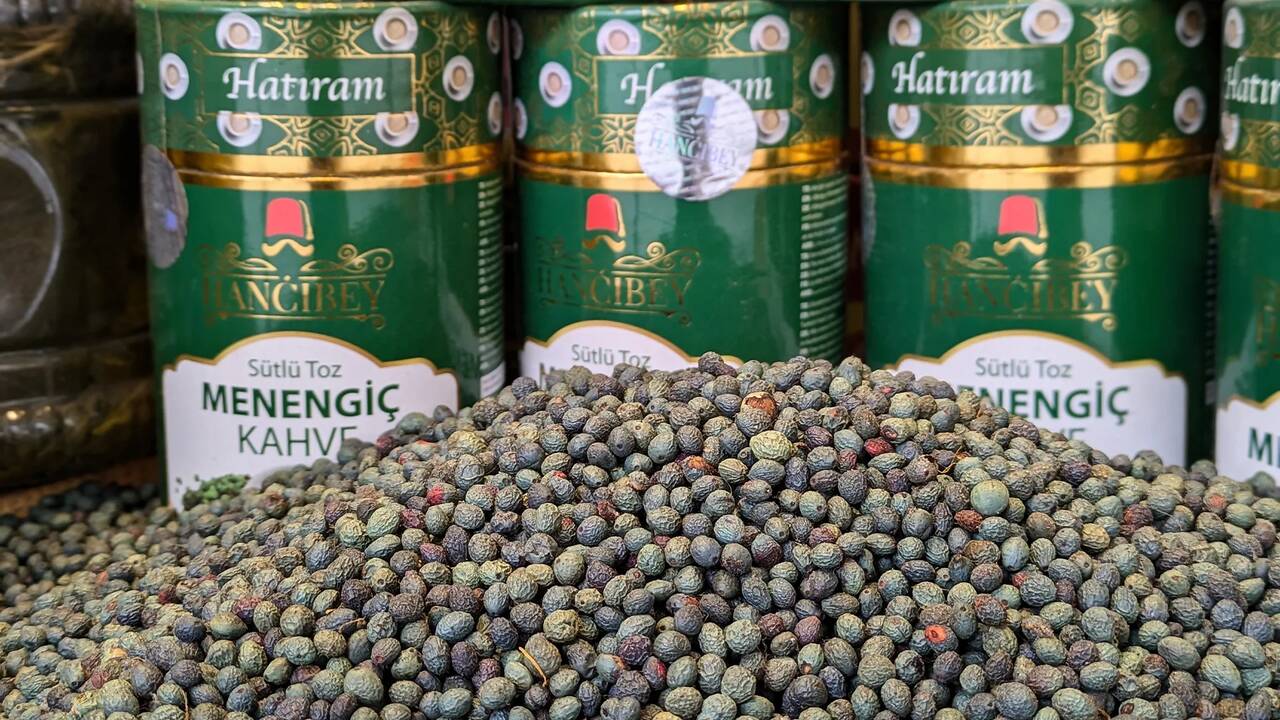 Jen Rose Smith
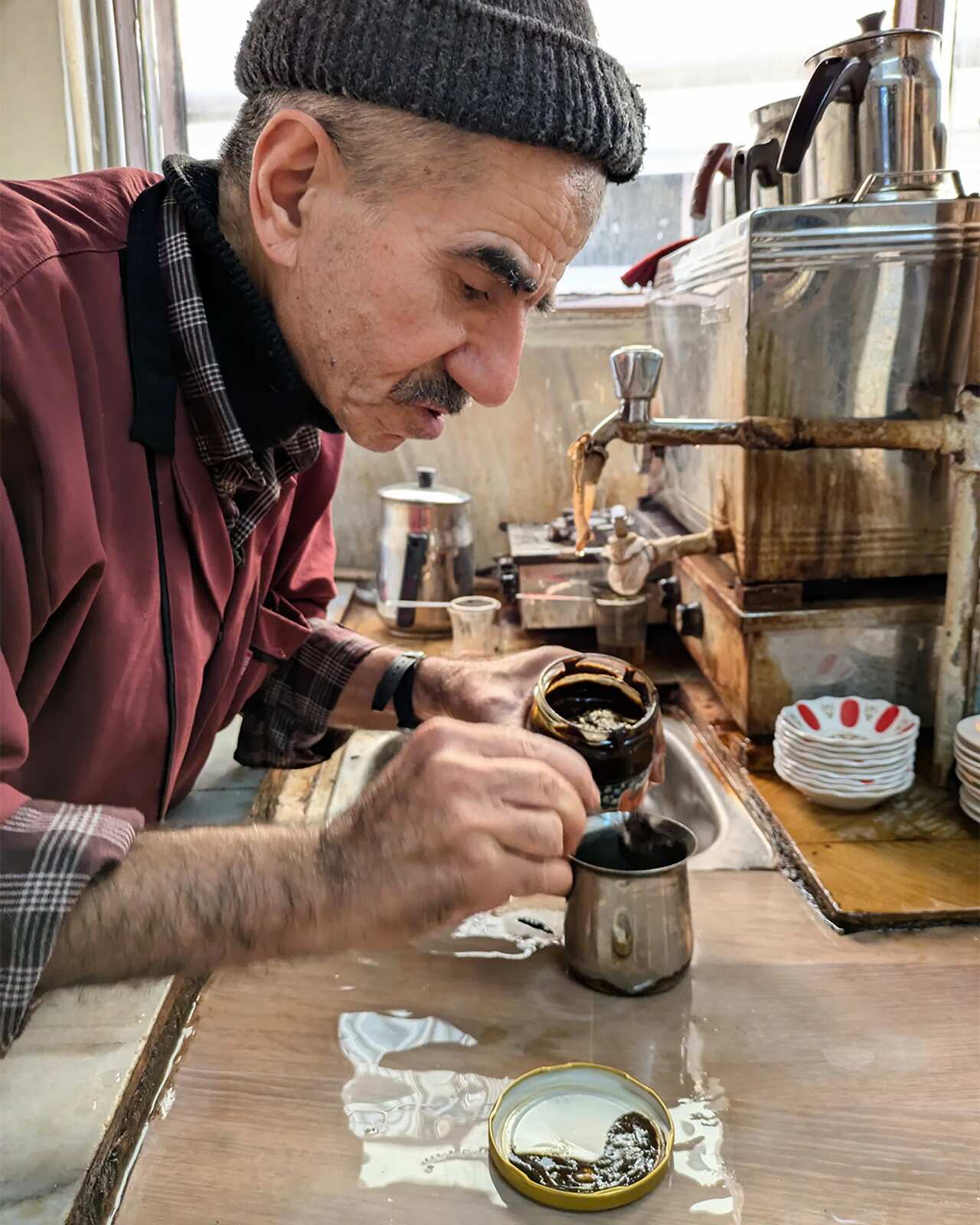
Around the corner from Tahmis Kahvesi, I met Mustafa Zor, an 86-year-old who started producing menengiçin the 1970s. Decades later, Zor still presides over a tiny storefront lined with jars of ground menengiç ready to be boiled with milk or water.
He explained that when he was growing up in a nearby village and one of seven brothers prone to catching colds, his female relatives would incorporate the healthy ingredient into drinks and other dishes for him. "My grandmother was my doctor," Zor recalled. "She and all the old women of the village knew the recipes for menengiç, which were given to them by their own grandmothers."
Science is still catching up to the traditional medicines used in south-eastern Turkey. While human clinical trials on the benefits of consuming menengiç are few, research does point to the benefits of consuming the protein- and mineral-rich terebinth fruit. Preliminary research has also explored its antioxidant and anti-inflammatory properties, lending some support to menengiç's longstanding reputation as a winter tonic.
Ancient origins
As with so much culinary heritage, the story of menengiç coffee has largely been passed down orally – like when Zor's grandmother taught him to brew the drink in the family's village home. Yet, its story hints at ancient roots. Local legend has it that the Ottoman Sultan Mehmet IV tried the drink when passing through Gaziantep in the 17th Century; a sign in front of Tahmis Kahvesi claims he stopped at the cafe while on a military campaign.
Archaeobotanical findings suggest that menengiç – or something resembling it – may have even deeper roots. At the Neolithic site of Göbekli Tepe, a Unesco-listed site two hours east of Gaziantep, researchers have found the remains of wild pistachios amid its art-inscribed megalithic structures erected nearly 12,000 years ago.
Today, the landscape surrounding the site is dry and sparsely treed. But researchers believe that in the early Neolithic period, it was far more temperate – a forest where resident hunter-gatherers could harvest the fruits of wild pistachio and almond trees.
More like this:
When Zor explained how his family harvests menengiç, I found it easy to picture the region's ancient people gathering wild pistachios in much the same way. "We just roll out a curtain under the tree, and we shake it until the menengiç falls to the ground," he'd said. Archaeologists have found thousands of grinding stones at Göbekli Tepe – the largest such collection from Neolithic Mesopotamia – suggesting that these harvests could have been crushed and processed into pastes like those still sold in the Gaziantep bazaar.
They might have used more creative preparations, too. At Tahmis Kahvesi, coffee is served with a small dish of nostalji çerez, a crunchy mix of roasted menengiç, chickpeas and hemp seeds that's often given to children as a healthy snack. Decades ago, traditional cooks in south-eastern Turkey used menengiç as a spice; blended it into breads and pastries; cooked it with pilaf; crushed it for oil; or mixed it with grape molasses and wheat flour to make a thick, sticky sweet. Such dishes are "about to be forgotten", wrote Abdullah Badem, a researcher at Karamanoğlu Mehmetbey University, in a 2021 paper on menengiç's traditional uses.

But the drink brewed from menengiç is here to stay. Across Gaziantep, I found cafes full of locals chatting across their foamy cups of menengiç coffee– in smoky, late-night hangouts; inside hipster shops; and within the courtyards of converted konaks (mansions).
Before leaving town, I made one last stop at another coffee shop – Menengiç Kafe, in an elegant home built in 1900 among the cobbled streets of Gaziantep's historic centre. After showing me around the gracious courtyard and upper rooms, owner Zeynel Abidin Tahtačı joined me for a glass of menengiç by the cafe's small wood stove.
"For a person from Gaziantep, it's impossible to think of life without menengiç coffee," he said, warming his hands. "We could never forget it. It's who we are."