Equal Treatment
Medium | 26.12.2025 00:09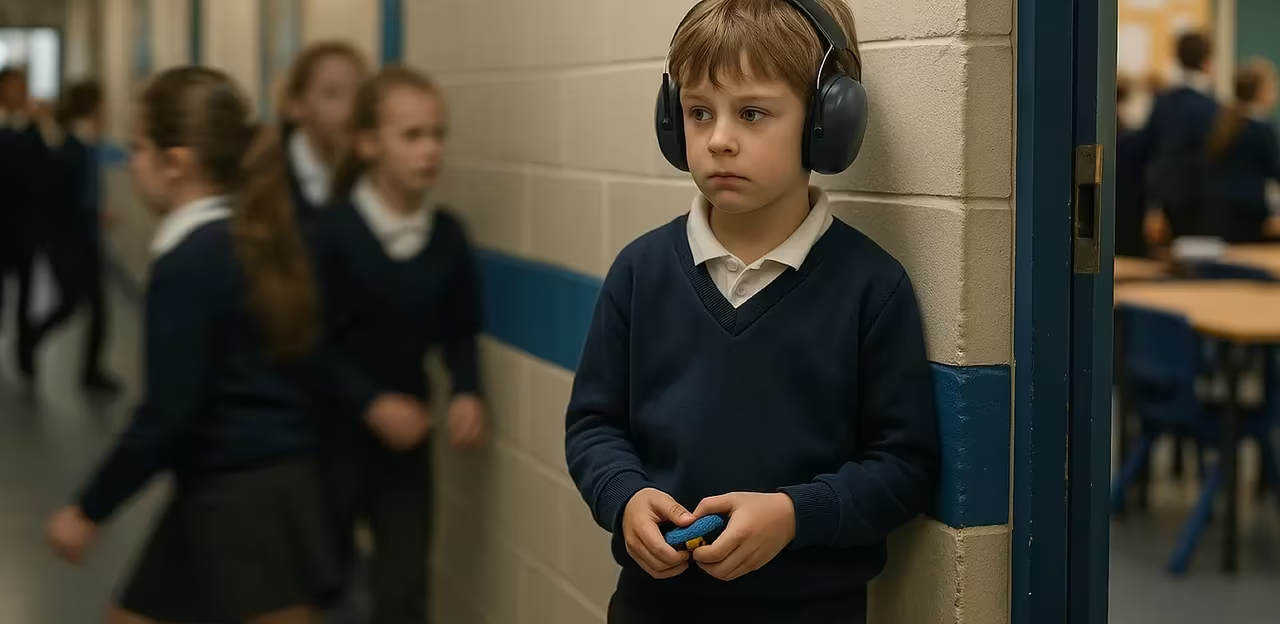
Equal Treatment
6 min read
·
Just now
--
Listen
Share
Before a book is opened or a lesson begins, the corridor noise, the rush of instructions, and the unwritten rules of behaviour have already decided which children have a chance to take part.
“Equal treatment.”
We like to say school is fair: the same classroom, the same teacher, the same lesson, the same funding constraints. We say equality starts once everyone is inside. But for a lot of children, the outcome is already decided before the door even opens.
Access is not a single key.
It is a set of nested locks. And we are the ones who fitted them.
There is the environment a child must walk through, the pace a day demands, the kind of language adults use, the way behaviour is judged. If any one of those locks refuses to turn, equality is a promise made of glass.
The day begins in the crush of drop-off. Engines, chatter, the whistle, a bell. Coats are shrugged, bags are swapped, names are called, the stream moves fast.
For some children, the noise is information; for others it is weather. They start the day already braced against it. Before a register is taken, they are paying a tax the timetable never lists.
Instructions tumble. “Shoes there, bags there, hang it on your peg, don’t forget your reading folder.” The words are simple; the sequence is not. A child who needs time to process sits still long enough to lose the flow, then gets labelled as behind the flow.
Adults are not unkind; they are quick. The day demands it. Access to meaning needs time, and time is the one thing schools never have enough of.
Now the classroom. Light that flickers, a room that hums, a display that shouts. “Find your place, copy the date, get started.” This is the moment we tell ourselves equality kicks in. Same desks, same task. But equal treatment on unequal ground is not equality. If the room itself is a test, some children are already taking two.
Access wears layers.
It is the sensory layer – the buzz of the lights louder than the teacher’s voice, the crush of bodies in the corridor, the scrape of chairs. Staying present is not drifting; it is coping.
It is the cognitive layer – the stream of instructions too quick to catch, too many steps at once, no beat to turn words into action.
It is communication – the answer that comes by gesture, by picture, by silence. Not every answer arrives in a sentence, and not every question needs one.
It is time itself: the transitions, the sudden changes, the day with no safe edges that asks a child to walk a tightrope without a net.
It is social: the silent rules about what “good” looks like. Still body. Quiet mouth. Eyes up. If those are the tickets through the gate, some children will always be left outside.
Even procedure becomes its own barrier. Rules that claim to fit everyone but bend to only a few, punishing difference and calling it fairness.
You can feel the difference when access is honoured. The room gets softer without getting lower. Instructions land one by one. Pictures live where words used to live alone. A child moves, and the movement does not count as misbehaviour, it counts as being able to stay. Nothing dramatic has happened. The door has simply opened further.
On paper a child is included. Their name sits on the roll. There may be a plan with a long title. There may be a one-to-one adult. Yet they spend much of the day at a table in the corner, or in a small room nearby, or walking the corridor with someone kind who is doing their best to keep the day from going sideways.
Inclusion measured by enrolment is not inclusion. In school is not the same as in lesson. Present is not the same as participating.
One-to-one support can be a bridge or a bunker. Done well, it connects a child to the room: it translates pace, buffers noise, makes tasks legible, fades when the child is flying. Done without enough support, it surrounds the child without ever opening the door. The adult becomes a private corridor.
The child is safe, but outside.
We tell ourselves the room is the point, not the route. We point to the policy on the wall. We say the rules must be the same. But the same rules applied to different bodies and nervous systems do not make fairness.
They make friction.
Every “just try harder” is a way of saying “this place won’t bend.” Every “you knew the rules” is a way of saying “we won’t change them.”
Constraints are real. But they cannot be the answer we give a child.
Every teacher I know wants their classroom to work for everyone. Access is what makes that wish real.
If this sounds abstract, listen to the day for a minute.
A child steps through the classroom door and meets a wall of sound they cannot turn down. Another hears the instructions but not in order and is lost by instruction three. Another reads the room’s unwritten rule – stay still, stay quiet, look up – and spends all their energy on the rule, leaving none for the work.
The lesson has not yet begun, but their lesson has. It is called staying.
Access is not a pity corridor. It is not a permanent exile to “the room at the end.” It is not a laminated checklist and a pat on the head. It is not making everything soft. It is not lowering the bar.
It is the work adults do to remove the friction they have the power to remove. It is design, pacing, translation, expectation, and then teaching.
What access is, is posting the day visually so the day has edges.
It is offering ear defenders without ceremony. It is giving instructions one at a time and waiting the extra beat for the response to arrive. It is letting writing happen by keyboard or by mouth or by picture when hands are busy surviving. It is predicting the hot points (assembly, lunch queue, last-minute changes) and making them walkable.
It is deciding that movement can be learning, not just a break from it.
It is telling a child, with the shape of the day itself: we built this room expecting you.
When access fails, a child leaves the room. Sometimes for five minutes, sometimes for five hours. The school still calls it inclusion because the child is enrolled, because support exists somewhere on paper, because a kind adult walked the corridor with them.
But that is not the equality we promised. That is an inclusion/exclusion loop that spins and spins until everyone is tired enough to call it inevitable.
Each time the door does not open, a child learns something unintended. They learn school is a place to endure. They learn that “equal” means “on our terms.” They learn that their own ways of being – flapping, pacing, pausing, looking away to think – are problems to be corrected rather than tools to be used.
And they learn faster than adults notice.
Children always do.
We can keep measuring equality by what happens after the bell, or we can start measuring by what happens before it.
How many children arrive already braced? How many instructions land before a child has time to breathe? How many hands go up because the question was asked in a way that can be answered more than one way? How many children who left the room today left because the room could not hold them yet?
If the answers make us uncomfortable, the room is telling the truth.
The phrase “equal treatment” makes sense only when the room has been opened to the bodies and minds inside it. Until then it is a slogan.
Access is not an extra. It is the condition for everything we say we value: attention, effort, learning, belonging.
Equal treatment does not start when the lesson begins. It starts when the day lets you enter it.
It starts when the door opens, and then it starts again at every door inside.