Will AI replace human coaches or harm smaller nations?
BBC | 05.12.2025 13:17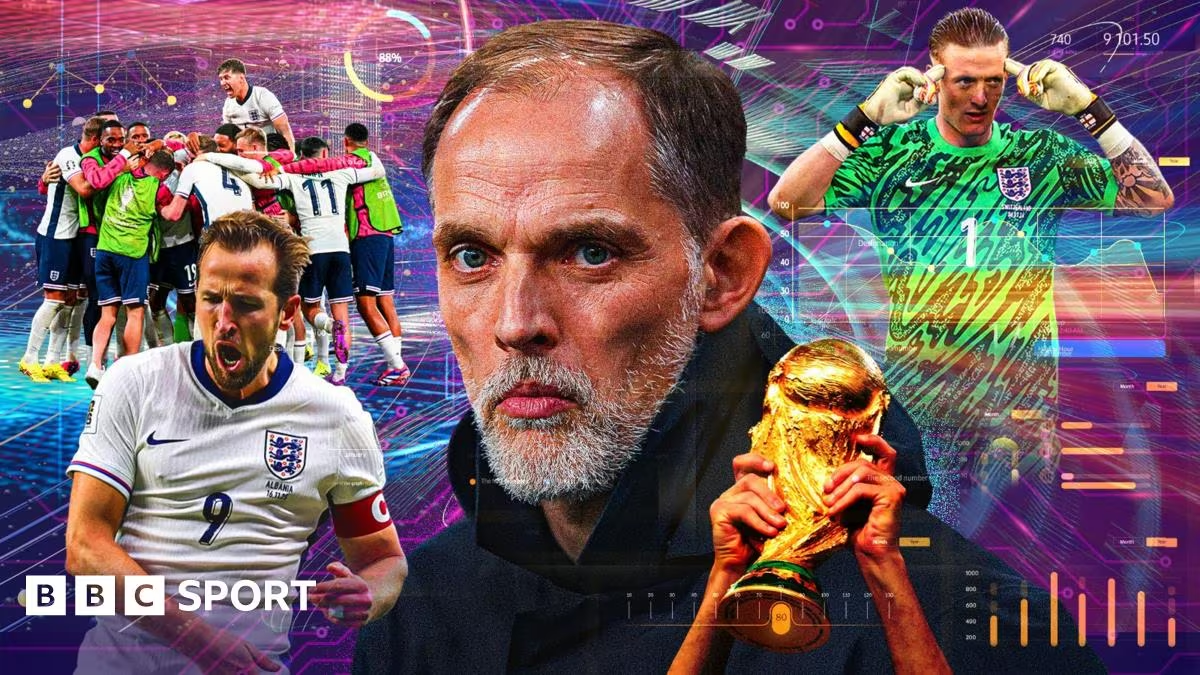
Artificial intelligence is making a big mark in elite football, and England are at the cutting edge when it comes to using it in the men's international game.
From penalty taking and powering players' wellbeing to targeting their rivals' tactical weaknesses, AI is underpinning the Three Lions' plans for next summer's World Cup.
Could a technology which is beginning to change the world around us really help England to glory in North America?
As well as the coaches and physios who sit alongside head coach Thomas Tuchel on the bench, England's staff includes groups of analysts, data scientists and in-house software development teams.
They use different AI tools - some purchased from external tech firms, some built inside the FA - to analyse data, find interesting information, and create presentations which are used in meetings to make complex information understandable for coaches and players.
The idea is that England's players are then able to make better decisions on the pitch, including their approach to penalties.
"AI can show certain tendencies for where opposition players put their penalties that we probably weren't thinking of," explains Rhys Long, who since 2016 has been the FA's head of performance insights and analysis.
"When we get to a World Cup, we have 47 teams' worth of information to profile - where has every player in every squad put every penalty since they were 16?
"It used to take us five days to collect one team's worth of penalty-taking information. Using AI, that can now be brought down to about five hours. Then that becomes a five-minute conversation with our goalkeeper, for five seconds of them hopefully saving a penalty."
In theory, then, the penalty information stuck on goalkeeper Jordan Pickford's water bottle is more accurate and detailed then ever before.
And the results so far are strong.
Since Long arrived, England's penalty record has improved significantly, and analysts' use of AI is also used to reduce the mental pressure for England players choosing where to place penalties.
"The penalty stuff really opened my eyes," explains Conor Coady, a member of the England squads at Euro 2020 and the 2022 World Cup.
"We had a big meeting before the Euros - there was a diagram up on the board of where you're more likely to score, then they would give you individualised information on where they think is best for you to go."
The visuals are based on both opposition goalkeeper tendencies, like if they dive more often to one side, and analysis of how each England player prefers to strike the ball.
"Them telling you where to go took the pressure off, because it was them saying - 'it's on us'," Coady says. "It was something we needed."
Crucial to the success of analysis like that is players' willingness to engage with data and understand the information given to them.
"Players are getting far more attuned to interpreting their own data," Long says.
"The amount of information we're trying to make sense of has exploded. You've got to filter all of that information down to have a good conversation with a coach and then a player.
"It's translation work."
England leading tech charge
In the past few years, AI football software has advanced to the extent that it can now track tens of thousands of on-field movements and events every second, is able to tag tactical patterns during live play so that analysts can immediately find them on video for in-game adjustments and half-time feedback, and can create graphics instantly.
While Spain, France and Argentina have been more successful in the most recent international tournaments - and will be among the favourites next year - it is England, Germany and the USA who are widely believed to be at the forefront of using AI to try to gain an advantage.
"England have a big resource and have heavily invested in this," says Allistair McRobert, professor of performance analysis at Liverpool John Moores University. "They have data engineers, data analysts and performance specialists behind the scenes across all their teams from juniors up to senior.
"We did a piece of work with one of the analysts who works at England about building tactical knowledge.
"When we went from data to the big Subbuteo-style table to demonstrate it, the players got really involved with the tactical aspects - because they knew of assets that their goalkeeper had - and it changed the way they played against the opposition."
AI is not just harnessed by England for on-field matters - they also use it to monitor players' wellbeing.
"What AI is doing is surfacing things up - it can look at what is having an effect physically, tactically or technically on a player," Long says. "It might spot something in wellness data that we collect from the players that is then having some kind of impact on their training.
"It's then for a doctor, physio, coach, or specialist analyst to have a conversation with the player and make sure we're getting the best out of them.
"To try and do all of that really quickly used to take days. It's now taking hours. It might take minutes in the future."
Coady explains the process: "You wake up every morning and as you're going down to breakfast there is a wellness area where you fill out a form on an iPad.
"'How did you sleep? How did you feel this morning? Are you fatigued?' And then you leave comments on it - maybe 'my hamstrings are sore from training yesterday'. And then the staff cater for you during the day, in terms of what you need in training, your food, how they set up a session.
"The detail that goes into you individually, but more importantly the team, is out of this world."
New AI tech firms are being created every day, and one piece of software can cost national federations hundreds of thousands of pounds.
"It's not about going after every shiny new AI toy and using them for the sake of it," Long says. "What you've got to do is ask if it is really going to help performance."
Because of the costs involved, there is a risk some of the less wealthy nations are left behind.
"I think AI will widen the gap," says Tom Goodall, who works in analysis for Iceland. "England, for example, have basically unlimited resources, money, and staff. We are the polar opposite of that.
"I'm the only full-time analyst here and money is tight. It's very difficult for us to take a gamble on an expensive piece of technology."
There are also widespread concerns about AI's impact on jobs in the future.
"What we've got to remember is it's not a silver bullet," Long says. "AI will make everything far more efficient, but it's about having people in sport who can really understand how to use this new technology very well.
"We're not going to replace humans - it's about augmenting their decision making. AI won't be picking the team and it won't be playing the game.
"But if you can get your coaches to use it effectively, and in turn it helps our players, then that is a good competitive advantage which will hopefully help us get over the line."