Julianne Moore Never Stops Upping the Stakes
Elle Magazine | 10.11.2026 15:00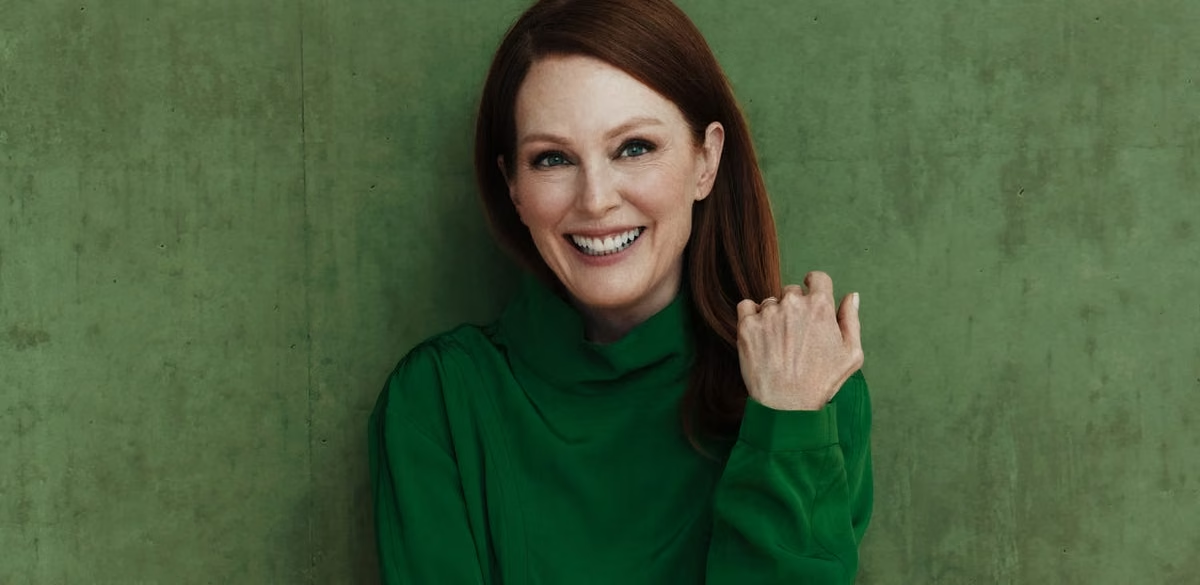
8 min read
Julianne Moore wants me to imagine I’m running late. “You feel like your heart’s going to come out of your chest. Everything’s going wrong. And if you step back, you go, ‘The world’s not going to end if I get there 15 minutes late,’” she says. “Your body doesn’t know that, and your head doesn’t know that. You somehow are like, ‘This seems to be the most urgent thing in the world.’”
There might be no better summation of the way the actress brings unprecedented intensity to even the most quotidian moments onscreen. “I’m really interested in those emotional stakes,” says Moore, who arrives at our interview fresh off the subway with a cheery “Hi, I’m Julie.” Her bright red hair is hidden under a baseball cap, and she sports the downtown New York uniform of a simple black top and track pants.
It’s hard to square this soft-spoken, thoughtful woman, who seems to edit herself in conversation the way a filmmaker edits in camera, with the emotionally labile roles she’s known for playing. Watching her act is like seeing the shell of a building under construction, the interior beams exposed to the elements.
Norman Jean Roy
Coat, shirt, pants, Ralph Lauren Collection.
In her new film The Debut, it feels, at times, like she’s playing a Julianne Moore character dropped into the story. (There’s a reason it feels like that: Writer-director Jesse Eisenberg penned the part specifically for her.) When Moore first read the script, she was sitting at her dining room table, her preferred reading spot, and, she tells me, she had to stand up. “I started taking deep breaths, because I was like, ‘Oh my God, I cannot believe how good this is.’”
Her character, Mona, is a meek New Jersey wife and mother who is cast in a community theater musical, her first-ever stage role. As she comes into her own, squaring off with its dictatorial director, played by Paul Giamatti, the stakes become skyscraper-high. The absurdist comedy comes from the way Mona takes the “No small actors” dictum to heart, disappearing into her minor part as an apartment superintendent in ways that confound our understanding of what a performance can be. It feels like a meta-commentary not just on acting, but on Moore’s entire career, from her pharmacy meltdown in Magnolia to her unsettling, childlike turn in May December. Even when they go to extremes, her characters feel rooted in very real and human impulses.
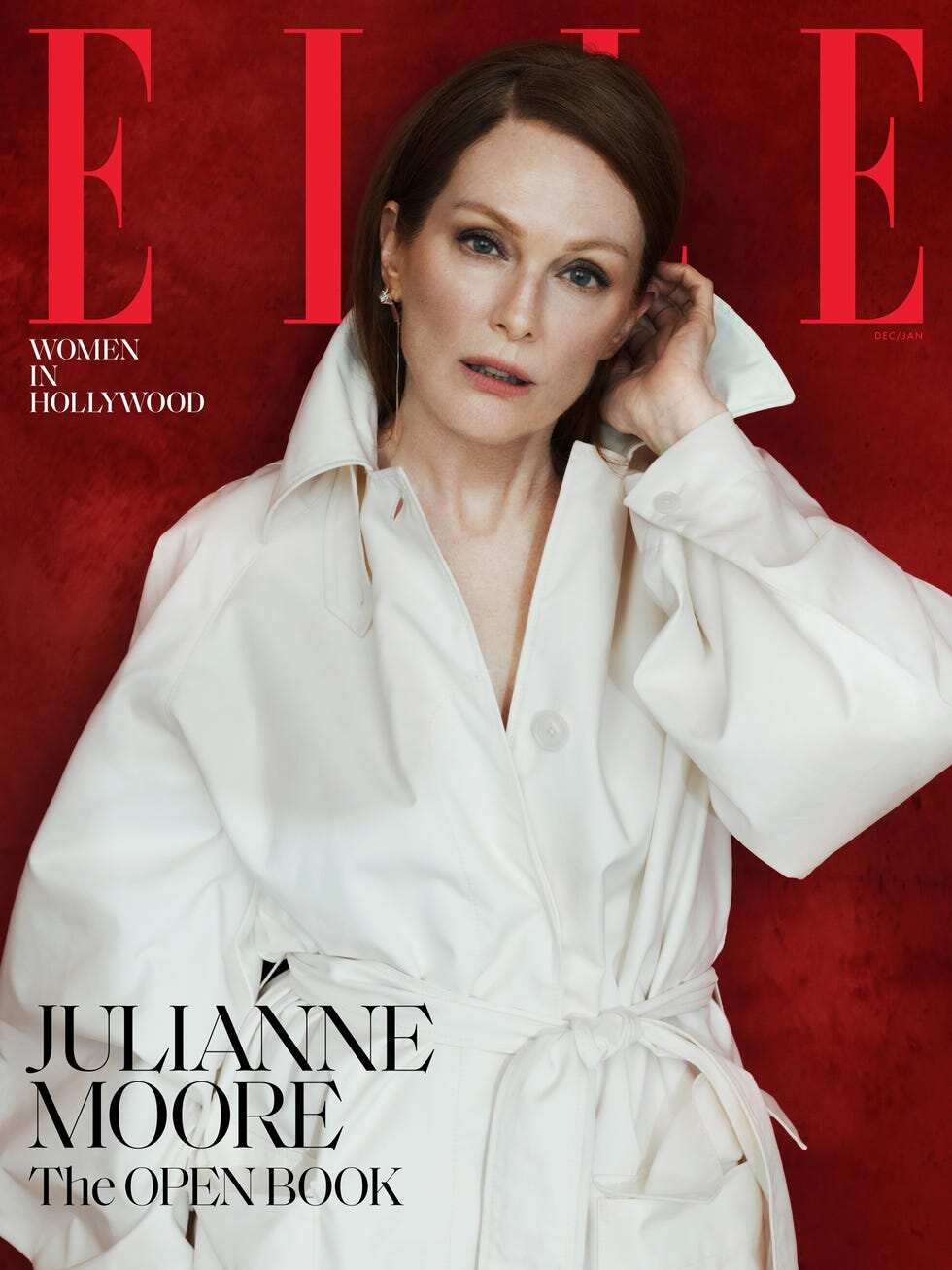
Norman Jean Roy
Coat, Ralph Lauren Collection.
To hear Moore tell it, her career has been less about pursuing a singular passion than following her own interests as they arise. And indeed, one of the first things you notice about Moore is how interested she is. She wants to know everything about me (not a common experience for an interviewer). She tunes in to the frequency of the guy in the booth behind us, loudly wheeling and dealing on the phone. She’s fascinated by human relationships, she says. “All of that stuff seems, to me, really urgent and interesting.”
Beauty Tip: For brighter and smoother undereyes, try Neuraé Harmonie The Eye Contour, which contains hyaluronic acid, caffeine, and watercress extract.
She also has a penchant for playing women, whether from the past or the present day, who find themselves trapped by circumstances. “I’m moved by people and the choices that they make, how they live and who they love and how we’re affected by the society that we live in,” she says. “Particularly for women: What world are you living in? What choices are offered to you? As someone who was born in the 20th century and saw what was offered to the women around me, what changed and what didn’t—I saw what opportunities were afforded to my great-grandmothers, my grandmother, my mother, and then me. My mother was someone whose parents didn’t send her to college, because they didn’t send girls to college. They sent her brother to college. So she went later, after she had kids.”
Moore is following up The Debut with an array of varied roles, including portraying The Joy of Sex author Alex Comfort’s girlfriend in an adaptation of the book, and playing a small part in her friend Tom Ford’s Cry to Heaven. She’s also gearing up to return to the stage for the first time in 20 years, starring in Sarah Ruhl’s Faydra at the Manhattan Theatre Club in February. Why theater; why now? “I think [it goes] back to what I was saying about following your interests,” she says. “That’s all you can do.”
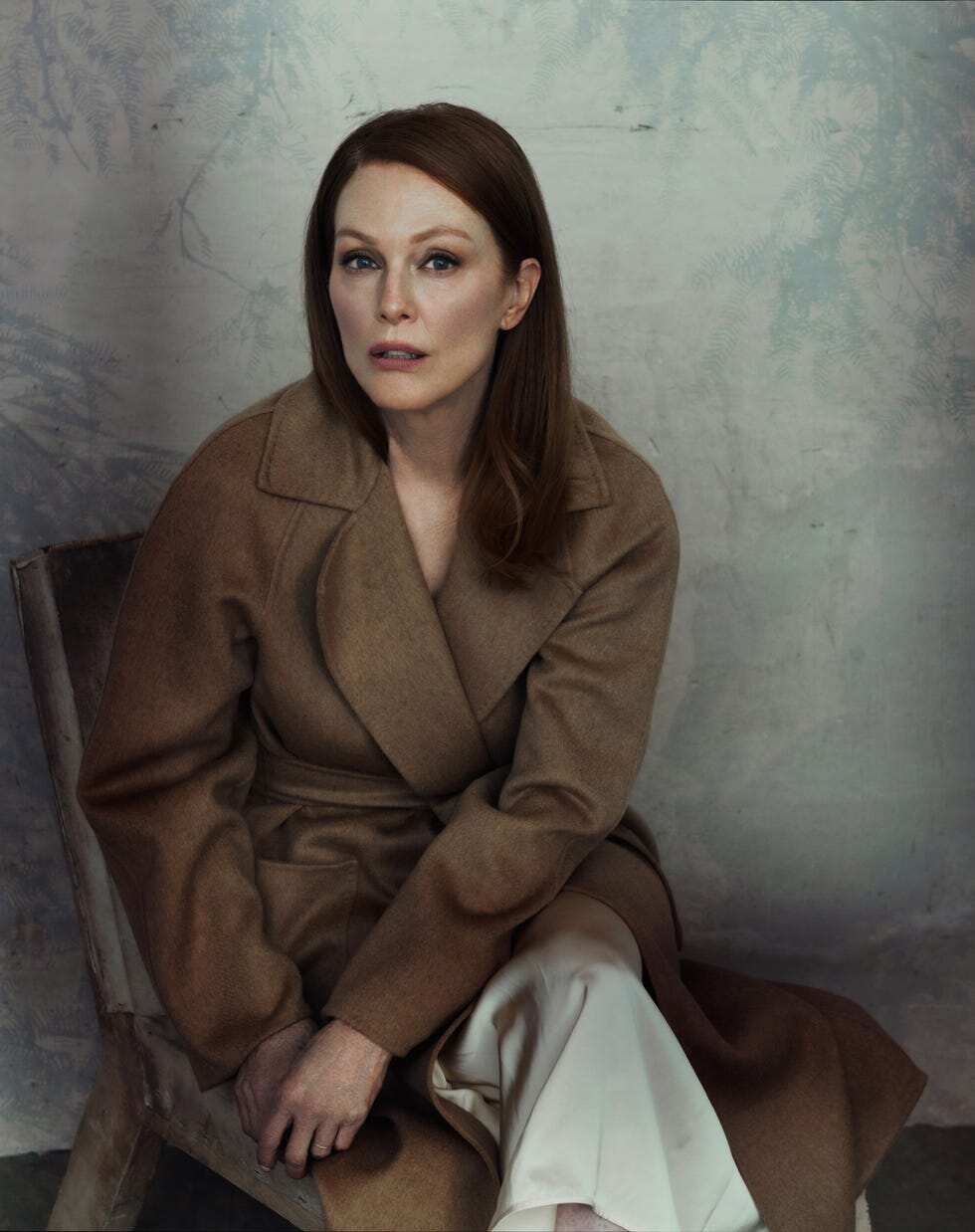
Norman Jean Roy
Coat, Max Mara.
On a role that changed everything
It was three films that all came out at once. Robert Altman had seen me in Vanya on 42nd Street. He cast me in Short Cuts. Then Vanya, which we’d been doing for five years as a theater production, became a movie. And Todd Haynes put me in Safe. They all came out around the same time in the early ’90s, and suddenly I had a profile.
On being part of the first wave of independent film in the ’90s
The ’90s were amazing. They were as great as everybody says. We didn’t know it. That was when my whole career changed, with independent film. Suddenly there were all these new voices, because it was the advent of video stores. You could make a movie on a really low budget, and all you had to do was make your budget back in VHS. You could make a movie for a million dollars, and if you made that money back and a little bit more, you’d be like, “Great, we can make the next one.” I think Vanya was $900,000. Safe was a million dollars. Suddenly we had opportunities. You had all of these new voices making these movies, and they could cast who they wanted to, and they [covered] subjects that maybe studios wouldn’t have. Nobody was going to make Safe.
That was very much Todd’s voice. Everything was very scrappy. You didn’t make any money as an actor. You shot it very quickly. The funny thing was, back then we would shoot it in 35 days. Now you have 23. So we felt 35 was short, but then later we got to 23. But it was fun, because you were like, “Okay, we can put this together. We can get a budget. We can shoot it.”
On mastering Mona’s singing voice for The Debut
The unsteadiness was easy for me, because I’m not a natural singer. I haven’t been trained. So that was easy and kind of fun in a way—because it’s not like she can’t carry a tune; she sang in church—but she doesn’t have any power, and she has no emotion behind it. I worked with a wonderful vocal coach and with all of our [supporting cast]; they’re all from musical theater. But the day that I had to sing that song [Mona’s big solo moment] live in the room was very early on in our shoot. A lot of people were there—they were in the other room around the monitor, and all of those people I’m singing to are real [Broadway] singers. There was a lot of support for me, and I think a lot of concern. I was scared.
On working with Eisenberg
[Mona’s pivotal scene] is, like, eight pages. It’s a lot. And he said, “Listen, I don’t want you to worry about memorizing it. On the day, we’ll have a teleprompter. You don’t have to worry about it. Because I know if it were me, all I would be thinking about is remembering those lines,” and I was like, “Phew, what a relief.” But of course, because he said that, by the time we shot it, I had memorized it. He took the burden away from me emotionally and allowed me to be able to learn it.
Norman Jean Roy
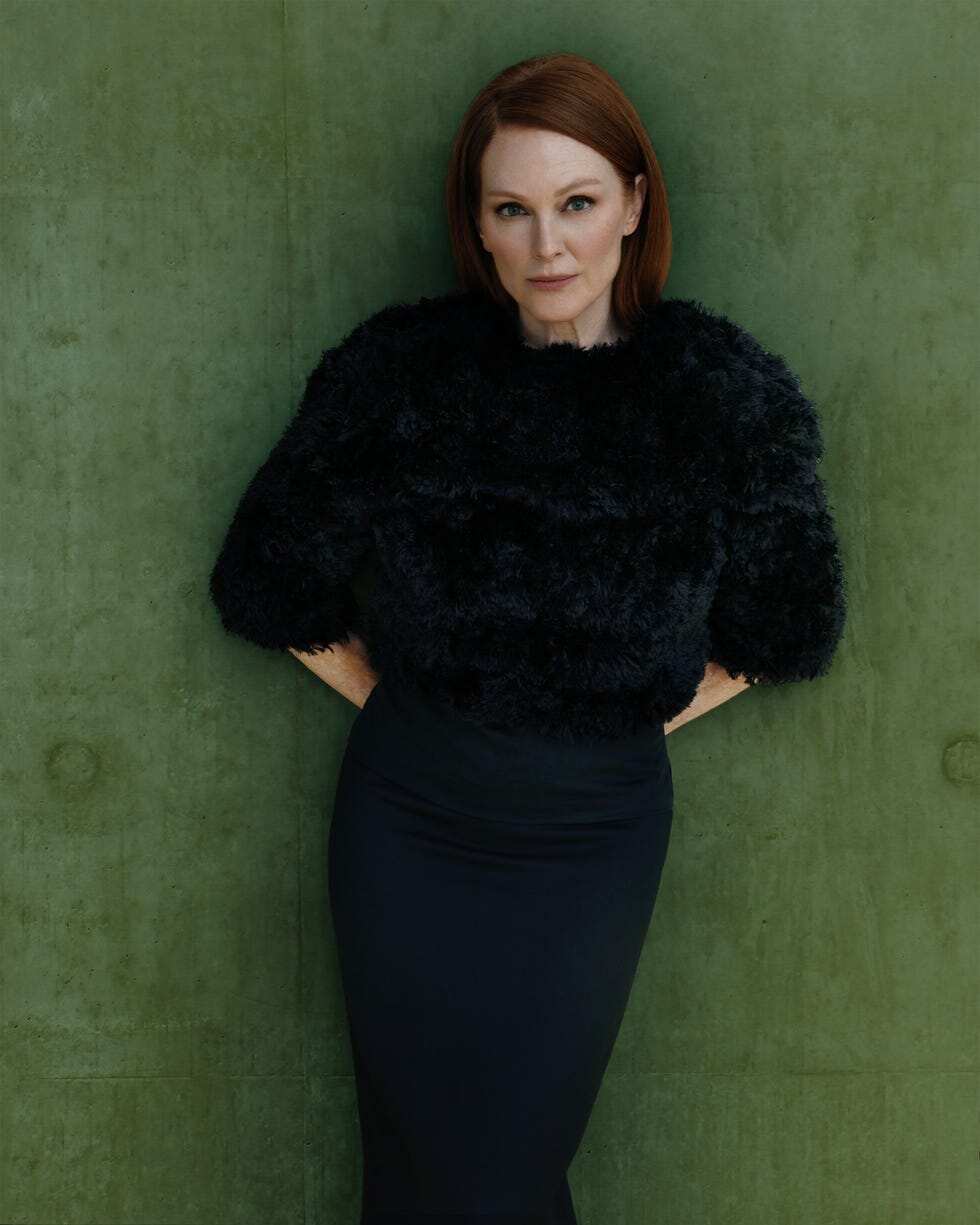
Top, skirt, Calvin Klein.
On the awards buzz for her performance
You cannot think about it. That’s a narrative unto itself. And I think that obviously the people who are releasing these movies like to have these movies in conversation, because it means more attention comes to the movies themselves, and more people buy tickets and go. So the ultimate goal is for people to see these movies. That’s really what it comes down to. And so of course we feel gratified when people are talking about it that way, because you go, “Oh my God, people really like it and people might really see it.”
On aging
When they say “aging gracefully,” I’m like, “What is that supposed to be? We don’t have a choice. We age one way or another. It is a fact. And it’s an uncomfortable fact, because it leads to death.” So that’s where everything gets conflated, because people talk so much about looks, and really at the bottom of all of that stuff is that we all enjoy being alive and we want to function as well as possible and we don’t want to die. So it’s like, “We can talk about that, about what it means to live,” but then cosmetic stuff, you’re just like, “Ah, that’s a whole other deal.”
There’s not a right way or a wrong way to age. So given that we have a limited time on earth, let’s not put that pressure on ourselves that we’re doing it wrong. I read that Helen Mirren said something like, “There’s this idea that somehow the things that happen to you when you’re older will feel less interesting to you because you’re old.” And she was like, “They don’t. They feel just as interesting.” And I think as a young person, you don’t always know that, because we’re always so focused on ourselves, we just assume that when we’re older, nothing will matter. But it does.
On the character she’d most like to have lunch with
Well, put it this way, they’re always with me. I think the worst thing and the best thing about being an actor is that as distant as these people seem from you, you’re able to conjure them from yourself. So oddly, even the most reprehensible are in you. You’ve been able to manufacture even sometimes the worst of them, but yes, they’re always having lunch with you, in a sense.
Lead Image: Top, skirt, Bottega Veneta.
Hair by Orlando Pita at Orlo Salon; makeup by Hung Vanngo for Hung Vanngo Beauty; manicure by Elle Gerstein at A-Frame Agency; set design by Peter Klein; produced by Alexey Galetskiy at AGPNYC.
A version of this story appears in the December 2026/January 2027 issue of ELLE.
This story is part of ELLE’s 2026/2027 Women in Hollywood portfolio. Click the link below for all the cover stories.