Iran in Revolt: A Nation’s Present Confronting its Past, and Defining its Future
Medium | 15.01.2026 21:11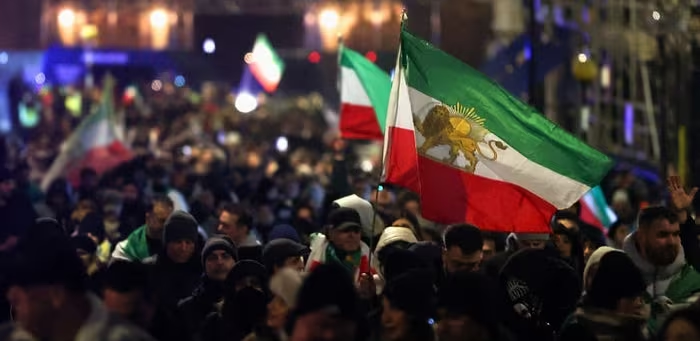
Iran in Revolt: A Nation’s Present Confronting its Past, and Defining its Future
Follow
4 min read
·
1 hour ago
Listen
Share
Iran is not “unrest-prone.” It is not “going through another cycle.” What is happening now is neither episodic nor accidental. It is the delayed collision between a population and a state that has never possessed legitimate authority — only endurance.
The protests spreading across Iran today are often framed as reactions to inflation, sanctions, or economic mismanagement. These factors matter, but they are not explanatory on their own. Iran’s crisis is not primarily economic. It is political, structural, and historical. It is the result of a state born not out of popular sovereignty, but out of an ideological seizure of power that has spent decades mistaking control for consent.
To understand Iran’s present, one must abandon the comforting myth of 1979 as a “revolution.” What occurred was not a pluralistic uprising that culminated in collective self-rule, but an Islamic coup that hijacked a moment of genuine popular revolt. Diverse political forces — secularists, leftists, nationalists, liberals — were instrumental in dismantling the monarchy. Once that objective was achieved, clerical power consolidated rapidly and violently, eliminating rivals and installing a theocratic system immune to accountability.
This distinction matters. Revolutions create legitimacy through participation; coups manufacture authority through force and ideology. The Islamic Republic belongs to the latter category. Its institutions were designed not to reflect society, but to discipline it. From the Guardian Council to the Supreme Leader’s unchecked power, the system was engineered to ensure permanence, not representation.
For decades, this architecture appeared stable. Repression worked. Ideology substituted for performance. External confrontation was used to suppress internal dissent. But stability built on coercion ages poorly. It accumulates contradictions, resentment, and institutional decay. Eventually, society stops negotiating with the system and begins to reject it outright.
That is where Iran is now.
The current protests are not reformist in nature. They do not seek accommodation within the existing order. Their language — spoken and unspoken — is post-legitimacy. What is being contested is not a policy failure, but the right of the state to define morality, identity, and power. This is why repression has intensified: because the challenge is existential.
What makes this moment particularly dangerous for the regime is the convergence of social groups. Students alone can be crushed. Workers alone can be co-opted. Women alone can be policed. But when grievances align across class, gender, and generation, repression loses efficiency. The system’s usual tools — fear, fragmentation, exhaustion — become blunt.
Equally destabilizing is the collapse of belief. The Islamic Republic was never sustained solely by force; it relied on a shrinking but real constituency that accepted its ideological claims. That constituency is eroding. When slogans no longer persuade and rituals no longer bind, power is reduced to surveillance and violence. That is not governance. It is occupation.
The reappearance of Shah-era symbolism and figures like Reza Pahlavi must be understood in this context. This is not a coherent monarchist project. It is a political signal. When a society invokes its former rulers, it is not endorsing their return — it is indicting the present. Nostalgia here is not about monarchy; it is about normalcy, predictability, and a state that does not wage war on its own citizens’ private lives.
This symbolic turn exposes the regime’s greatest failure: it has so thoroughly delegitimized itself that even deeply flawed alternatives appear attractive by comparison. That is not a sign of monarchist strength — it is evidence of systemic exhaustion.
Get Anhal Kozhaya’s stories in your inbox
Join Medium for free to get updates from this writer.
Subscribe
Subscribe
Yet Iran’s crisis is not only internal. It is also revealing something deeply uncomfortable about global political discourse.
Selective Morality and the Cowardice of “Complexity”
Iran’s uprising has been met with an eerie quiet from many who habitually frame themselves as moral actors. This silence is not rooted in lack of information. It is rooted in ideological inconvenience.
Much contemporary activism operates on a rigid moral geometry: power is assumed to be Western, resistance is assumed to be virtuous, and oppression is acknowledged only when it aligns with this worldview. Iran explodes that geometry. Here is an anti-Western regime exercising brutal control over its own population — and suddenly the moral vocabulary collapses.
Instead of solidarity, we are offered “nuance.” Instead of outrage, we are given silence dressed up as sophistication. Complexity becomes an escape hatch, not an analytical tool. Iranian lives are treated as an intellectual inconvenience rather than a political emergency.
This is not confusion. It is avoidance.
Supporting Iranians would require admitting that authoritarianism does not become progressive simply because it opposes the West, and that oppression is not redeemed by ideological branding. For many, that admission carries social and political costs. Silence, therefore, becomes the safer option.
But silence is not neutral. It is a choice. And it reveals that much of what passes for activism today is not grounded in principle, but in alignment. It is less concerned with power itself than with who wields it.
Iran exposes this failure brutally.
What lies ahead is uncertain. The Islamic Republic may survive in form, but survival is not the same as legitimacy. A state can persist long after it has lost the right to govern. If power shifts in Iran — whether gradually or through rupture — the consequences will reverberate across the region, forcing a recalibration of assumptions about authority, stability, and control.
But the deeper question is not geopolitical. It is moral and political.
Iran forces us to ask whether we believe that people have the right to challenge power regardless of who holds it, or only when it flatters our narratives. It asks whether legitimacy comes from slogans or from consent. And it exposes the cost of pretending that ideology can substitute for justice.
What is unfolding in Iran is not chaos. It is clarity. And clarity, for systems built on myth, is the most dangerous force of all.