A Tale of Two Streets: One Side Feasts, The Other Starves
Medium | 11.12.2025 06:16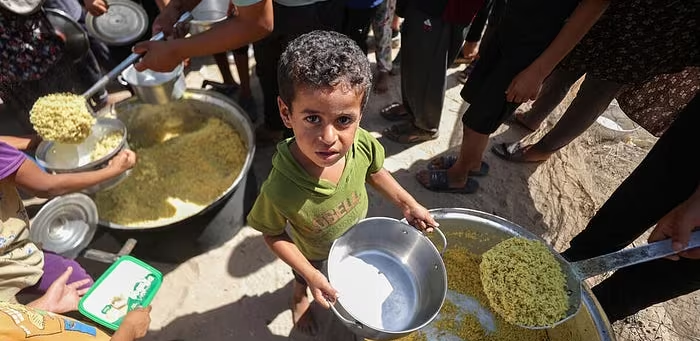
A Tale of Two Streets: One Side Feasts, The Other Starves
5 min read
·
Just now
--
One brims with food, the other echoes with emptiness
On one edge of the city, streets gleam with the glow of plenty. Markets overflow with fruits polished to perfection, bread stacked like miniature fortresses, and vegetables that glisten under the early morning sun as though they were jewels. The smell of roasted coffee and fresh spices floats through narrow alleys, teasing the senses of every passerby. Vendors shout over one another, their voices merging into a symphony of commerce, a song of abundance. Children tug at their parents’ hands, eyes wide with fascination and delight at the cornucopia around them. The city here is alive, bursting with color, sound, and motion, yet underneath the surface, a subtle truth lingers.. a truth most ignore. Amidst this abundance, no one truly hungers. There is nourishment, yes, but not for the soul. The people here are full of things to eat, but starved of purpose, of quiet reflection, of the kind of presence that reminds you that life is more than consumption. Their laughter, often loud, carries a hollow note, as if echoing from rooms left empty. They have the means to fill their stomachs but not the need to fill their hearts.
Walk a few miles, take the rickety bridge over the canal that smells faintly of decay, and you enter a different world. Here, the streets are quiet, too quiet. Homes crouch under the weight of neglect. The air carries the scent of dust, damp, and desperation. Children’s laughter is scarce, replaced by cries that dissolve into the walls. The market stalls that do exist are half-empty, boards warped by weather, goods meager and expensive. Hunger is a constant companion, gnawing at bones and hearts alike. Women stand in line with trembling hands, counting coins that barely cover the price of a single loaf of bread. Men wander aimlessly, shoulders heavy with shame, looking for work that doesn’t exist, hoping for a kindness that rarely comes. Hunger here is not just physical; it is a constant reminder of absence, of longing, of the city’s failure to provide not only food but dignity.
The contrast between these two edges of the city is not simply economic; it is spiritual, existential. On one side, the abundance mocks the emptiness that lives in full stomachs. On the other, the scarcity humbles, yet it carries with it a purity, a rawness, a clarity of human need. Those who have everything often forget the value of small blessings. Those who have nothing feel every blessing more acutely, every morsel a lifeline, every drop of water sacred. And in the quiet moments, when the night settles over both edges, the city holds its breath, and one can almost hear the unspoken question that binds both worlds: How did we come to this, where some drown in plenty while others starve in the shadow of plenty?
I walked these streets for hours, watching the subtle interplay between despair and complacency, between abundance and lack. I saw a mother in the wealthy district tap her smartphone impatiently while her child, eyes glazed, ignored the tower of pastries in front of them. I saw a boy in the impoverished quarter clutch a torn bag of rice like it was a treasure, every bite measured, every crumb sacred. The weight of inequality pressed upon the chest like a relentless tide. I felt it in the air, in the smell of bread and dust, in the silence between the shouts and cries. And I understood that this was not a city of merely rich and poor, but a city divided by attention and neglect, by empathy and its absence, by the willingness to notice and the decision to look away.
In moments of reflection, the edges blur. I imagined the hands that harvested the fruits, baked the bread, carried the water across distances, and I thought of the hands that trembled from hunger, that reached out for the same sustenance but found only air and indifference. The city’s arteries pulse with life and death simultaneously, a rhythm that is both brutal and hypnotic. The silence of the hungry speaks louder than the music of the markets. And I, a lone observer, felt a strange kinship with both edges. I understood that the presence of abundance does not guarantee happiness, nor does scarcity alone define suffering. It is the relationship between being and having, between noticing and ignoring, between offering and withholding, that shapes the human experience.
There is a Sufi whisper that threads through these streets if one chooses to listen. The outer hunger mirrors the inner void. Those who are full in body but empty in spirit, and those who are empty in body yet rich in the simple awareness of life’s fragility, are both seekers of sustenance beyond the material. The city becomes a mirror of the soul, its contrasts reflecting the subtle inequalities within our hearts. Compassion is scarce on both sides….
on the wealthy side, it is diluted by comfort and distraction; on the poor side, it is buried beneath the struggle to survive. Yet the quiet moments, the small acts of kindness, a shared loaf, a guiding hand, a word of reassurance remind one that even in a city divided by hunger and plenty, the possibility of connection endures.
By evening, I sat on the curb of the poor district, the sun sinking low and painting the walls orange and gray, thinking of how easily the edges of this city could be rewritten. One small act, one community aware, one bridge built over the silence, and the patterns could shift. I thought of a world where no child measures life in crumbs, where abundance is paired with awareness, where hunger is not merely physical but an opportunity for empathy, for understanding, for awakening to the deeper truths of our shared humanity. Hunger and plenty are not enemies; they are teachers, each demanding attention, reflection, and action. And perhaps the city, in its vast, contradictory existence, is reminding us that the greatest nourishment lies not in food or coin, but in presence, in noticing, in responding.
As night fell, the city exhaled. From one edge, the smell of roasted coffee faded into the darkness. From the other, the faint cry of a hungry child lingered in the empty streets. I closed my eyes, feeling the pulse of both worlds, understanding that the lesson was not in choosing sides, but in recognizing the entirety, the fullness and emptiness, the noise and silence, the plenty and the hunger. And in that understanding, perhaps, there is a kind of quiet transcendence, a reminder that the human heart is vast enough to contain both edges, that the soul can find peace in the acknowledgment of disparity, and that empathy, like water, nourishes even the driest land.
Reading this, I hope you pause. I hope your breath catches. I hope your eyes water, your heart stirs, and a small, quiet compassion arises, a willingness to notice, a desire to act, a moment of reflection that ripples beyond this page. For in the city of surplus and hunger, we are all citizens, and our humanity is measured not by what we have, but by what we see, acknowledge, and respond to.