5- Human Rights as a Weapon: Selective Morality in Action
Medium | 25.01.2026 20:14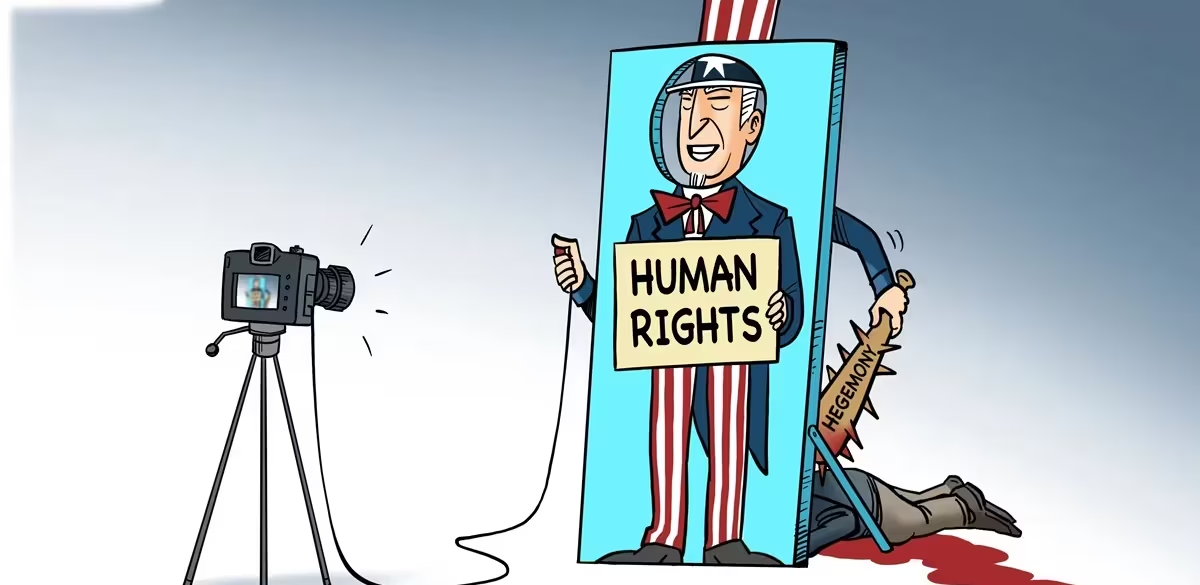
5- Human Rights as a Weapon: Selective Morality in Action
Few ideas carry as much moral weight in Western discourse as human rights. They are presented as universal, sacred, the very foundation of modern civilization. Yet when I look closer, I see that human rights are not always principles they are instruments. They are invoked when convenient, ignored when costly, and weaponized when strategic.
Iraq revealed this clearly. The invasion was justified as liberation, a defence of human rights against tyranny. But the bombs that fell destroyed homes, schools, and hospitals. Abu Ghraib exposed torture and humiliation, drone strikes killed civilians, and the promise of freedom gave way to endless suffering. Human rights were not guiding principles they were slogans, used to justify war while hiding its brutality.
Palestine tells another story. Every day, people live under occupation, displacement, and violence. Yet Western governments, so quick to lecture others, turn blind when the victims are Palestinians. The principle of human rights collapses into silence, because behind the scenes lies a benefit: alliances, influence, and strategic footholds.
The same blindness appears in Syria, Libya, and Sudan. Horrors unfold daily civilians murdered, societies torn apart yet Western concern rises only when oil, migration, or terrorism touch their interests. Otherwise, silence. Human rights are remembered when useful, forgotten when inconvenient.
And yet, when protests erupt in Iran, China, or Russia, Western leaders rush to defend them. Statements are issued, solidarity is declared, human rights are celebrated. The principle is invoked loudly, because it suits Western strategy to highlight repression abroad.
But when protest rises in Western streets, the mask slips. In France, the Yellow Jackets demanded fairness, only to be met with tear gas, batons, and mass arrests. In the United Kingdom, climate activists and economic protestors faced surveillance, restrictions, and police crackdowns. In the United States, the Black Lives Matter movement exposed deep fractures, yet the response was militarized policing, curfews, and violence against demonstrators. Later, when activists protested ICE after the killing of a Minnesotan woman and the tearing apart of immigrant families, they too were met with force. The same country that lectures others about freedom of assembly showed how fragile that freedom becomes when it challenges its own power.
From my perspective, this hypocrisy feels like watching a play with two scripts. Abroad, human rights are defended when they weaken rivals. At home, they are forgotten when they threaten authority. The illusion is powerful because it is wrapped in noble words, but the reality is selective morality.
In the end, human rights in Western politics are less about humanity and more about dominance. They are invoked to justify interventions, to punish enemies, to protect allies, and to reassure citizens that their governments act with virtue. But when stripped of this selective morality, the illusion collapses. To unmask it is to insist that human rights must be universal not conditional, not strategic, not a weapon wielded by the powerful, but a principle that applies equally to all.