Gains and a weak point: Sami Al-Jaber reads between the lines of the Korea and Uzbekistan tests
Goal | 18.11.2026 11:30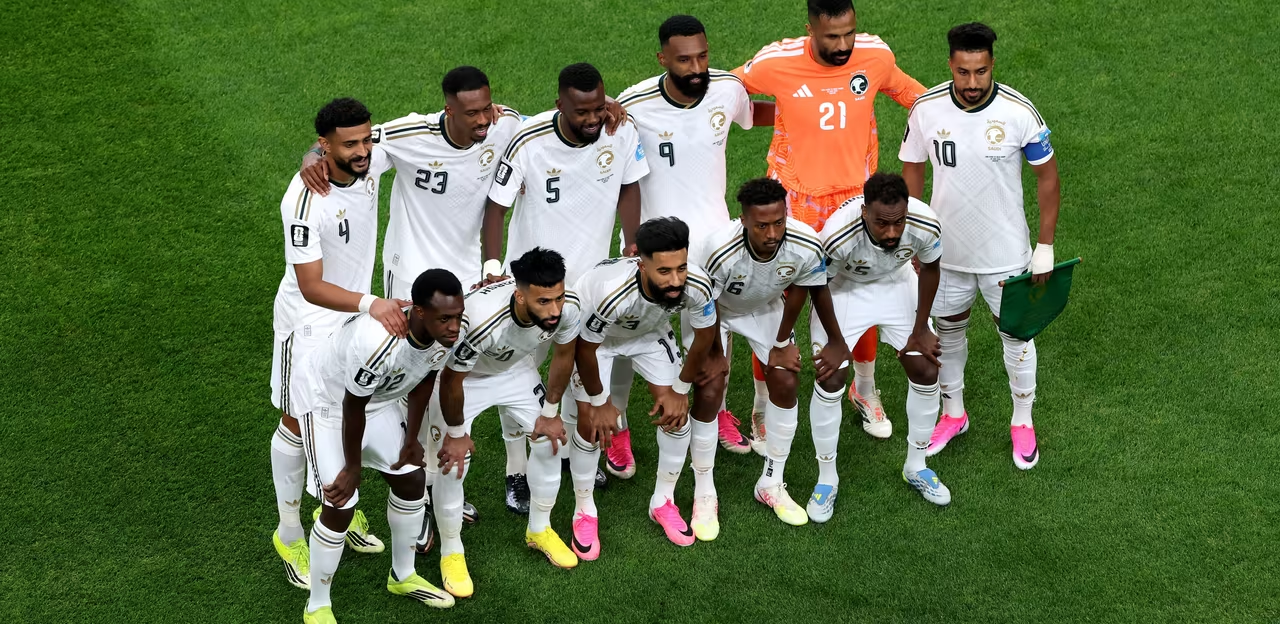
The friendlies against South Korea and Uzbekistan showed signs of the progress the Saudi national team is striving for ahead of their upcoming commitments, but they also exposed technical details that need to be addressed. While Saudi Arabia came away with gains in terms of cohesion and a wider pool of options, former Saudi Arabia star Sami Al-Jaber highlighted a problem that recurred in both matches, warning against it persisting in the games ahead.
Analysing both games on MBC's Nadina programme, Al-Jaber said: "Both tests were very good in my view, regardless of the results. The team's general state is a continuation of what it was at the Gulf Cup, except that the opponents and rivals have changed. The Korea match was really excellent, with fewer mistakes, and perhaps our only criticism was of the receiving and passing and some minor individual errors."
He added: "Today the individual errors were repeated, whether in the defensive area or even from the goalkeeper, even though there was not much time between the two matches. Nevertheless, I see that the Saudi team were not bad at all. On the contrary, they were good to very good in some spells of the match, and the better side in other spells."
Then he turned to the numbers: "When you talk about shots, it was nine against eight, and dangerous chances were three against two. The Uzbekistan team are also very well organised and managed to play on the Saudi team's capabilities, but the individual errors that were repeated from the Korea match to the Uzbekistan match must be addressed, because in a friendly they are acceptable, but repeating them in more than one match is a question mark."
Al-Jaber also highlighted how Donis changed his approach between the two games: "The approach Donis used against South Korea was completely different from this match, and this match was roughly similar to the UAE game, as he relied on high pressing. Today the team could not apply high pressing because Uzbekistan were very strong at playing the ball out cleanly, and that is not surprising because Uzbek football is very advanced."
Read also: Not just slips: 3 gaps threatening the Saudi national team
Uzbekistan weren't at full strength either, he noted: "Today some high-level players did not play for them, and there are one or two big names, whether in defence or in another position. But when you talk about the performance, Donis and Saudi Arabia, there are many positives the team gained from the two matches, the most important of which is cohesion."
On rotation and spreading minutes across the squad, he said: "It is difficult to play two matches with the same line-up, and today the rotation that took place, even in the second half, saw several stars come on. I believe that had the match continued 11 against 11, the Saudi team would have been able to offer more. Notice a very important moment: the team got two chances in roughly the last ten minutes, and I think bringing on Mohamed Kanno was very positive. He played superbly and created two chances."
Read also: "What's stopping you, Don?": Al-Hilal provocation puts Ronaldo in front of Al-Nassr's biggest challenges
He went on: "Honestly, the two tests were excellent, and this is what we want: to have a larger number of players and names the coach can use. In his technical work during the two friendlies, Donis always needs time, and that is number one. He also needs very strong competition, and that is available in the Saudi league."
Al-Jaber finished by pointing to a shift in the Saudi player's mentality: "Today I saw in the two matches that we have players with great ability, and this is very positive. Even the mentality of the Saudi player has changed since the Gulf Cup, because the tournament sent a big signal to a number of players: why shouldn't I be in the national team? If there are 16 foreign players playing on the pitch, then the rest are just Saudis, and that means they are the elite. Today Donis and his technical and administrative staff, together with the planning that took place, managed to deliver fine results for us at the Gulf Cup, and also this first tournament and the friendly ahead of the Asian Cup. I believe the postponement of the Asian Cup works in the favour of Donis and the Saudi team."
Read also: Arsenal duo the victims: Real Madrid set the price for parting with Vinicius
journalism and writing are a passion before they are a profession. Since taking my first steps down this path in late 2010, I have been weaving my stories across the pages of Egyptian and Arab websites. I don’t view sports in general—and soccer in particular—as merely a game, but rather as a canvas of life that reflects the pulse of societies and carries within it social and cultural stories that intertwine with the threads of politics to shape people’s consciousness.
I delve into covering and analyzing soccer from multiple angles: I cover the game from multiple angles where storytelling meets analysis, and where the pitch connects to broader social and cultural narratives.
Over time and as my experience grew, my passion expanded to draw connections between the economics of the game, modern technology, and cryptocurrencies—all of which have become part of a soccer industry that extends far beyond the boundaries of the field.
My experience has spanned several prominent Arab outlets: in Egypt, Jordan, and Saudi Arabia, such as Goal (Saudi edition) and Koora, where I have worked as a multi-tasking desk editor since 2019."I don't just cover stories, I find them where others aren't looking, then reshape them until they're worth reading.
with analytical depth and a human touch to deliver an unforgettable story to the reader.
My Story with Soccer
My passion for soccer began early, specifically at the age of six during the 1994 World Cup. The atmosphere at home was different; the whole family was awake to watch the matches even though they were broadcast at dawn, and that is where my true passion was born. I was captivated by Romário’s mesmerizing skills, amazed by Thomas Brulin, and impressed by the physical and technical prowess of the Nigerian national team led by the late Rashidi Yakini, while the image of Roberto Baggio missing his penalty kick in the final remains etched in my memory as the first dramatic moment I experienced with the game.
As the years passed and my fascination with international soccer grew, certain matches remained defining moments in my football education, such as the 2001 UEFA Cup final between Liverpool and Spain’s Alavés—that wild 5-4 clash whose intensity didn’t subside until the 117th minute, when an own goal sealed the title for the Reds, cementing it in my memory as an unforgettable match.
My Best Soccer Memories
Unforgettable moments include Real Madrid’s 2002 Champions League victory, Liverpool’s historic 2005 final, and Egypt’s 2006, 2008, and 2010 African Cup of Nations triumphs under Hassan Shehata.
My All-Time Team
Buffon
Cafu - Paolo Maldini - Ramos - Roberto Carlos
Zinedine Zidane - Iniesta
Diego Maradona
Lionel Messi - Ronaldo “The Phenomenon” - Cristiano Ronaldo
My Favorite Articles:
The Ronaldo Mystery... Death in a Foreign Land!
Third dimension.. Barefoot... Has Messi Really Settled
The Debate Over the Greatest of All Time?
(2) Messi Chases Pelé... Has the Debate Over the Greatest of All Time Really Been Settled?
Third dimension: The Terrifying Test... Salah Inherits the Crown of the Seven Years
The Fortune of Cryptocurrencies... Messi Alone Among America’s Stars
The Champions’ Disaster and Barcelona’s Betrayal... How Will
Blockchain Technology Solve the Great Crisis?
The story of crypto levers... Is
Laporta gambling with Barcelona’s future?
Chaos in the land of samba... Will Ancelotti escape the vortex of pressure?
Social media accounts: