Real Politics: A vote for the DA may keep the ANC in power
Scrolla | 07.09.2026 15:04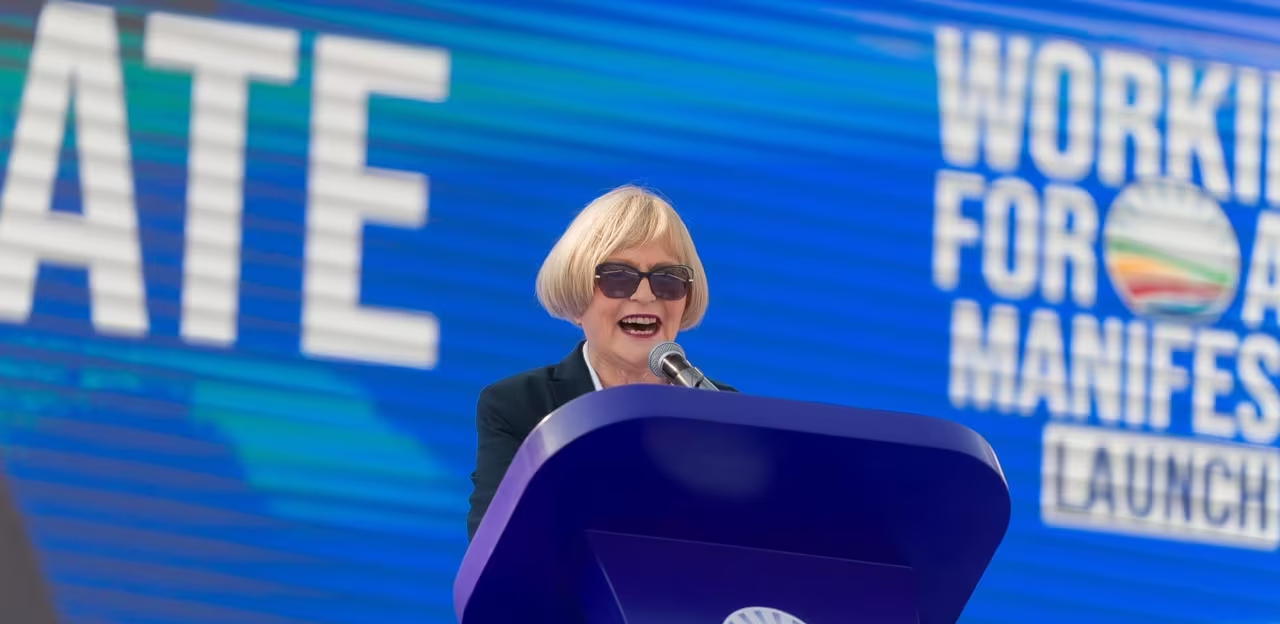
The DA says cooperation with the ANC protects stability, but voters may begin to question whether the party is replacing the ANC or preserving it, writes Zukile Majova in Real Politics.
Helen Zille once warned voters that supporting a smaller opposition party was a circuitous way of returning the ANC to power. Two years into the government of national unity, that warning presents an awkward question for her own party: has a vote for the DA also become a vote for the ANC?
The allegation is not entirely fair, but neither is it frivolous.
South Africans did not remove the ANC from power in 2024. They did something more constitutionally precise and politically consequential. They removed its majority and ended its right to govern alone.
The ANC remained the largest party, but it could not elect Cyril Ramaphosa again, pass budgets or form a government without opposition support. The DA used its parliamentary strength to keep Ramaphosa in the presidency and the ANC at the centre of government.
In KwaZulu Natal, where the MK Party emerged as the largest party but fell short of a majority, the DA joined an IFP led provincial coalition that also retained the ANC in government. In both cases, the DA helped construct a governing centre designed principally to exclude MK and the EFF.
There were defensible reasons for doing so.
Businesses, investors and financial markets feared that an ANC coalition with MK and the EFF would weaken fiscal discipline, constitutional institutions and property rights. It could also have disrupted economic reforms in energy, logistics and public administration just as some were beginning to produce results.
The GNU offered continuity without returning the ANC to unchecked power. It promised constitutional stability, more disciplined economic management and an opportunity for the DA and other parties to constrain the ANC from inside government.
That stability has economic value. Investment decisions involving factories, mines, renewable energy projects and infrastructure are made over years, not electoral news cycles. Investors need confidence that budgets will pass, contracts will be respected and policy will not change whenever political pressure rises.
Improved electricity supply, structural reforms, South Africa’s removal from the Financial Action Task Force grey list and the country’s first sovereign credit rating upgrade in two decades have all lifted the economic mood. The GNU cannot claim sole credit for these developments, but its survival has reduced the political uncertainty surrounding them.
The DA can therefore argue that it did not betray its mandate. It used that mandate to prevent a riskier government, protect the constitutional order and pull policy towards the economic centre.
But a justification that worked after the 2024 election cannot give the DA a permanent exemption from explaining what it has become.
Get Real Politics in Your Inbox
Sharp political analysis, delivered straight to you.
Subscribe free
Is it still an opposition party seeking to replace the ANC, or is it becoming the ANC’s indispensable constitutional insurance policy?
The local government elections on 4 November will force an answer. The latest Ipsos survey suggests several metros could again produce councils where no party has a majority. It places the ANC at 31% and the DA at 27% in Johannesburg, with the DA ahead in Tshwane and MK dominant in eThekwini.
In April, Zille appeared categorical that the DA would not work with the ANC, MK or EFF in Johannesburg. By July, her position had become more pragmatic.
“You don’t know what coalition you’re going to have until after the elections because you don’t know what options you’re going to get,” she said. “If we don’t get to 50% plus one, we will look at the options and we will take the least bad option. They will all be bad, but we will take the least bad.”
DA leader Geordin Hill Lewis made the underlying calculation even clearer.
“We went into government with the ANC to prevent the MK Party and the EFF from taking government, but it might not replicate itself in other areas,” he said. “We will have to look at the least worst option everywhere, and it will be different everywhere.”
These statements leave the door open to agreements with the ANC where the DA decides that every other possible arrangement would be worse. The GNU may not be replicated across the metros, but its governing logic could be.
For the DA, that logic is simple. When voters produce no majority, the party will choose the arrangement it considers least damaging, even if that means keeping the ANC in office.
The DA would not need to enter a formal coalition to keep the ANC in municipal power. It could support an ANC administration on budgets and motions of confidence, tolerate an ANC led minority government or reach agreements on individual issues while remaining formally in opposition.
Ekurhuleni has already shown how blurred these lines can become. The DA helped the city pass its budget after extracting concessions, even while describing the administration as a failing ANC led coalition. It was not a coalition agreement, but it showed that political cooperation does not require parties to share executive positions.
The elections also offer the GNU parties an opportunity to honour an overlooked commitment in their founding statement of intent: “stabilising local government, effective cooperative governance.”
This matters because the credibility of the GNU cannot be separated from municipal performance. National reforms will mean little if the cities responsible for development approvals, water, electricity, roads and revenue collection continue to deteriorate.
The metros control enormous budgets, employ thousands of people and oversee the infrastructure on which the urban economy depends.
Johannesburg alone accounts for about 15% of national GDP. In July, the National Treasury temporarily withheld equitable share transfers from Johannesburg and 68 other municipalities because they had failed to meet financial obligations and properly address unlawful expenditure. Across all municipalities, irregular expenditure reached R40.14 billion in the 2024 to 2025 financial year.
Coalition negotiations determine who controls procurement, infrastructure spending and valuable municipal land. They affect whether businesses receive electricity, developers obtain approvals and cities can collect revenue or service their debt.
Billions in public and private capital will be needed to reverse urban decline. Johannesburg wants private investors to help reclaim derelict and hijacked buildings in the city centre and turn them into safe residential, commercial and mixed use properties.
Similar partnerships will be required to repair water systems, increase electricity capacity, improve transport networks and regenerate declining business districts.
Private investors will not commit that capital if mayors and finance committee chairs can be removed every few months. Urban renewal also cannot succeed if billing systems collapse, planning applications remain trapped in bureaucracy and criminal syndicates influence municipal administration.
Business therefore wants at municipal level what it initially welcomed nationally: stability, credible financial management and a broad political centre capable of making decisions.
The “least bad option”, however, cannot mean preserving ANC power regardless of how decisively voters reject its municipal record. A grand coalition that merely divides positions and procurement between the two largest parties would reproduce the political protectionism that voters tried to end.
Any agreement between the ANC and DA would require strict conditions. These should include a public coalition contract, professional appointments, measurable service delivery targets, protection for officials who enforce financial rules and automatic consequences for corruption or missed targets.
The political cost to the DA would nevertheless be substantial, particularly among black middle class voters it needs to attract.
These voters may be alienated from ANC corruption and administrative failure without being natural DA supporters. The GNU gives the DA an opportunity to demonstrate competence in national government, but it also blurs the alternative the party offers them.
The DA must prove that cooperation is conditional, productive and directed towards reform. It needs visible achievements, clear limits and a convincing account of how it intends eventually to replace the ANC rather than remain its permanent junior partner.
November will therefore determine more than who runs Johannesburg, Tshwane and other contested councils. It will show whether the GNU’s promise to stabilise local government can be translated into functioning cities, and whether the national coalition was an exceptional compromise or the foundation of a new governing establishment.
If cooperation with the ANC is sometimes the DA’s least bad option, it must say so honestly and explain the conditions. Otherwise, Zille’s old warning will acquire a damaging new meaning. The shortest route back to the ANC government may run not through a small party, but through the DA itself.
Pictured above: Helen Zille.
Image source: @Our_DA/X