5 problems the new NSFAS administrator cannot avoid
Explain | 22.05.2026 20:21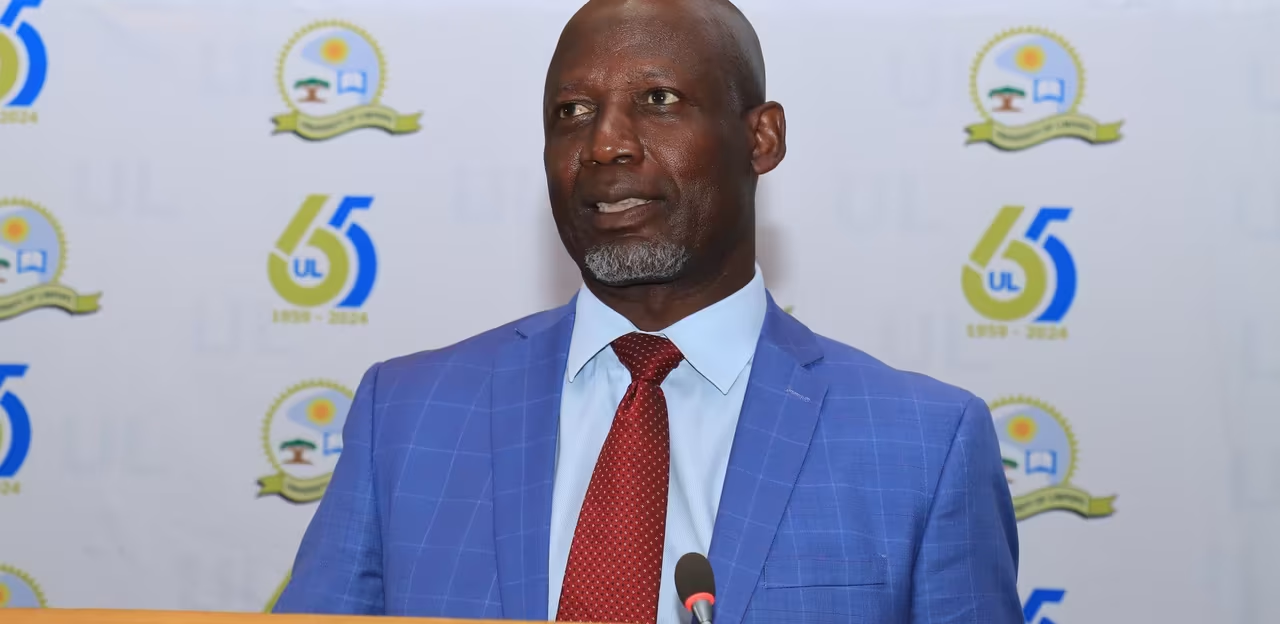
From broken technology to political battles over funding, these are the biggest challenges facing NSFAS’s new administrator.
On 4 May, Higher Education and Training Minister Manamela dissolved the National Student Financial Aid Scheme (NSFAS) board and appointed Professor Hlengani Mathebula as administrator for the next 24 months. He certainly has his work cut out for him.
We unpack five issues that Mathebula will have to contend with as he attempts to set NSFAS’s house in order.
1. The funding model
The first is the funding gap itself.
The National Student Financial Aid Scheme (NSFAS) currently covers students from households earning less than R350,000 a year. The so-called “missing middle” families earning up to roughly R600,000 remain stuck between grants and unaffordable private debt. Closing that gap would require a single national tertiary funding instrument. But that decision sits with the Treasury, not NSFAS.
2. Who should control the money?
The second battle is over disbursement.
EFF leader Julius Malema argued earlier this month that the government should “do away with NSFAS and provide money straight to universities”. Days later, the DA echoed the same position, calling for NSFAS to be scrapped entirely and replaced with a decentralised system managed by universities themselves.
DA higher education spokesperson Dr Delmaine Christians told /explain/ the party is exploring legislative and policy mechanisms, including possible amendments to existing laws.
But critics of a full reset warn that the old model already failed once. Organisation Underdoing Tax Abuse (Outa) head investigator Rudi Heyneke said direct university disbursement previously collapsed because institutions failed to reconcile funds properly at year-end. At one stage, the University of Pretoria alone reportedly held about R400 million in unreconciled NSFAS money.
The debate, Heyneke argues, is not about who holds the funds but about whether the institution that does can properly account for them.
3. The technology problem
The third issue is technological.
For NSFAS to function cleanly, its systems need to integrate seamlessly with the South African Revenue Service for income verification, Home Affairs for identity checks, and universities for registration and academic progression. That integration does not currently exist.
4. The court fight over the board
The fourth crisis is already heading to court.
The seven dissolved NSFAS board members filed an urgent application in the Gauteng High Court on 13 May, with the matter expected to be heard on 2 June. Their legal team argues that the dissolution was procedurally unfair and that the newly appointed administrator, Mathebula, is not “fit and proper” for the role.
Questions around Mathebula’s suitability have also surfaced elsewhere: when at Sars Outa points to his previous executive role at Sars, where he was placed on precautionary suspension in 2019 after the Nugent Commission. He later exited through a settlement before disciplinary proceedings concluded.
5. The students currently inside the system
The fifth problem is immediate.
NSFAS released R1.1 billion to private accommodation providers on 7 May, while universities are only weeks away from mid-year fee-block periods. That places enormous pressure on an already unstable system.
Earlier this year, Outa released findings highlighting major flaws in student accommodation oversight. In one case, a property accredited for 200 students was allegedly just a three-bedroom house.
This is the kind of operational dysfunction Mathebula inherits.
Back in 2019, former administrator Randall Carolissen warned Parliament that NSFAS would either end up under administration again in two years’ time or collapse entirely. Seven years later, it has been placed under administration for the third time.
If the structural problems remain unresolved, Carolissen’s timeline suggests a fourth instance may already be loading.
Yeshiel Panchia is an investigative journalist and producer with a focus on transnational crime, politics and data journalism. His bylines include BBC Africa Eye, Al-Jazeera English, Daily Maverick, News24 and his photojournalism can be found on the Associated Press, Agency-France Press, European Pressphoto Agency and Xinhua. He is based in Johannesburg.