This Map Shows the Best (and Worst) Tap Water in the U.S., Ranked State by State
The Kitchn | 11.12.2025 21:06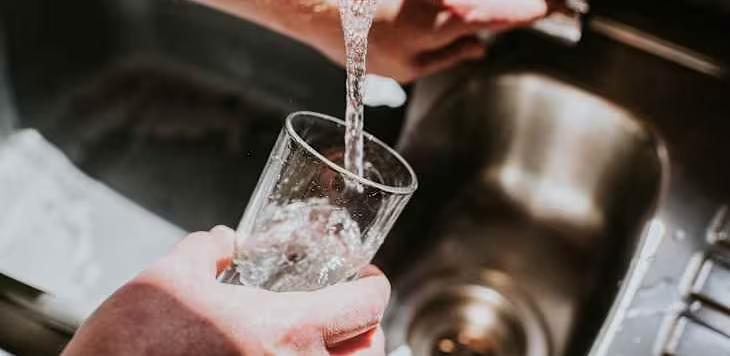
Whether or not you drink your home’s tap water, the quality of local water is top of mind for many Americans, and for good reason. According to Aquasana’s 2025 Water Quality Survey, a majority of respondents had some level of concern about the quality of their home’s unfiltered tap water. This goes beyond a funny smell or an odd taste — it’s about what exactly is in your water and how safe it is to drink.
While water quality varies from place to place, there’s data that helps paint a broad picture of how good the water is in each state, which can help you understand your baseline water quality better. From there, you can determine next steps for any testing or filtration needed. (The Centers for Disease Control says you really only need a filter if your tap water doesn’t contain harmful germs or chemicals — although it can improve the taste, regardless of contaminants!).
I set out to find which states had the best tap water, and which states’ water could use improvement (or, at least, filtration). By looking at lots of data and calculating one clear score for fair comparison, we’ve made our list, and checked it twice. Read on to learn more about how the different states’ water stacks up.
To determine the states with the best tap water, I looked at three key indicators of public water quality: regulatory compliance, oversight of public water systems, and water contaminants. I gathered this data from two sources to measure these indicators: the federal government Environmental Protection Agency’s (EPA) Drinking Water Dashboard, which tracks regulatory violations and system compliance, and the nonprofit research group Environmental Working Group’s (EWG) Tap Water Database, which reports contaminant levels compared with federal and health-based guidelines.
Once I calculated these metrics, I used AI to help create a weighted point system based on public-health significance for each metric. Then I standardized all the measurements so each state’s tap water could be compared fairly. You can learn more about the methodology and data below.
One crucial thing to remember about the rankings: All tap water in the U.S. is technically safe to drink because it is monitored by the EPA and public water systems that treat the water. About 10% of people in the country rely on private wells, which is not regulated under the Safe Drinking Water Act (SDWA), and these rankings don’t take private well water into account.
States that ranked lower down on the list still have tap water that is safe to drink. They may just have more SDWA violations and contaminants. Be sure to test your own tap water to decide if you want to use filtration.
Curious where all the states land on our list? Check out the ranks below and find your state:
1. South Carolina
2. Hawaii
3. Minnesota
4. North Dakota
5. Maryland
6. Alabama
7. Michigan
8. Wisconsin
9. South Dakota
10. New Hampshire
11. Georgia
12. Virginia
13. Vermont
14. Iowa
15. Tennessee
16. Maine
17. Washington
18. Kansas
19. Mississippi
20. Massachusetts
21. Colorado
22. Nebraska
23. New Jersey
24. California
25. Florida
26. Pennsylvania
27. Rhode Island
28. Arkansas
29. Illinois
30. Oregon
31. Arizona
32. Missouri
33. Montana
34. Kentucky
35. Utah
36. Idaho
37. Connecticut
38. New Mexico
39. Indiana
40. North Carolina
41. Nevada
42. Wyoming
43. West Virginia
44. Delaware
45. Ohio
46. New York
47. Texas
48. Alaska
49. Louisiana & Oklahoma (tied)
No matter where your state lands on the list, it’s essential to do your own research about your tap water’s quality. Dr. Eric Roy, a water scientist and head of science at global water treatment company Culligan International, says a good place to start is with your municipality’s Consumer Confidence Report (CCR), an annual EPA-mandated disclosure. You can find your local CCR here.
“It’s a bit jargon-heavy, but the big acronyms for thresholds to pay attention to are: Maximum Contaminant Level (MCL), which in layman’s terms is ‘legal limit,’” Roy explains. “The other, more strict threshold is the Maximum Contaminant Level Goal (MCLG), which is the level below which there’s no known or suspected health risk.”
Roy also stresses the importance of testing your water, even if you live in an area that’s known for having “good” water. “The reality is that water quality can vary dramatically, even from house to house,” he says. “Many contaminants can’t be seen, smelled, or tasted, which is why testing your water is very important.”
Roy says a personalized test and consultation with an expert is best for understanding any issues that may arise with your tap water. From there, you can determine the best course of action for your home, whether it’s getting a small water filter or something more robust like a reverse osmosis system.
To track regulatory compliance, oversight of public water systems, and contaminants, I pulled the following data points:
EPA metrics (averaged into a single five-year score using data from 2020 to 2024): The average percentage of health-based violations of the Safe Drinking Water Act in the state, including MCLs, the potential to cause illness via contaminants, failure to conduct regular monitoring of drinking water quality, failure to meet public notification requirements, and more. (You can see the full definitions for these metrics on the EPA’s Enforcement and Compliance History website.)
EWG-based metrics (using data published between 2013 and 2024): Number of contaminants detected in water, found above health guidelines, and found above legal limits.
Below is the weighted scoring system I used to compare the metrics across all states. Check out the scoring system below for more details.
- Average % of systems with health-based violations: 0.25
- Average % of systems with acute health-based violations: 0.20
- Average % of systems identified as priority systems: 0.15
- Average % of systems with monitoring and reporting violations: 0.10
- Number of contaminants found above health guidelines: 0.10
- Average % of systems with public notification violations: 0.05
- Average % of systems with formal enforcement actions: 0.05
- Average % of systems with inspections/sanitary surveys: 0.05
- Number of contaminants detected in water: 0.02
- While I used data from two reputable, publicly available sources to create this list, there are some factors to consider with the calculations:
- The numbers don’t account for 2025 data, as the full calendar year’s findings aren’t available as of this publishing in December 2025.
- According to the “Caveats” section of the EPA website: “Data shown in the EPA/State Dashboards are based on data reported to EPA and may not reflect all compliance monitoring/inspections, enforcement or the full extent of noncompliance within a state. State environmental agencies may have more information on activities and noncompliance within their state on their agency websites.”
- The EWG’s data is from reported test results between 2013 and 2024; this doesn’t mean contaminants were present during this whole period.
- While this list gives a high-level view of each state’s tap water quality, it’s important to note that tap water quality within each state varies greatly.