Real Politics: The coalition nobody wants but every city needs
Scrolla | 27.07.2026 15:12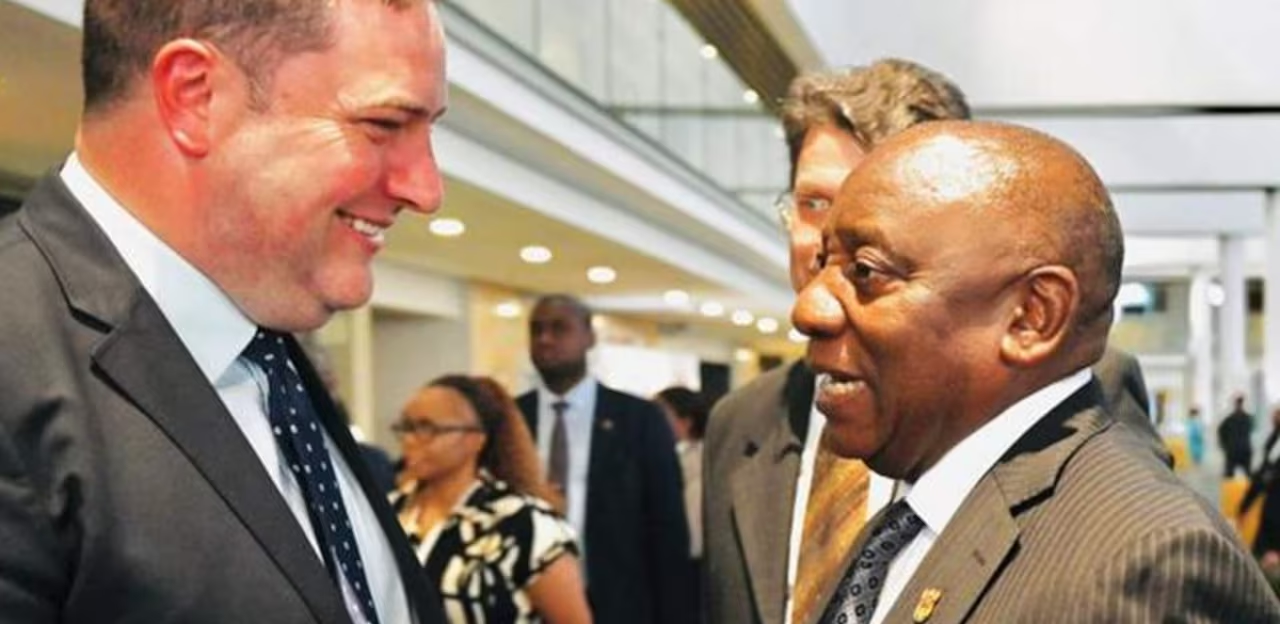
After the 4 November local government elections, Julius Malema and Jacob Zuma may hold the balance of power in some of South Africa’s biggest and most economically important cities, writes Zukile Majova in Real Politics.
That prospect should worry ratepayers, investors and political parties alike.
The Economic Freedom Fighters and uMkhonto weSizwe Party could jointly command between 20% and 25% in some contested councils. If neither the ANC nor the DA wins an outright majority, Malema and Zuma may be able to decide who becomes mayor, who controls the municipal budget and which parties receive the most powerful portfolios.
But the two men who could become the country’s most influential municipal kingmakers are potentially the worst coalition partners available.
Both lead highly centralised parties built around the authority and political fortunes of their founders. Neither organisation has a credible record of municipal government. Both favour aggressive populism over the compromises required to keep water flowing, repair roads, collect revenue and maintain investment-grade cities.
There is an alternative. The ANC and DA should take the cooperation they established in the Government of National Unity and extend it into hung municipalities.
The two parties disagree profoundly on transformation, economic policy, property rights and the role of the state. They will remain electoral rivals. But they share a basic commitment to constitutional government, institutional continuity and an economy capable of financing public services. That common ground is more important than ideological purity in municipalities approaching collapse.
After the 2021 election, 66 councils were hung. That number is unlikely to decline in November and may increase as MK, the Patriotic Alliance, the IFP, ActionSA and smaller parties fragment the vote further. At least five metros — Johannesburg, Tshwane, Ekurhuleni, eThekwini and Nelson Mandela Bay — are highly likely to be hung. Mangaung could join them.
These cities do not have another five years to waste.
Johannesburg has had eight mayors since 2019. Governments have been assembled and removed through deals involving parties with tiny electoral mandates. Kabelo Gwamanda became mayor despite Al Jama-ah holding only three of the council’s 270 seats. His appointment was not an expression of voters’ will. It was the result of larger parties being unable to agree on which of them should govern.
While politicians fought over positions, Johannesburg’s water, electricity and road infrastructure deteriorated. Residents were left with dry taps, collapsing traffic lights, power interruptions and rising municipal bills. Similar instability has affected Tshwane, Ekurhuleni and Nelson Mandela Bay. Mayors are removed before their programmes can be implemented. Municipal budgets become bargaining instruments in coalition negotiations.
This is not democracy working. It is fragmentation paralysing government.
The ANC and DA together could end most of this instability.
Based on their 2021 results, the two parties had a combined vote of approximately 60% in Johannesburg, 67% in Tshwane, 67% in Ekurhuleni, 68% in eThekwini, 79% in Nelson Mandela Bay and 76% in Mangaung. The numbers will shift in November, particularly in eThekwini where MK has reordered KwaZulu-Natal politics. But an ANC-DA combination will still command clear governing majorities in all six metros.
A simple principle could govern these coalitions: the party with the most council seats takes the mayoralty, while the second party receives the deputy mayoralty, speakership and a proportional share of portfolio positions. The agreement should not be renegotiated separately in every city behind closed doors. The parties should negotiate a national framework establishing transparent rules for municipalities where their combined vote produces a stable majority.
That framework should include a binding five-year programme, merit-based appointments, independent supply-chain controls, public performance targets and dispute-resolution procedures. Residents should know before they vote that an ANC-DA coalition would be based on the election result, not on secret negotiations over tenders and portfolios.
The Government of National Unity has already demonstrated the strategic value of this kind of cooperation. Whatever its internal tensions, it prevented national power from becoming dependent on either the EFF or MK after the 2024 election.
The same principle worked in KwaZulu-Natal. The IFP, ANC, DA and NFP combined to keep the provincial government functioning despite MK emerging as the largest party. Without that agreement, Zuma’s party would have used its 37 seats and its EFF alliance to dominate the province. Instead, the IFP’s Thami Ntuli became premier and a multiparty executive was formed around parties prepared to operate within the constitutional framework.
Municipalities need the same firewall.
This is not an argument that the EFF and MK should be excluded because their policies are radical. Voters who support them are entitled to representation. The danger lies in handing control of struggling cities to parties whose leadership cultures, policy promises and coalition conduct offer little assurance of stable administration.
The EFF has almost 1,000 councillors and commands roughly 10% of the vote, yet it has not won outright control of a single municipality. MK has never governed a municipality, province or national department under its own name. Its structures remain bound to Zuma’s personal authority, while many of its prominent figures emerged from the networks associated with the worst years of state capture.
An EFF-MK bloc could be large enough to bring down governments but not disciplined enough to run them.
The ANC and DA are not innocent bystanders in the municipal crisis. The ANC presided over cadre deployment, corruption and administrative decay in many councils. The DA has contributed to instability through rigid coalition management and an inability to sustain relationships with smaller partners.
An ANC-DA pact would work only if both abandoned the belief that cooperation requires the other party’s surrender. The ANC would have to accept professional administration, stronger financial controls and consequences for corruption. The DA would have to accept that transformation and the extension of services to historically neglected communities are central functions of municipal government, not optional ideological concessions.
Such an agreement would not end political competition. It would move that competition away from motions of no confidence and towards measurable performance. The party running the finance portfolio could be judged on revenue collection. The party responsible for infrastructure could be judged on water losses, road repairs and capital spending. Residents would finally be able to compare results.
Malema and Zuma may emerge from November as powerful kingmakers. But South Africa’s biggest cities should not be forced to depend on them.
The ANC and DA already possess the combined electoral mandate to govern these metros. Their duty is to use it.
A grand municipal coalition would be uncomfortable, argumentative and imperfect. But five years of predictable government would be vastly better than another term of collapsing coalitions, proxy mayors and political looting.
South Africa does not need another experiment in municipal chaos. It needs its two largest parties to accept that, in the country’s broken cities, stable government has become more important than permanent political warfare.
Pictured above: Geordin Hill-Lewis and Cyril Ramaphosa.
Image source: Geordin Hill-Lewis/X