Real Politics: ANC mistake breaks decades of political control
Scrolla | 21.09.2026 14:46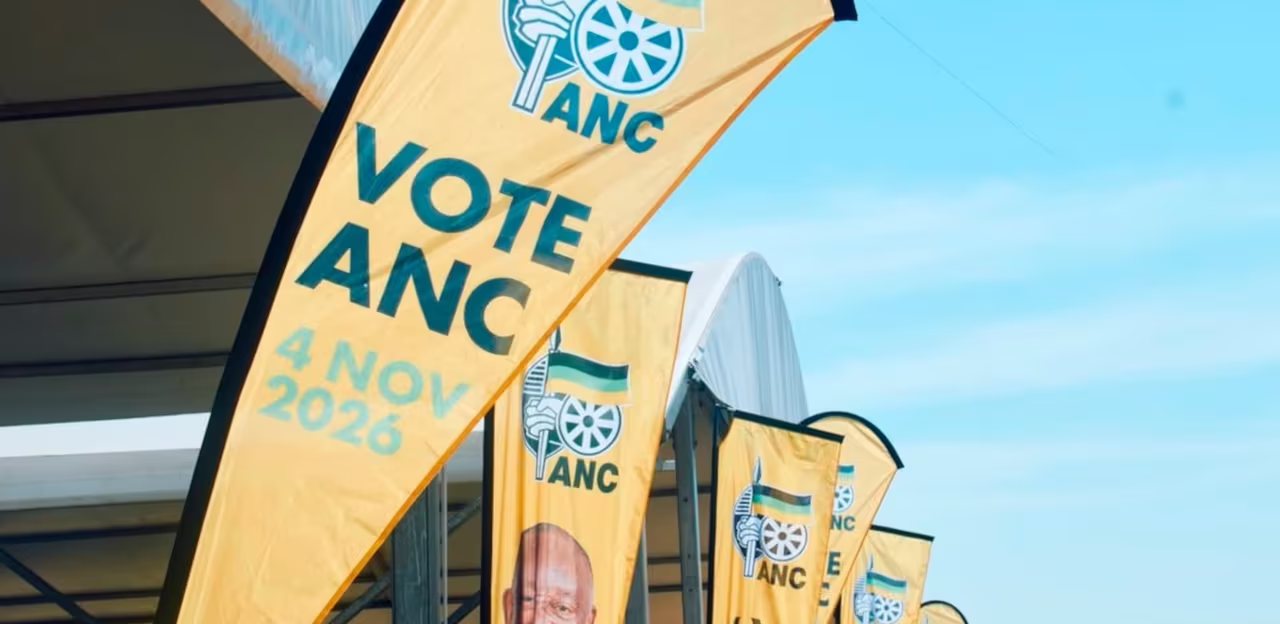
The ANC’s failure to register candidates has given neglected communities a rare opportunity to demand more than another political promise, writes Zukile Majova in Real Politics.
For the people of Ingquza Hill and Port St Johns, the ANC’s candidate list blunder is not primarily a story about the ANC.
It is a story about them.
For years, politics in parts of the Eastern Cape has seemed less like a contest than a permanent condition. The ANC has dominated local government for generation after generation. Yet the basic economic circumstances of many residents remain extraordinarily difficult.
In Ingquza Hill, just 17.6% of households had piped water inside their homes in the 2022 Census. In the 2011 Census, youth unemployment was recorded at 60.9%.
Port St Johns tells much the same story. Only 19% of households had piped water inside their homes in 2022. Its youth unemployment rate was 61% in 2011.
These are not abstract statistics. They describe communities where social grants can become the economic foundation, young people reach adulthood without jobs and the promise of development remains just that, a promise.
Now something extraordinary has happened.
Because the ANC failed to complete the registration of its candidates on time, voters in six municipalities are heading into the 4 November local elections with an electoral map fundamentally different from the one their politicians expected.
The Electoral Court rejected the ANC’s application to restore 181 excluded candidates. The affected municipalities are Ingquza Hill, Port St Johns, Mangaung Metro, uMshwathi, Walter Sisulu and Sundays River Valley. The ANC says it will pursue further legal options.
The consequences are especially dramatic in Ingquza Hill and Port St Johns, where the ANC has no candidates on the ballot.
In 2021, the ANC won 46 of Ingquza Hill’s 64 council seats. It won 31 of the 39 seats in Port St Johns.
The political establishment may spend the next few weeks asking which opposition party will benefit.
That is the wrong question.
The more important question is what happens when the party that has dominated a municipality for decades is suddenly no longer an option.
There is a temptation to regard this merely as an electoral gift to whichever opposition party can capture displaced ANC voters.
But the opportunity is bigger than that.
It allows voters to ask every party seeking their support a more uncomfortable question:
What exactly will you do with this place?
Ingquza Hill and Port St Johns possess assets that most municipalities would envy.
The Wild Coast is one of the country’s great natural assets. Port St Johns describes itself as the centre of Wild Coast tourism, with opportunities around its coastline, beaches, fishing and natural environment.
Yet the surrounding communities remain among the country’s poorest.
That contradiction should embarrass every political party.
The region should not have to choose between development and environmental protection as though the only alternatives were a mine or poverty.
The real challenge is to construct a development model in which local communities share in the economic value of their land and natural resources, whether that value comes from tourism, agriculture, mineral resources, conservation or a combination of them.
Xolobeni illustrates the problem.
For more than 15 years, communities have fought over a proposed titanium mine on the Wild Coast. The dispute has become a national symbol of the conflict between mining, environmental protection, community rights and economic development.
The 2018 Baleni judgment established that communities holding informal land rights must give consent before mining rights can be granted over their land.
But after all those years, the fundamental question remains unanswered:
How do you turn the natural wealth of the Wild Coast into economic opportunity for the people who live there?
That requires political leadership.
Not slogans about transformation. Not promises made at election time. And not another decade of arguing while young people remain unemployed.
The same question is visible further inland in Mangaung.
Bloemfontein should be one of the country’s great inland economic centres. Instead, the metro has been under government intervention since 2019, with the intervention escalated to national level in 2022.
Recent reporting describes deteriorating infrastructure, returned infrastructure grants, water losses, sewage problems and billions of rand in unauthorised expenditure.
The result is not merely damaged roads or unreliable services.
It is lost economic opportunity.
A city cannot attract investors while its infrastructure is deteriorating. Agriculture cannot flourish without functioning roads, water and electricity. Tourism cannot grow when public spaces decay. Businesses cannot create jobs indefinitely when municipal failure becomes another cost of operating.
That is why the candidate list fiasco matters beyond the ANC.
It has unexpectedly forced the question of governance onto the ballot.
The DA will point voters towards uMngeni in KwaZulu Natal as evidence that municipal government can improve within a single electoral cycle.
There is evidence that the municipality’s financial and administrative performance improved after the DA took control in 2021. Its records show consecutive financially unqualified audit outcomes, compared with a qualified outcome in 2020/21. The municipality also says its roads maintenance budget increased from R11 million to R42 million.
Those achievements include political claims that voters should test against municipal records. But the broader lesson does not belong exclusively to the DA.
Municipal performance can change.
That is an important lesson for voters in the six municipalities affected by the ANC’s administrative failure.
They have choices.
Some may choose the DA. Others may choose the EFF, MK or another established or emerging party. Some may choose independents or civic organisations.
The ANC’s absence does not leave an empty ballot. It leaves a more fragmented political marketplace.
Fragmentation carries its own risks.
A party that has never governed a municipality has no municipal record against which voters can judge its promises. A party can campaign brilliantly and still discover that running a municipality requires something different.
It requires competent administrators, functioning revenue systems, credible budgets, infrastructure maintenance, procurement controls and the ability to attract investment.
Voters should therefore not simply ask which party is angry with the ANC.
They should ask which party can run a municipality.
Can it collect revenue and maintain roads and water infrastructure?
Can it produce credible budgets, achieve clean or unqualified audits and stop corruption and waste?
Can it attract businesses and turn a municipality’s natural and economic assets into opportunities for local people?
The ANC’s candidate list failure was an extraordinary political blunder.
For the ANC, it is plainly bad news.
For democracy, however, there is another possibility.
It could become a blessing in disguise, not because it guarantees that an opposition party will govern better, but because it has temporarily broken the assumption that the political status quo is inevitable.
In Ingquza Hill and Port St Johns, voters have suddenly been handed an unusual political laboratory.
The ANC cannot ask them to vote for its candidates.
That means the opposition cannot simply ask voters to vote against the ANC.
They must persuade them to vote for something.
The people of the Wild Coast, Mangaung, uMshwathi, Walter Sisulu and Sundays River Valley do not need another promise that their turn is coming.
They need evidence that somebody knows how to make their turn happen.
That is the real test created by the ANC’s blunder.
Sharp political analysis, delivered straight to you.
Subscribe free
Pictured above: Vote ANC banners.
Image source: @MYANC/X