NHS Grampian publishes leaked report at centre of hospital scandal
BBC | 27.11.2026 21:25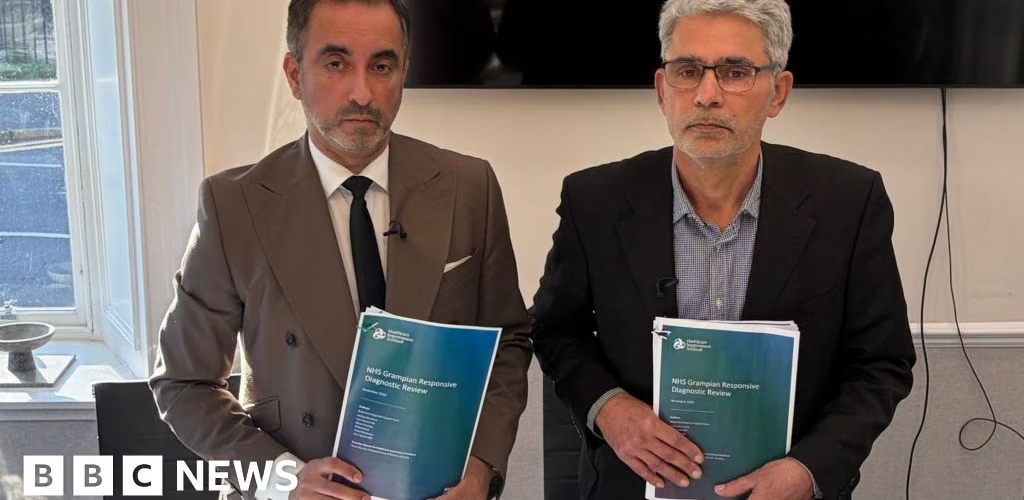
NHS Grampian has published the internal report which revealed there had been 19 avoidable deaths of patients who had undergone liver and pancreatic surgery at Aberdeen Royal Infirmary.
It was leaked last week by surgeon Dr Mohammed Habib, who called for NHS Grampian to face a corporate homicide probe after the report said some patients bled to death on the operating table.
NHS Grampian has now released the report from September 2022, along with a redacted version of a follow-up from November the same year.
The health board said they were being published now "in the interests of absolute transparency".
Meanwhile, written submissions have also been published from witnesses who will appear at the Scottish Parliament's health committee next week.
These include two whistleblowers and Prof Caroline Hiscox, former chief executive NHS Grampian.
Separately, the health board has apologised after confidential papers containing sensitive medical and personal details of 22 patients were found discarded on a street near Aberdeen Royal Infirmary.
A passer-by found the documents near a bin on Raeden Park Road, near Foresterhill Health Campus, on Thursday.
NHS Grampian has been at the centre of controversy since a report from the health watchdog published two weeks ago highlighted "major deficiencies" in its leadership and culture.
Habib, a consultant surgeon at Aberdeen Royal Infirmary (ARI), leaked the 2022 report the following week.
The Scottish government then announced an independent review into concerns around hepatobiliary (HPB) surgery at the health board.
A number of patients have come forward to raise concerns about their treatment.
On Thursday, Scotland's chief medical officer Sir Gregor Smith, who had faced questions over his role, resigned on mental health grounds.
The September 2022 report was written by Prof Stephen Wigmore, regius professor of clinical surgery at Edinburgh University.
It looked at 45 patients in the care of liver and pancreatic services at ARI between 2015 and 2021.
It said 31 had died, and 19 of them were considered to have died of avoidable consequences of surgery or intervention.
The review criticised decision-making in liver surgery for occasionally being "overly aggressive", with surgery going ahead even if the disease was thought to be inoperable.
In pancreatic surgery, patients were regularly rushed into theatre without adequate planning or consideration of non-surgical alternatives, the report said.
A follow-up report was published in November 2022 where Wigmore was asked to review more HPB surgery cases which had not been within the scope of his original report.
It found unacceptably high mortality rates for some pancreatic surgeries, as well as "extremely high" blood loss for a number of pancreas and liver operations.
The professor said surgeons had low caseloads, which harmed their technical experience.
He offered to support the surgeons, then issued a letter in May 2023 which said HPB services at NHS Grampian had improved and was now safe.
The health board's chief executive Laura Skaife-Knight said the names of patients and families had been redacted from the second report to protect their identities, and the health board was "contacting/re-engaging" them to offer support.
"I recognise the significant concern the events of the last week have caused our patients and local community," she said.
"However, I would encourage anyone who needs our care to come forward at the earliest opportunity.
"Please continue to engage with our healthcare services and attend appointments and operations as normal. Our priority remains patient safety."
Prof Hiscox, who was in charge of NHS Grampian when the reports were written, has submitted evidence ahead of the Holyrood health committee meeting on Wednesday.
She said the NHS Grampian board was fully briefed on the first Wigmore report at a meeting on 27 October 2022.
This was done to "protect patient and staff confidentiality", provide time for patients and families to be contacted, and "enable full and frank discussion of the issues and avoid causing undue public alarm that could potentially increase the likelihood of late presentation and possibly lead to poorer health outcomes".
Her evidence said this "communications approach was shared with relevant officials at Scottish government".
She also said the families of 17 of the 19 patients whose deaths had been avoidable were contacted, but contact details could not be identified for the other two.
A Scottish government spokesperson said the documents released to date had shown that a number of government officials were aware of the concerns raised by Dr Habib.
"It is a matter of public record that the Scottish government has engaged on the concerns raised by Dr Habib over a number of years," it said.
The spokesperson added that the independent review would deliver "clarity, transparency and accountability to patients and their families".
Does Scotland's NHS have a revolving door problem with senior managers?
The committee will also hear from two whistleblowers who have raised concerns about patient safety at NHS Grampian.
In his evidence ahead of the hearing, Dr Izhar Khan - who currently works as a consultant pephrologist at ARI - said the roots of the problems dated back more than 14 years.
"For years senior management has not listened to clinical advice and on occasions when advice was given, often it was ignored," he said.
The senior clinician also said he believed Dr Gray's Hospital in Elgin, Moray, was not fit for purpose to deliver acute services.
Dr Khan said the health board needed "strong and resilient leadership that listens to clinicians and staff".
Prof Zygmunt Krukowski, former consultant general surgeon at ARI, has also written to the committee ahead of his appearance.
He said it was "distressing" to see the reputation of the hospital where he worked for more than 40 years damaged by "inept management and clinical governance".
"If there had been effective clinical leadership and management the pattern of poor care which was clinically obvious as early as 2010 would have been addressed," he added.
Confidential papers found on street
The confidential papers found discarded on a street on Thursday are believed to consist of four crumpled pages, dated from the day before.
They are understood to have listed names, CHI numbers and medical conditions of 22 neurosurgery patients.
NHS Grampian's senior information risk officer, Shantini Paranjothy said: "We are making efforts to contact those patients whose data was contained in these documents and apologise for the distress this has caused.
"Investigations into how these documents ended up in a public place are under way and this incident has been reported to the Information Commissioner's Office.
"Patients have the right to expect their data to be stored securely. We take the issue of data protection very seriously."