Real Politics: MK’s future cannot rest on Zuma alone
Scrolla | 12.10.2026 14:21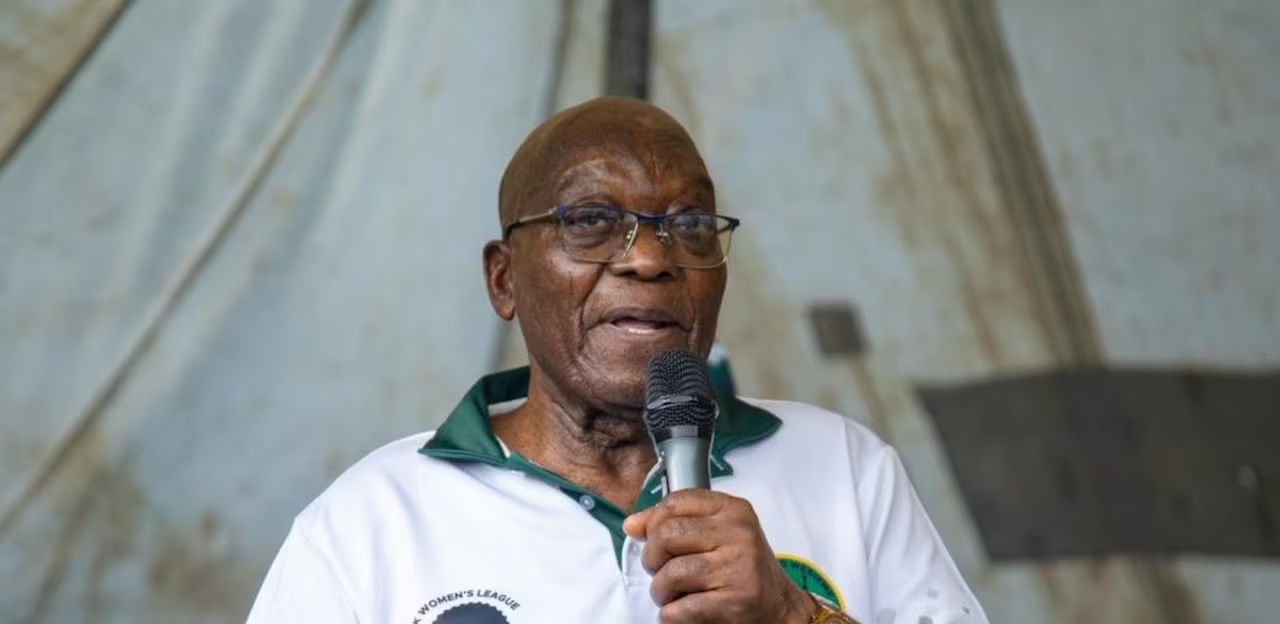
Zuma’s hospitalisation raises a question about whether MK can turn loyalty to its leader into a political organisation capable of outlasting him, writes Zukile Majova in Real Politics.
Anyone who has met Jacob Zuma will tell you that it is difficult not to be charmed by his warmth. You might expect a former president to be a stately figure, shaped by the formality of high office. Instead, his simplicity and common touch can catch you off guard.
For those of us working in Johannesburg, a thousand kilometres from our families in the rural Eastern Cape, there is something familiar about his welcome. He greets you like a father or grandfather receiving his children home for Christmas.
I first met Zuma more than 20 years ago. I have reported on him for much of that time, often disagreeing profoundly with his leadership and political choices. Yet I have never stopped admiring his ability to connect with ordinary people, make them feel seen and put them at ease.
That is the paradox of the man known by his clan name, Msholozi: you can disagree with the politician and still love the man.
Perhaps that is why news of his hospitalisation has touched such a nerve among supporters and others who have encountered him beyond politics. Their concern is about more than a former president. It is about a man whose warmth has sustained a political bond that no successor can automatically inherit.
His hospitalisation has exposed a vulnerability at the heart of the uMkhonto weSizwe Party, known as MK: its dependence on a leader whose personal authority has yet to be matched by a clearly established succession process.
Zuma has reportedly been receiving care at Netcare St Anne’s Hospital in Pietermaritzburg after becoming unwell while campaigning in KwaZulu-Natal. MK initially described his hospital visit as a routine examination and said he was healthy and in good spirits. Conflicting reports have nevertheless fuelled anxiety as the November 4 local elections approach.
President Cyril Ramaphosa has confirmed that Zuma is receiving medical treatment and that the military surgeon general has been briefed. He wished his predecessor a speedy recovery.
The details of Zuma’s condition have not been publicly established. Reports that his family resisted a proposed transfer to 1 Military Hospital in Pretoria have added to the uncertainty, but the arrangements have not been fully clarified.
The government must respect Zuma’s medical privacy. Conflicting accounts, however, have created an information vacuum around a man whose political fortunes are inseparable from those of a major party.
For MK, the timing could hardly be more difficult. It needs to demonstrate that its remarkable emergence in 2024 was more than a temporary protest against the ANC.
Zuma remains central to that proposition. He draws crowds, connects with supporters in KZN and gives opposition to Ramaphosa a recognisable identity. His absence from the campaign trail would leave the organisation facing a test it has not convincingly prepared for.
Can the party he has built survive the day he is no longer able to lead it?
MK has experienced leadership changes, disciplinary disputes and factional tensions without holding an elective conference. Zuma’s appointments have shaped its structures without necessarily settling who would succeed him.
His son Duduzane’s appointment as first deputy president has inevitably raised succession questions. Tony Yengeni, the second deputy president, is also part of the leadership equation.
The published constitution describes the deputy’s role as deputising for the president. The party must still explain how its two deputy positions would operate in a permanent transition.
Neither appointment, by itself, establishes who would become president should Zuma die or become permanently incapacitated, or whether the organisation would accept that person’s authority.
Would MK rally behind a successor chosen by Zuma? Would it insist on an elective conference? Or would competing groups dispute whoever emerged?
These questions concern control of the party, its MPs, its provincial structures and the careers of people who have built their political futures around Zuma.
An unsettled succession could turn existing disagreements into a struggle over the organisation’s identity.
In KZN, the consequences could extend beyond MK. Its 2024 performance reshaped the province’s politics. Its support reflects opposition to the ANC, dissatisfaction with governance and, for some voters, a connection to Zuma’s political and cultural identity.
His appeal to sections of the Zulu electorate cannot be reduced to traditionalism. He has combined political defiance and cultural familiarity with a claim to represent people neglected by the governing establishment.
Duduzane may inherit his father’s surname, but political authority does not automatically pass through family ties. Nor can a successor assume that those who rallied behind Zuma will remain loyal regardless of who leads MK.
The party must reconcile several constituencies: disaffected former ANC supporters, voters drawn to its message and people whose attachment to Zuma is more personal or cultural.
If competing leaders claim different parts of that legacy, MK could fragment. Some supporters might remain with the organisation, others could follow individual leaders, while some might reconsider their allegiance altogether.
None of these outcomes is inevitable. All deserve consideration.
Inkosi Mangosuthu Buthelezi and the Inkatha Freedom Party offer a revealing comparison.
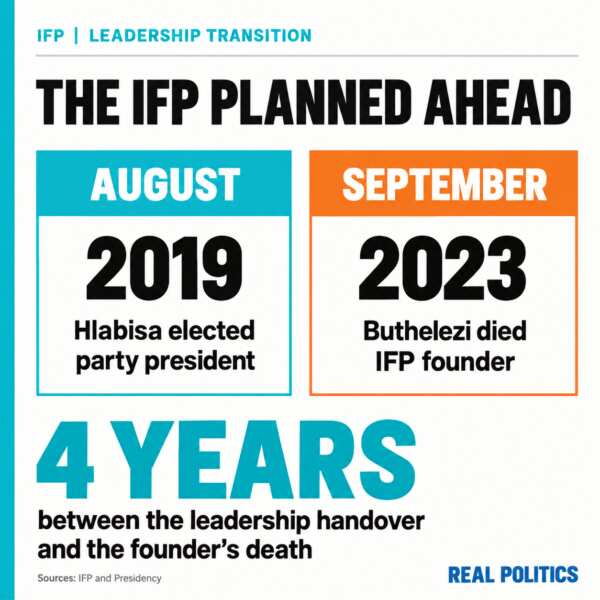
Buthelezi announced in 2019 that he would not seek another term as IFP president. Velenkosini Hlabisa was elected unopposed at its national conference that August.
Buthelezi remained influential until his death in September 2023, but the leadership transition had already taken place.
That distinction mattered. The IFP did not have to resolve its presidency for the first time while mourning its founder. It had a recognised successor and structures capable of allocating responsibilities.
It has remained an important force in KZN’s provincial government and municipal politics. Succession planning alone does not explain that position, but the transition shows the value of establishing leadership legitimacy before a founder’s departure.
There is also the question of what Zuma represents beyond party politics. His relationship with the ANC under Ramaphosa is deeply antagonistic. MK opposes both the ANC and the Government of National Unity, the national coalition formed after the 2024 election.
If Zuma were to die, Ramaphosa would face the delicate responsibility of recognising a former president while navigating a relationship marked by bitter disputes.
A state funeral would provide national recognition without requiring him to endorse every aspect of Zuma’s record.
The family would also have legitimate interests in the arrangements. South Africa’s official policy provides for state funerals for former presidents and recognises a role for their families in determining aspects of the ceremony and burial.
Those arrangements should not become a contest over ownership of the deceased.
The prolonged litigation between former Zambian president Edgar Lungu’s family and the Zambian government illustrates how a funeral can become a political and legal confrontation.
The wider danger is allowing uncertainty to deepen mistrust. Speculation about Zuma’s health, a military hospital transfer and possible security deployments has created fertile ground for rumour.
MK has challenged reports linking his health to possible unrest in KZN. There is no basis to treat violence as inevitable.
Clear communication about political leadership and responsibilities, within the limits of medical privacy, is in everyone’s interest.
Zuma’s supporters face an anxious period when their party needs confidence, momentum and visible leadership. MK must demonstrate that it is more than one man’s vehicle, even as it depends on him to mobilise voters.
Buthelezi understood the importance of preparing his party for a future beyond himself. Zuma’s greatest political legacy may depend on whether the movement he built can do the same.
Subscribe free

![From Mooi River to LA: Mzansi’s angel returns to the Victoria’s Secret Fashion Show [video]](https://cdn.thefuse.co.za/images2/4/a/c/9/4/4ac94dcc-ca5d-3b78-9f3c-80f6d94e31e5-1200x675.jpg)

![Tyla turns heads at 2026 VMAs in daring snakeskin look [PICS]](https://cdn.thefuse.co.za/images2/8/9/2/1/0/8921043f-4914-3278-9d3a-5e597ed3bbbe-1280x720.jpg)