Zulu King’s Warning Resurfaces as Royal Alliances Spark Debate Over South Africa’s Political Future
iReport South Africa | 01.04.2026 14:30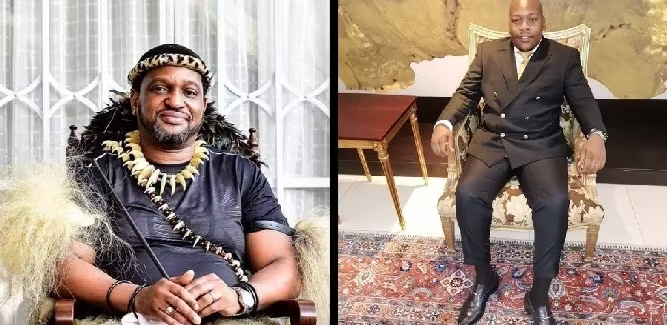
As the East London March draws to a close, royal leaders ignite debate about the end of politics as we know it.
Following recent events involving traditional leadership, a speech that was delivered earlier this year by King Misuzulu kaZwelithini has resurfaced in national discourse. This has raised questions about the possibility of a realignment of influence between the various royal houses in South Africa.
In January, the Zulu monarch issued a message that was both firm and symbolic. In it, he issued a warning that “something significant” was on the horizon, while also emphasising the Zulu nation’s unwavering presence and unity. In addition, he advocated for the elimination of the word “Natal” from the name KwaZulu Natal, a statement that was met with a variety of responses at the time and was, in some circles, disregarded by political leaders.
The recent events that have taken place in East London (uGompo) have, however, rekindled interest in the King’s statements. Ngizwe Mchunu, an activist, asserted that a delegation went to Komkhulu at the AmaRharhabe Royal House in order to request permission to take part in a march. The delegation claimed that they were acting in accordance with the Zulu King’s authority.
The Zulu and AmaRharhabe royal houses, whose leadership is connected through lineage, have historical and familial ties that have drawn attention to this development. These ties have been passed down through generations. This connection, according to observers, has the potential to serve as the foundation for increased cooperation between traditional authorities, which is particularly relevant at a time when discontent with political leadership appears to be growing among certain communities.
According to reports, royal structures were responsible for organising the march that took place in East London. During the march, Prince Xhantilesizwe Sigcawu expressed grievances on behalf of the attendees, including concerns regarding governance and service delivery. He expressed his dissatisfaction with the current state of the nation in a forceful manner, which reflected a more widespread sentiment of dissatisfaction among some citizens.
In spite of the fact that there has been a lot of talk about the possibility of traditional kingdoms working together more closely, political analysts warn against jumping to any hasty conclusions about the implications this could have for South Africa’s constitutional order.
Despite the fact that traditional leadership continues to play an important cultural and social role, any suggestion of fundamental political restructuring would require careful consideration within the framework of the Constitution, according to Thando Mbeki, a political analyst.
In spite of this, the events have brought to light a growing intersection between traditional authority and contemporary political discourse, with royal institutions increasingly expressing their opinions on matters pertaining to the nation.
Despite the fact that South Africa is currently facing ongoing socioeconomic and political challenges, the role of traditional leaders and the extent to which they have the ability to influence public sentiment continues to be a topic of intense interest. It is likely that in the coming months, it will become clearer whether the recent events indicate a more profound shift or whether they remain symbolic gestures.
As a result of power struggles and silence, the disappearance of Sputla raises questions about the direction that energy policy should take.
Electricity Minister Kgosientsho Ramokgopa, also known as “Sputla,” has been conspicuously absent from public discourse, which has sparked a renewed debate about the direction that South Africa’s energy policy is heading in as well as the growing tensions between the priorities of the government and the influence of the private sector.
Despite the fact that Ramokgopa was once a prominent and visible figure in the country’s efforts to address the ongoing electricity crisis, he has largely disappeared from the public eye as a result of reported disagreements with President Cyril Ramaphosa regarding the proposed privatisation of transmission assets. A turning point appears to have been marked by the divergence in views, which has raised concerns about the alignment of internal policy at the highest levels of government.
The controversial discussion regarding the function of private capital in South Africa’s energy sector is at the core of the problem. In the past, Ramokgopa had been linked to a more state-centric approach, which placed an emphasis on the necessity of maintaining strategic control over transmission infrastructure. On the other hand, it appears that Ramaphosa’s more comprehensive reform agenda, which includes increased participation from the private sector, has gained the stronger position.
In the context of government structures, where competing visions for economic reform frequently result in quiet sidelining rather than open confrontation, political analysts suggest that Ramokgopa’s decreased visibility may be a reflection of a broader shift in influence. It is argued by some that this pattern is not new. The private sector interests have a tendency to prevail in policy disputes involving state control versus market liberalisation, according to critics, who have pointed to a recurring dynamic associated with this phenomenon.
This shift has significant repercussions that need to be considered. The energy crisis that South Africa is currently experiencing continues to be one of the most pressing challenges that the country is currently facing. Load shedding continues to have an impact on economic growth, investor confidence, and living life in general. For the next several decades, the future of the energy landscape will be shaped by decisions regarding transmission infrastructure, particularly with regard to the question of whether it should continue to be under public control or whether it should be opened to private investment.
There have also been concerns raised by observers regarding accountability and transparency. They have pointed out that the absence of key policymakers from public engagement can lead to uncertainty and erode trust. According to the words of one energy policy expert, “When crucial decisions are being made behind closed doors, it becomes difficult for the public to understand whose interests are being prioritised.”
Ramokgopa has not made any official comments regarding his diminished public presence; however, his silence has only served to intensify speculation regarding the direction of reform and the internal divisions that exist within the organization. A defining tension in South Africa’s governance landscape is the balance between public mandate and private capital. This tension is expected to continue for the foreseeable future.
A recently married man purchased a Porsche Cayenne from WeBuyCars and was subsequently spotted with another woman. The vehicle is used in the couple’s VIP shuttle business. The incident sparked widespread discussion on social media.