Equality vs. Freedom: The Trade-Off No One Wants to Make
Medium | 05.01.2026 21:48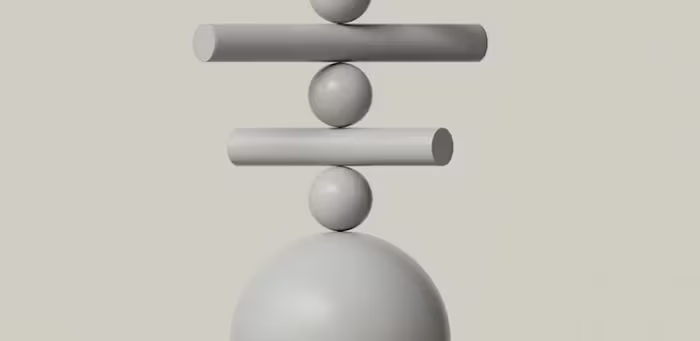
Equality vs. Freedom: The Trade-Off No One Wants to Make
Follow
5 min read
·
Just now
Listen
Share
What happens when our highest ideals start working against each other?
I used to design perfect societies in my head.
No rich, no poor. No racism, no sexism. Just people equal, safe, and content.
It wasn’t just a dream; it felt like a moral imperative, a destination humanity was meant to reach.
But then I hit a wall the kind of wall you only see when you start asking how.
How do you keep everyone equal without someone wanting more?
How do you protect that equality without telling people what they can’t say, can’t want, can’t question?
And what happens when the very act of preserving utopia requires the thing it promised to abolish: control?
I began to realize that two of our most cherished ideals equality and freedom might be at war.
Not in theory, not in dusty philosophy books, but in the messy reality of human nature.
We want both. We preach both. Yet every society in history has tilted toward one, often at the expense of the other.
This is the trade-off we avoid naming.
The uncomfortable bargain hidden inside every political system, every revolution, every vision of a better world.
What if we can’t have it all?
What if every step toward perfect equality is a step away from total freedom and vice versa?
I’m not here to sell you answers.
I’m here to sit with the question and to ask what we do when the dream of “having it all” starts to crack.
MY VISION OF A PERFECT WORLD
I imagined a world without lines.
Not just lines on maps, but lines between people.
A world where Black and white families lived side by side not just legally, but truly without stereotypes, suspicion, or fear.
Where healthcare was free, and cures were universal.
Where poverty and extreme wealth didn’t exist; where everyone had enough, no one had too much, and no one had to beg.
And where authority wasn’t questioned, because authority wasn’t oppressive it was trusted, like the steady hand of a parent in a well-run home.
In this world, fairness wasn’t a policy. It was the air we breathed.
You didn’t have to fight for respect, demand your rights, or protest for dignity it was simply given, woven into the fabric of society.
No one looked down on anyone else, because there was no “down” to look from.
We were all on the same level.
It was more than a society. It was a sanctuary.
And in my mind, it didn’t feel naïve it felt like the only moral destination worth pursuing.
THE CRACKS IN THE UTOPIA
But utopia has a flaw.
It assumes we will always be satisfied.
And humans, I learned, are rarely satisfied for long.
When contentment fades, questioning begins.
Then comes the whisper: What if I had more?
The neighbor’s garden looks greener. Their voice is heard louder. Their life seems brighter.
And in that flicker of comparison, equality begins to crack.
Soon, questioning turns into wanting.
Wanting turns into taking.
Taking demands power.
And power once held by a trusted authority starts to corrupt.
The government, designed to protect, begins to erase silencing critics “for the greater good,” not realizing it is planting seeds of rebellion.
The white man remembers his skin and calls it superiority.
Men hurt women to feel control.
Greed rises like a fever: This is mine. That should be mine.
Property becomes possession; sharing becomes sacrifice.
My perfect world didn’t account for the hunger inside us —
the hunger for more, for different, for better, for power.
It assumed we could be forever good.
But human history is a story of good intentions buckling under human nature.
Get Jasminekira’s stories in your inbox
Join Medium for free to get updates from this writer.
Subscribe
Subscribe
I thought equality would erase selfishness.
Instead, I saw that selfishness could erase equality.
SO WHERE DOES THAT LEAVE US?
I used to think this was my own private disillusionment — a failure of imagination, or perhaps a failure of hope.
But then I opened the history books.
I read the philosophers.
I studied revolutions.
And I found that my “discovery” was not mine alone.
It was humanity’s oldest political lesson, learned in blood and repeated in every utopian experiment:
We cannot have perfect equality and perfect freedom at the same time.
Plato’s Republic sacrificed individual liberty for collective harmony.
Marx’s communism demanded a “temporary” dictatorship to erase class a temporary that often became permanent.
Even the American dream freedom above all allowed staggering inequality to grow in its shadow.
Every system chooses, consciously or not, which value to prioritize.
And every system pays a price.
If you prioritize equality, you must limit the freedoms that allow some to rise above others the freedom to accumulate wealth, to speak against the collective, to dissent.
If you prioritize freedom, you must accept that people will choose differently, succeed unevenly, and leave others behind.
We don’t like this trade-off.
We vote for politicians who promise both.
We march for justice and liberty in the same breath.
We want the fairness of socialism and the dynamism of capitalism without admitting they pull in opposite directions.
But in avoiding that choice, we risk building societies on a lie…
Or worse, we swing violently from one extreme to another when the lie collapses.
AN HONEST ENDING
So where does that leave us?
If perfect equality costs us freedom, and perfect freedom deepens inequality
if utopia is forever out of reach because of who we fundamentally are
then what do we do with our dreams of a better world?
Maybe the answer isn’t in choosing one over the other forever.
Maybe it’s in choosing again, every day.
Not a fixed utopia, but a living balance
a society that guards dignity without suffocating dissent,
that allows difference without allowing cruelty,
that knows when to lift barriers and when to set limits.
History suggests we will always tilt toward one side.
But hope asks: can we tilt, and then correct?
Can we design systems that are humble enough to admit their own flaws,
and flexible enough to change when they fail?
I no longer design perfect societies in my head.
Instead, I look for the small, possible adjustments:
A little more equality here.
A little more freedom there.
A world not made in one grand blueprint,
but built, broken, and rebuilt by people who know that the trade-off is real,
but who refuse to stop negotiating it.
In the end, maybe the most honest question isn’t “Which one will you choose?”
But rather:
“Is it possible for us to balance it or do we always have to choose?”
And perhaps, in asking, we already begin to build something better than perfection
something human.