Ramaphosa’s SONA 2026 and the countdown to local elections
Explain | 06.02.2026 20:14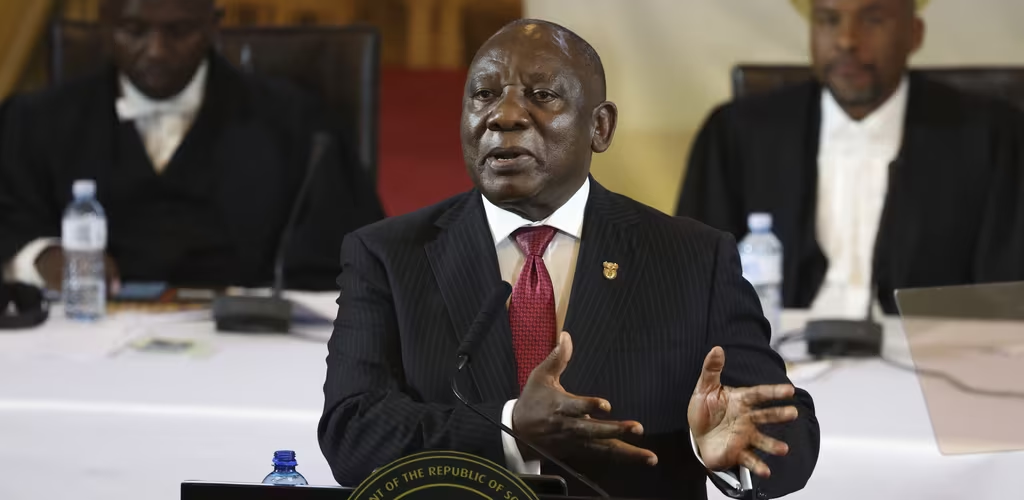
Another year, another SONA — and a familiar mix of big promises and bigger expectations. Ramaphosa says the state is turning a corner, but with water cuts fatigue, crime fears and election pressure mounting, South Africans want proof, not poetry.
It’s that time of year again: President Cyril Ramaphosa is gearing up for the State of the Nation Address (SONA) 2026, happening on 12 February at 7 pm — aka the annual moment where the president tells us what the government plans to do… and we all decide whether we believe him.
This will be the eighth SONA of Ramaphosa’s presidency. And yes, it matters — not because it’s always thrilling TV, but because this speech helps set up Parliament’s priorities (and the budget) for the year ahead.
The Economy. Local Government Elections. Inequality. Poverty. Geopolitical Instability.
So, what should you expect?
Analysts say there are a few big themes that are almost guaranteed to show up — and a couple that feel especially unavoidable this year.
The “always” topics: jobs, inequality, poverty… and the G20
Some things are basically guaranteed to show up in a SONA.
Naledi Modise, a political science lecturer at North-West University, told explain that there are three issues that almost never miss the cut: unemployment, inequality and poverty.
And honestly… fair. South Africa is regularly labelled one of the most unequal countries in the world, so it’s not like the president can pretend it’s not the core problem.
That inequality crisis — in South Africa and globally — also dominated last year’s G20 summit, and both Modise and Zukiswa Kota from the Open Government Partnership Steering Committee expect Ramaphosa to reference it in his speech.
South Africa hosted the G20 in Johannesburg in November 2025, and by most accounts, it was a political win for both the country and the president. One of the summit’s biggest moments was the launch of a landmark global inequality report, commissioned by Ramaphosa himself.
The report was authored by the 2025 G20 Extraordinary Committee of Independent Experts on Global Inequality, led by economist Joseph E. Stiglitz, with contributors including Adriana Abdenur, Winnie Byanyima, Jayati Ghosh, Imraan Valodia and Wanga Zembe-Mkabile. Its message was blunt: inequality is rising worldwide, and it’s becoming one of the defining crises of our time.
The findings were widely welcomed by G20 members — and Kota says she expects Ramaphosa to use SONA to outline what government claims it has done, and still plans to do, to tackle inequality at home.
Given that the president commissioned the report, it would be awkward if he didn’t arrive with at least a few concrete ideas.
After all, the report itself frames its ambition clearly: to be a “permanent legacy” of South Africa’s G20 presidency — and a tool to move the world closer to shared prosperity.
The obvious question, then, is whether that legacy starts where it matters most: in South Africa itself.
We’re officially in election season. The 2026 municipal elections are coming up later this year, and the stakes are high. Service delivery is collapsing in many municipalities, communities are frustrated, and that anger is almost certainly going to show up at the ballot box.
Every analyst we spoke to agreed on one thing: local government elections will loom large in this SONA.
But Ramaphosa won’t just talk about protecting the integrity of the vote, says Kota. He’s also expected to sketch out leadership and administrative priorities — in other words, how the government plans to steady the ship at a moment when local municipalities are under serious pressure.
Professor Susan Booysen from Wits puts it more bluntly: voters will use the elections to judge whether the coalition government has actually made life better for them. Even though the GNU doesn’t directly run municipalities, its performance still shapes how people feel about governance overall — and that sentiment will spill over into local polls.
The mood, though, is grim. There’s deep despondency and disillusionment among voters, and Booysen expects Ramaphosa to try to counter that by reminding South Africans that there are plans to fix local government.
Whether people believe him… that’s another matter.
Beyond the headline issues, Naledi Modise flags a few wildcard topics that could surface in the speech. Rising anti-immigration sentiment is one — a politically charged issue that’s been gaining traction and isn’t easy to sidestep.
She also expects references to the ongoing work of the Madlanga and Nkabinde commissions, both of which are meant to signal accountability but remain under close public scrutiny.
Then there’s foreign relations. Modise says Ramaphosa may touch on South Africa’s increasingly delicate diplomatic positioning, including the controversial expulsion of the Israeli Chargé d’Affaires, a move that has sparked both praise and pushback at home and abroad.
These aren’t guaranteed centre-stage moments, but in a tense political year, any one of them could quickly steal the spotlight.
Why SONA still matters (even if the vibes don’t)
Let’s be honest: SONA is long. It can run close to two hours, gets technical fast, and often feels like a greatest-hits remix of past speeches. Ramaphosa works through economic outlooks, policy priorities and political realities — and for many viewers, it’s a lot.
But none of it is accidental.
Every line of the speech is debated, negotiated and polished before it makes it onto the president’s iPad (yes, he reads it off an iPad — boomer stereotypes in shambles). Even if it sounds familiar, the wording matters.
What’s different this year is who’s behind the speech.
In the past, SONA was largely an ANC product. That changed in 2024, when South Africa entered the coalition era with the formation of the Government of National Unity (GNU). Coalitions aren’t new at the local level, but nationally, this is still uncharted territory.
According to Naledi Modise, it’s likely that this year’s speech includes input from GNU cabinet members — not just the ANC. And Professor Susan Booysen says that creates a real challenge for Ramaphosa: SONA has to reflect not one party, but a coalition.
As Booysen puts it, “it is high time and given that it is an election year, it is high time that the SONA show gives explicit recognition to the political reality of a coalition”.
Beyond the politics, SONA is still one of the clearest signals of what the government thinks is important. It’s meant to reflect progress on past promises and outline priorities for the year ahead. If you’re looking for a paper trail to hold government accountable, this is it. As Modise puts it, “if you want a tool to hold the government accountable, the SONA is that place”.
SONA is also a useful window into how the government balances competing demands. As Booysen explains, it allows the public to “observe the complexity of government and how many different expenditure priorities have to be balanced with one another”. In short, it’s democracy in all its messy detail.
There’s also a practical reason SONA happens in February: it marks the start of the parliamentary year and sets the scene for the national budget. And yes, that’s the budget that decides how much money goes to schools, hospitals and municipalities — and whether sin taxes on sugar, cigarettes and alcohol are about to jump.
Those everyday frustrations (potholes, water cuts, broken clinics, expensive universities, unreliable public transport) all flow from the policy commitments outlined in SONA.
That’s why, as Kota points out, it’s not enough to listen for promises. What matters is whether they’re backed by resources. As she puts it, “a promise without adequate resources, whether it’s financial or otherwise, remains just a promise”.
Still, for many South Africans, SONA can feel like a waste of money. The red carpet, the ceremonial pomp and the occasional chaos in the chamber often drown out the substance.
But strip away the drama, and SONA remains a pivotal democratic moment. It’s one of the rare occasions where all three arms of the state gather under one roof: the executive, the legislature and the judiciary. And yes, the shouting and interruptions from the benches aren’t necessarily a bad thing — they’re part of how democracy makes itself heard.
With local government elections around the corner, Ramaphosa’s words this week won’t just be symbolic. They’ll signal what the state thinks it can deliver — and what voters are being asked to believe.
And in 2026, belief is in short supply.


