Champagne, crocs and no roads: The secret luxury hideaway on Australia's wildest coast
BBC | 13.11.2026 15:00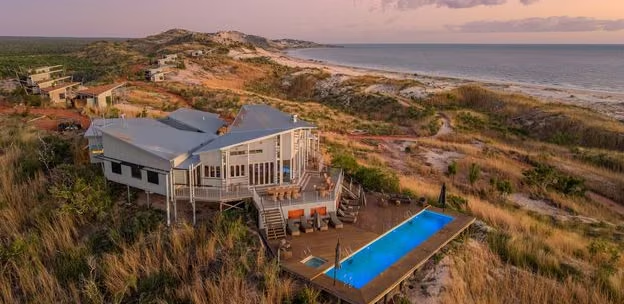
Accessible only by sea or air, this remote retreat pairs five-star luxury with ancient rock art, spectacular gorges and extraordinary isolation.
For most of the 80-minute charter flight from Darwin, there is nothing beneath me but the Timor Sea. There are no roads to where I'm going. Nor are there towns, settlements or shops.
Then, suddenly, Australia reappears. The endless expanse of blue gives way to pale sandbars and braided waterways, then rust-red rock, mangroves and a serpentine river slicing its way through the landscape.
Our Cessna banks towards a long red-dirt airstrip carved into the bush. As I duck through the plane's tiny doorway, I'm hit by a wall of hot, dusty air. Then someone takes my bag and hands me a glass of Bollinger.
This is Berkeley River Lodge, an off-grid luxury retreat on one of Australia's most inaccessible coasts.
Five-star luxury, 200km from the nearest road
I've travelled extensively across Australia, but I've never been anywhere that feels quite this remote. Berkeley River Lodge lies in the north-east of Western Australia's Kimberley region, a far-flung wilderness of sandstone escarpments, river gorges and empty beaches. From the airstrip, red earth and green scrub stretch to the horizon. Beyond the lodge, this vast stretch of coastline is virtually uninhabited. In a world where even far-flung destinations are increasingly within reach, this still feels completely off the map.
"If I dropped you out there and let you go for a walk, you would walk somewhere no [guest] has likely ever walked before," lodge guide Josh Halloran tells me later.
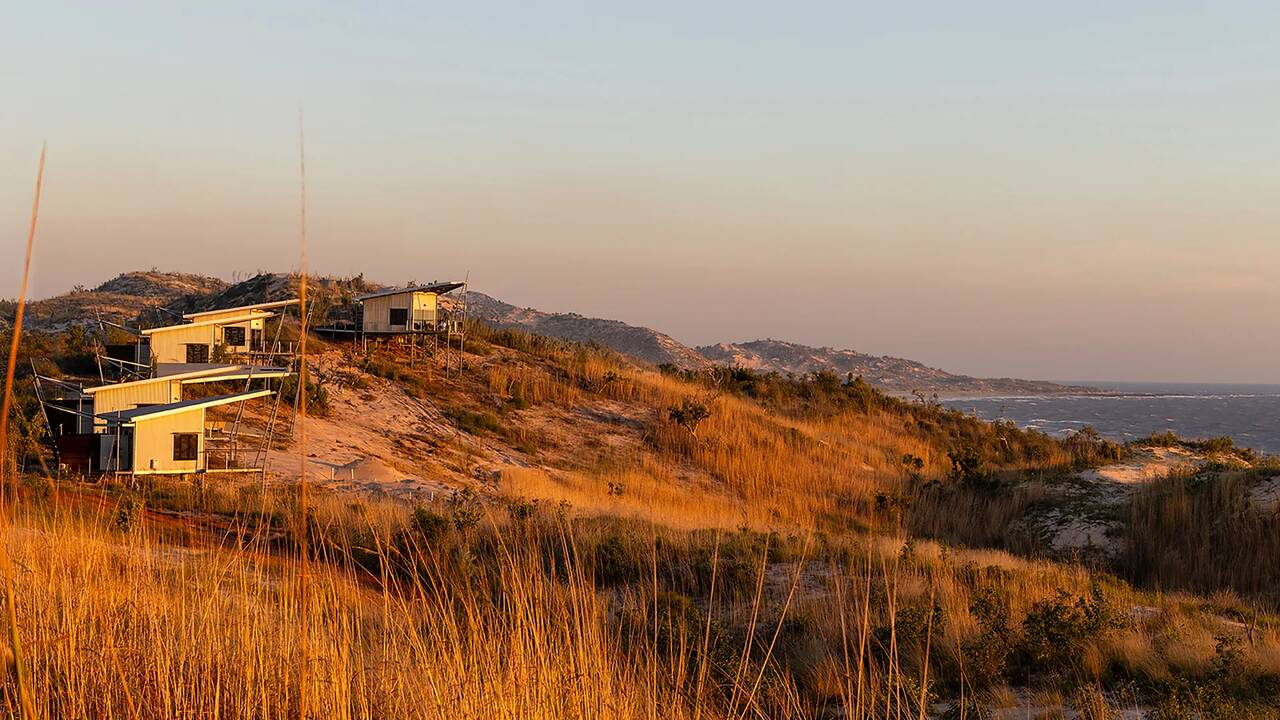
My five flight companions and I are ushered into an open-air safari buggy, our luggage already stowed. As we drive from the airstrip and crest a small hill, the lodge comes into view: 15 villas perched on sand dunes, linked by winding red-sand tracks and tethered by a main lodge, its brilliantly blue swimming pool looking decidedly out of place. As we get closer, I see a flurry of uniformed staff waiting for us to arrive. Nothing about the landscape outside suggests any of this should be here.
Although the sea is tantalisingly close, swimming is strictly off limits; this is saltwater crocodile country
The price is almost as startling as the location. A compulsory five-night, all-inclusive stay costs A$19,750 (£10,370/US$13,870) for two people. It's an extraordinary amount of money to spend travelling to a place with almost nothing around it.
But as I quickly learn, that is precisely the point.
A mirage in the dunes
On paper, Berkeley River Lodge doesn't really make sense. Only open for four months each year, it offers morning yoga on the deck, evening cocktails and multi-course tasting menus. There's a maximum of 30 guests at a time, with 22 staff to cater to their every whim. Yet there's no mains power or water, no mobile phone reception and, crucially, no road in or out. Although the sea is tantalisingly close, swimming is strictly off limits; this is saltwater crocodile country.
"The nearest road is over 200km [124 miles] away," says co-owner Rachel Bromage, explaining that the only way to reach the lodge is by air or boat. "Lots of the Kimberley is remote, but this is truly remote."
For guest Rob Wheeldon-Fookes, who has come here on honeymoon with his new wife Liz, the absence of almost everything is part of the appeal. "I love the idea of being cut off," he says. "There's something very luxurious about being away from other people."
It's surreal encountering civilisation in a place this wild. At the lodge entrance, a board cheerily lists the day's adventures, from barramundi fishing and river cruises to beach drives and bushwalks. I'm shown to my villa, an airy, understated space with timber floors, a huge bed dressed in crisp white linen and floor-to-ceiling glass doors opening onto a private deck. In the open-air bathroom, a freestanding marble tub sits beneath the vast Kimberley skies. Later that night, I lie back and gaze up at the luminous sweep of the Milky Way, soundtracked by the ocean and a chorus of fat frogs.
A landscape billions of years in the making
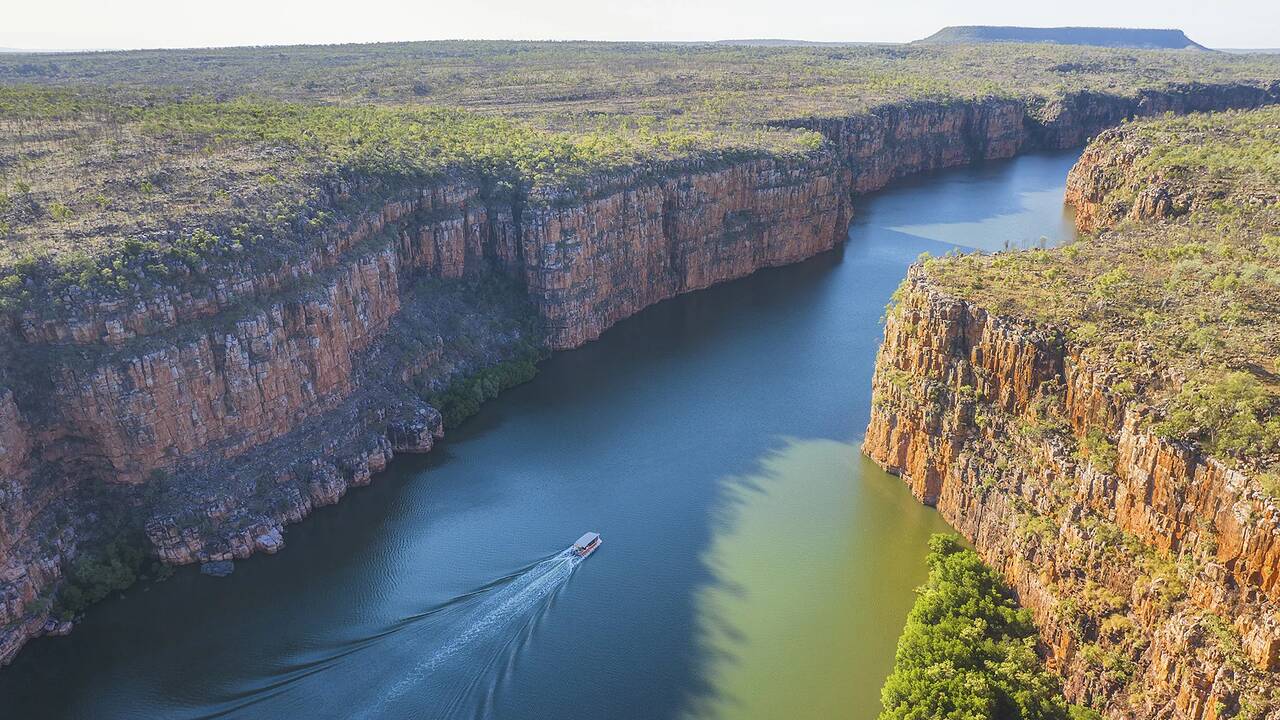
The next day, I'm aboard a boat, speeding up the Berkeley River into Casuarina Creek with a small group of guests. The waters are hemmed in by towering cliffs of rust-red sandstone, their enormous, striated blocks stacked like Jenga pieces. Halloran warns us against taking a dip. "You wouldn't want to enter the water here. There's big things that live in there."
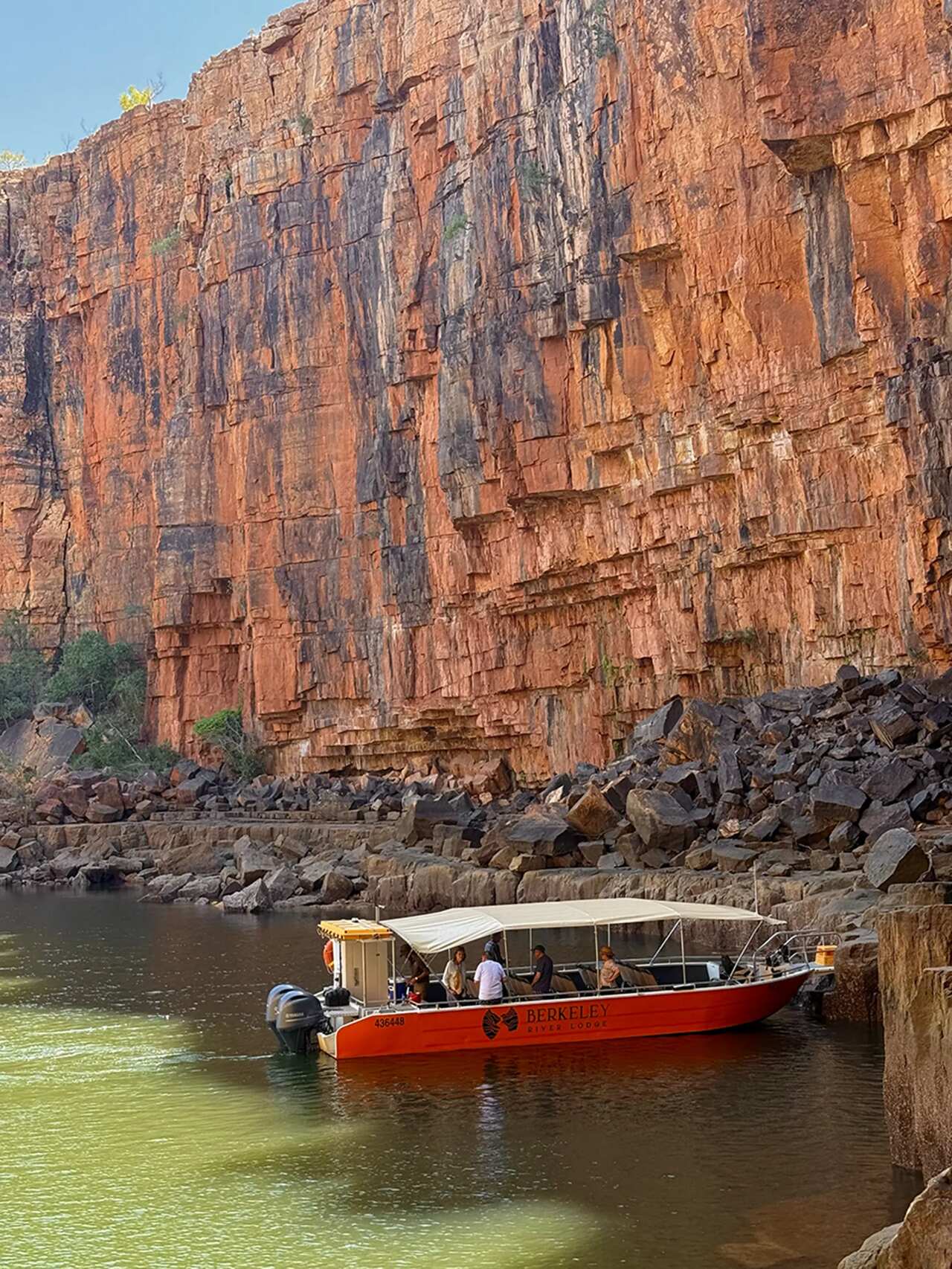
Instead, we head ashore and clamber up a steep slope of loose rocks, slipping and scrambling in the relentless heat. Halloran, who spends much of the hike barefoot, bounds ahead, stopping occasionally to point out things we'd otherwise miss: hundreds of tiny white shells carefully collected by a male bowerbird to attract a mate, trees whose bark can be used to carry water, a giant rock with the ripples of an ancient waterway seemingly frozen into its surface. This is an almost incomprehensibly old place, with rock formations dating back around 1.8 billion years, long before complex animal life evolved.
Getting there: Berkeley River Lodge is accessible via an 80-minute scenic charter flight from Darwin.
When to visit: The lodge is open from 1 May to 31 August. Its 15 villas accommodate a maximum of 30 guests.
Cost: Five-night, all-inclusive packages for the 2027 season cost A$19,750 (£10,370/US$13,870) for two people sharing, or A$18,250 (£9,545/US$12,825) for single occupancy. The price includes return charter flights from Darwin, accommodation, gourmet dining and beverages, one in-villa spa treatment per person and guided excursions.
What to do: Included activities include river cruises, guided hikes to ancient Aboriginal rock art, barramundi fishing and sunset 4WD beach excursions. New for 2027 are a Kimberley botanicals masterclass and a barefoot barbecue experience.
From the top, we gaze down into a spectacular gorge, its sheer cliffs plunging towards a ribbon of green water. I shuffle to the edge of the escarpment, slightly terrified by the vertical drop below me, and see a crocodile's tail poking out from the base of a waterfall. When Halloran later invites us to swim in a separate, pandanus-fringed waterhole, I decline, still unnerved by the croc sighting, though quickly regret it as I watch other guests float past on their backs like otters.
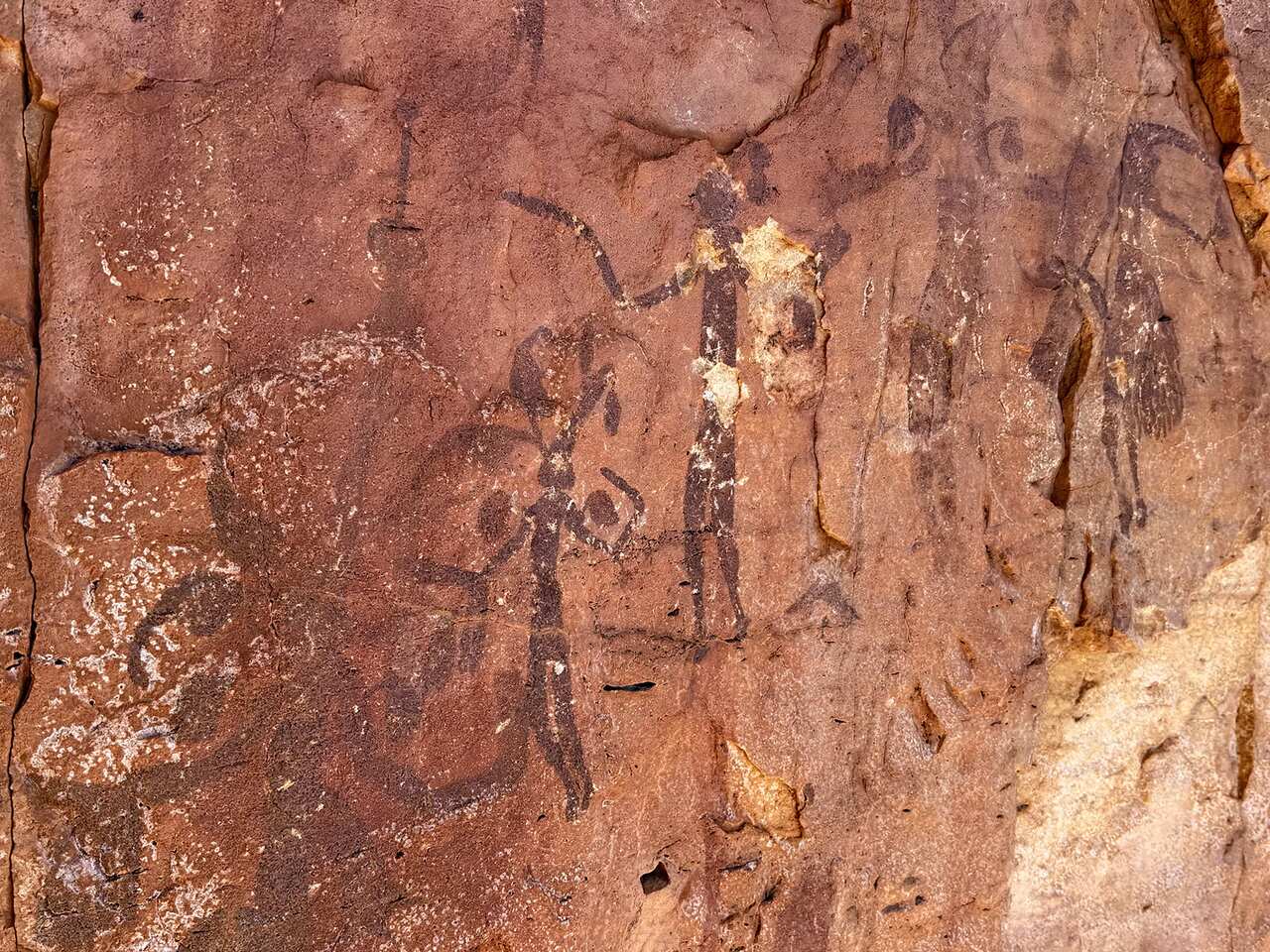
Eventually, Halloran leads us into a rocky overhang where he points to a series of faded ochre drawings. We're on Balanggarra Country, and the rock art offers a glimpse into the region's long Aboriginal history. Among the drawings is an animal that he says could be an extinct thylacine – a wolf-like marsupial once found across Australia.
I gaze at depictions of slender human figures with elaborate headdresses and tassels hanging from their bodies, examples of the mysterious 12,000-year-old Gwion Gwion rock art, sometimes known as Bradshaw paintings. Halloran suspects there is much more ancient art scattered across this vast landscape, still waiting to be found.
"Do you realise where you are?" he asks. "One of the most remote places in the world."
The price of paradise
Back at the lodge, a five-course dinner appears as effortlessly as if we were sitting in a city restaurant. Seated around a long table overlooking the tidal flats, with white linen and rows of wine glasses, we're served a wine-paired feast: duck rillettes, vitello tonnato, charred asparagus with miso hollandaise and wagyu sirloin. The meal ends with an elaborate creation of chocolate, cashew and tonka foam.
Behind the scenes, however, delivering this level of luxury requires extraordinary planning. The lodge operates entirely off grid, generating its own electricity and drawing water from a bore beneath the dunes. Fresh produce arrives on twice weekly flights, while larger supplies come by barge every 10 to 12 weeks.
"If you're out of lemons, you're not going to get any more lemons," general manager Hannah Wark, tells me, laughing.
And when things go wrong, it's not always as simple as a missing ingredient. Wark has dealt with bushfires, torrential rain and medical scares serious enough to involve the Royal Flying Doctor Service. With no hospital or road access, an emergency can require an evacuation by air.
But nothing could have prepared them for November 2025, when Cyclone Fina struck with devastating force. As the category-three cyclone's winds howled across the coast, two caretakers stationed at the lodge during the wet season took refuge in an underground bunker, emerging some 18 hours later. "It's like a bomb's gone off. It's apocalyptic," they told Bromage over satellite phone.
The lodge wasn't insured and the owners faced a difficult decision: walk away or attempt to rebuild in time for the next season, just five months away.
Remarkably, Berkeley River Lodge reopened in May 2026, just in time for the first guests of the season. Its villas and public spaces have been extensively refurbished, though diesel generators have temporarily replaced the solar power system destroyed in the cyclone, which is expected to be restored in 2027. "Anything that could move has been replaced. Every cushion, every side table, every chair. Every sun lounge," said Bromage.
There was even a snake discovered inside the staff pool table. "The Kimberley's the boss here; it's in control," Bromage said.
The luxury of being cut off
Despite – or perhaps thanks to – the isolation, there's a surprisingly sociable side to life at Berkeley River Lodge. With no TVs in the rooms, and everyone rotating through excursions and evening meals, strangers quickly become friends.
More like this:
• The tiny Arctic island where travellers have found refuge since 1897
• A stay in Pakistan's remote Ishkoman Valley, where humans still consult fairies
• 'Apparently I am afraid of heights': The Peruvian hotel with a terrifying check-in
Wark says guests often arrive at the airport in Darwin having never met, only to leave planning future trips together. "Some have already booked other holidays with each other before they even leave the property," she says.
And while the lodge's comforts are considerable, it's the surrounding emptiness that seems to make the deepest impression.
"It's so easy just to walk away and have complete silence," says Liz, the honeymooner I met at breakfast. "You get a complete vista of the ocean with nothing there. No boats. No people... absolutely nothing but nature."
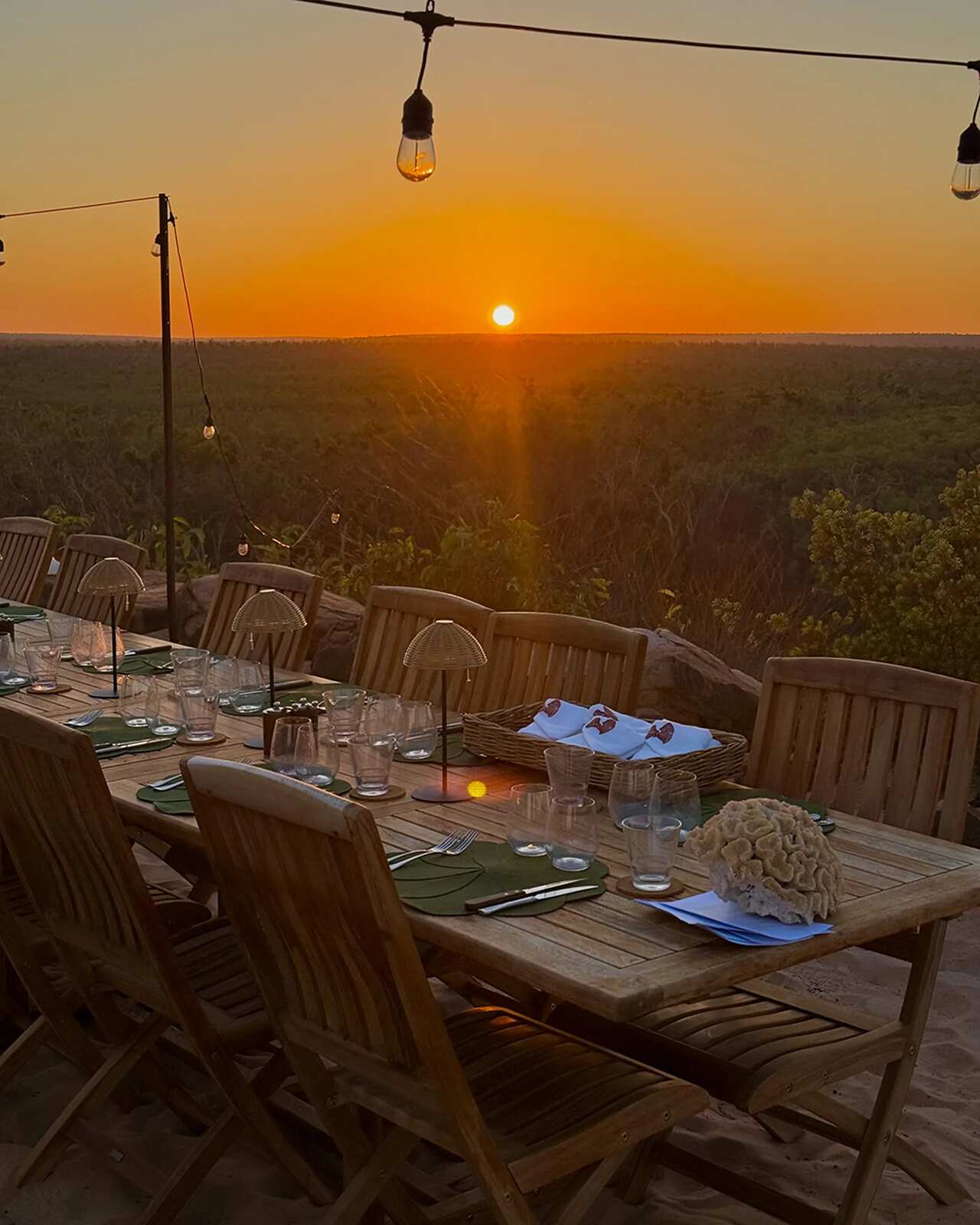
On our final evening, we're treated to a new barbecue experience the lodge plans to offer next season. At a sandy spot behind one of the villas, a long table has been set up in the sand, with lights strung overhead. As the last of the sunlight fades over the Kimberley, we're served heaping platters of chargrilled ribeye, honey-glazed carrots and grilled radicchio followed by flamed pineapple with macadamia crumble.
There's a celebratory mood in the air. We're the last guests of the season, and tomorrow, almost as soon as our plane takes off, the staff will begin the enormous task of packing the lodge up for cyclone season before they leave soon after.
A few days ago, we were strangers climbing aboard a tiny plane in Darwin; now we're swapping stories and bonding over our adventures. Tomorrow, we'll return to a world of roads, traffic and mobile phone reception. For now, though, sitting barefoot in the sand, hours from the nearest town, I find myself wishing the whole experience could start again.
"It still gives me goosebumps," Bromage tells me. "This is Australia at its rawest, and it's something that can never be replicated."
--
If you liked this story, sign up for The Essential List newsletter – a handpicked selection of features, videos and can't-miss news, delivered to your inbox twice a week.