They Didn’t Know Any Better
Medium | 27.01.2026 09:02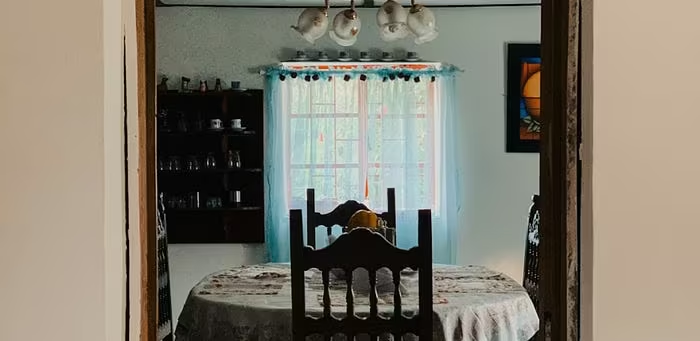
They Didn’t Know Any Better
Follow
4 min read
·
Just now
Listen
Share
They didn’t know any better at the time.
I will never forget the first time I heard a racial slur. I was sitting with my mom at my great grandparents house, gathered around the dining room table just moments after prayer. The word came casually, freely, from the mouth of my great grandfather, a man I adored.
This was the man who checked our tire pressure before we left. The man who waved us off from the driveway with tears in his eyes because he hated seeing us go. The man who could fix anything with his hands and hand draw a map to a location towns away, He felt safe. Familiar. Good.
I was around nine or ten years old, and the moment the word left his mouth, my body froze. I knew it was a bad word. A dehumanizing word. A word meant to reduce someone to less than human.
What stood out even more than the word itself was what followed or rather, what didn’t.
Not one adult at the table spoke up.
Not one person corrected him.
No one said, You can’t say that.
The conversation moved on as if nothing had happened, as if something hadn’t just cracked open inside me.
My mom brought it up on the way home. She spoke gently, trying to make sense of it for both of us.
“He grew up in a different time,” she said. “He doesn’t know any better.”
I stared out the car window, confused. I couldn’t understand how the man who knew how to repair engines, read weather in the sky, somehow didn’t know better?
That phrase “ they didn’t know any better” has stayed with me ever since.
When we read history, we often ask the same questions.
How did people allow things like this to happen?
How did no one stop it?
How did entire communities participate in or quietly ignore harm so obvious to us now?
The explanation we’re offered again and again is deceptively simple:
They didn’t know any better.
It creates distance. It lets us believe we are fundamentally different more enlightened, more evolved, more moral. It allows us to shake our heads at the past without examining the present too closely.
But the older I get, the more I wonder how true that really is.
Because knowing better isn’t always about access to information. Sometimes it’s about courage. Sometimes it’s about choosing discomfort over silence. Sometimes it’s about being willing to fracture a moment of peace to prevent something far worse.
Silence is often framed as politeness. As respect. As keeping the peace.
But peace built on harm isn’t peace at all, it’s just quiet.
I think often about how current times will be remembered. What footnotes will be written about us. What future generations will read and struggle to understand.
Get Chandra Pierce’s stories in your inbox
Join Medium for free to get updates from this writer.
Subscribe
Subscribe
How did they let this happen?
Why didn’t anyone intervene?
Didn’t they see what was happening?
And what will our answer be?
When I imagine speaking to my grandchildren one day, I wonder if I’ll be tempted to repeat the same generational line. We didn’t know any better. Or will I speak truthfully and admit that we did know and still struggled to act?
Because it feels different now.
The wrong isn’t hidden in textbooks or whispered behind closed doors. It waves giant red flags directly in our faces. It lives on our screens, in headlines, in videos we can’t unsee. The violence. The dehumanization. The slow erosion of empathy, often dressed up as policy, rhetoric, or “just the way things are.”
And yet, many still look away.
Whether out of hatred, ignorance, fear, exhaustion, or an unwillingness to take accountability, we minimize it. We downplay it. We treat it like a fly at a picnic, annoying, unfortunate, but not worth disrupting the meal.
Silence becomes easier than confrontation.
Comfort becomes more valuable than justice.
And slowly, quietly, the extraordinary becomes normal.
I don’t believe most people are inherently cruel.
I think many are tired. Overstimulated. Afraid of being wrong. Afraid of being judged. Afraid of losing safety, connection, or belonging.
But fear does not absolve us.
History shows us again and again that harm doesn’t require monsters. It only requires enough ordinary people willing to stay quiet.
I return often to that dining room table. To the prayer that had just been spoken. To the love I felt for the man who said the word. To the adults who said nothing. And to the child who knew without needing an explanation that it was wrong.
Maybe knowing better begins there.
In the pause.
In discomfort.
In the moment when your body recognizes what your mind hasn’t yet learned how to articulate.
The question is what we do next.
Do we explain it away?
Do we inherit silence and pass it down intact?
Or do we interrupt the pattern, even when our voices shake?
I don’t expect perfection from myself or anyone else. But I do hope that when the story of our time is told, it won’t be said that we didn’t know any better.
Because we did.