An American in Palestine
Medium | 29.12.2025 23:57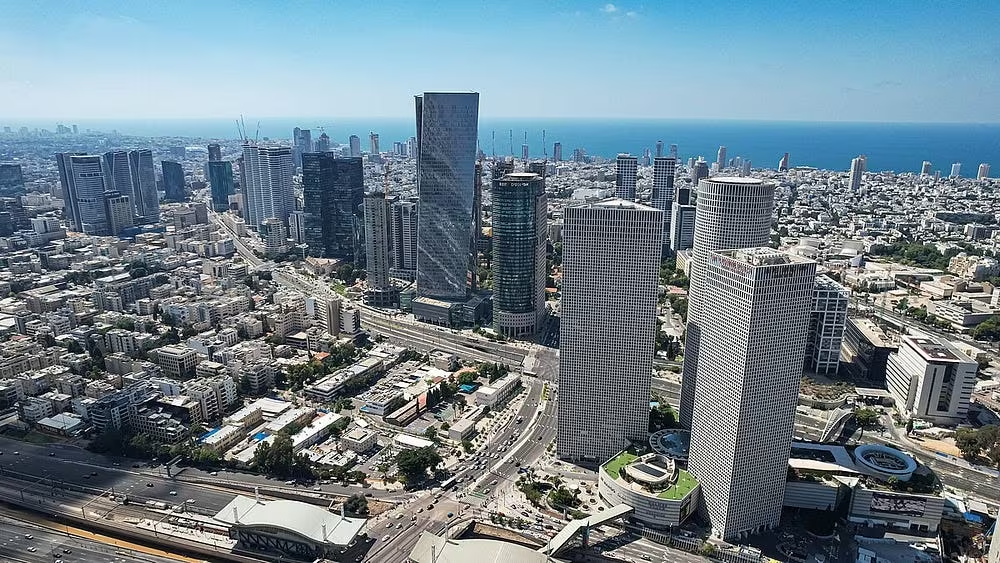
The author had read about living under a brutal occupation. But he wanted to see the situation with his own eyes. The chapters in this series reveal what he found.
NOTE: This is the last of 16 chapters in my An American in Palestine series of personal essays. In the future, I might add a preface and an extended epilogue and then assemble all of the pieces together into a self-published book, which I would make available at low cost. I would be grateful to receive your feedback about the possibility of proceeding with a book. If you think it would be a good (or bad) idea, please leave me a short reply in the comments section. Thank you for your interest in my work!
Shortly after waking up in the morning of my last day in the West Bank, I speculated on how my trip to Tel Aviv might unfold. I would be visiting for only a few hours before retiring for a brief nap in a hostel I had booked and then heading to the airport well before sunrise.
I knew one thing for certain: getting into Israel and then continuing to my city of departure would be yet another adventure. Throughout my one-month stay in Palestine, I had repeatedly experienced the interminable delays involved in surmounting all the restrictions on movement imposed by the occupying power. Yet I never anticipated that my coming journey would be filled with even more twists and turns than usual.
After making my way to the Excellence Center for final goodbyes, Osama kindly offered to drive me to the edge of the Old City to find a servee¹ that could take me to Bethlehem. Surprisingly, the trip to the town where Jesus was supposedly born over 2,000 years ago went off without a hitch. And unlike my last jaunt to the city, my cabbie knew exactly where to drop me off for the bus that could carry me to the other side of the separation wall into Jerusalem. So far so good. But then the difficulties emerged.
“The last bus just left!” a local cab driver announced while trotting away from a taxi stand toward me.
“What do you mean?” I anxiously asked.
“It’s getting close to Iftar, so no busses will be running for the next few hours,” he explained. And then he made an unusual pitch. “C’mon, we’ll beat the bus!” Seeing my puzzled expression, he clarified his proposal. “We’ll take side streets and get in front of the bus and then I’ll let you off so you can catch it.”
I immediately worried it was a scam. How could I trust this guy, I thought. But then another cab driver at the stand affirmed, “He’s telling the truth.”
What choice do I have? I reasoned. I figured the worst that would likely happen is that he would overcharge me. So I jumped into the passenger’s side while he hopped in behind the wheel. Then we sped off.
Racing along winding roads, I felt like I was in a chase scene in a low budget movie. Needless to say, I was skeptical that his plan would work. But as we neared the border to Jerusalem, he suddenly exclaimed, “There’s the bus in line at the check point — just run over there and they’ll let you get on!”
Peering ahead through the congested traffic at the bus inching closer to the large, multi-lane checkpoint, I couldn’t imagine sprinting toward the mayhem without getting shot by one of the many armed IDF soldiers surrounding the area.
“I’m sorry, but I don’t feel safe running there when it’s such a short distance from the checkpoint!” I confessed to my driver who, as a Palestinian living in the West Bank and the owner of a car marked with green license plates, wasn’t allowed to take me across the line that separated the occupied land from the occupiers on the other side.
Then, to my surprise, he himself darted toward the highway clogged with vehicles heading to Israel yet still far from the front of the line.
“Can you take this guy across the border?” the cabbie, who, by now, had certainly earned my trust, screamed at random to the motorists in the extended cue.
How is this ever going to work? I asked myself in hopelessness. But, within only a few minutes, a man invited me with a gesture to join him in his van. Again, I was nearly forced to put my life into the hands of yet another stranger.
“How much is the fare?” I asked my dare-devil driver who had flagged down my next chaperone.
“Whatever you want to give me,” he replied.
“How about this?” I inquired while producing a few bills.
“It’s so hard for me to earn enough to feed my family,” he pleaded. After a moment’s hesitation, I considered that he was indeed a low-income worker and had gone above and beyond for me. So I added a generous sum to the total and, following his genuine display of gratitude, rushed over to my next vehicle of transportation.
My latest escort, a Palestinian who lived in Israel, was especially good natured and immediately put me at ease. And best of all, for my purposes, his van was equipped with yellow license plates, the ticket that gives a select few Palestinians passage to and from the Zionist state where they reside as second-class citizens. He told me he was on his way home and would drop me off at a bus stop, where I could catch a bus that would take me to the central bus station in Jerusalem to catch yet another bus that would carry me to Tel Aviv.
A short while later, we pulled up to the stop. “How much do I owe you?” I asked.
“Nothing,” he replied. “It was my pleasure. May you have a safe travel home, inshallah.”
The rest of the way to Tel Aviv also presented stressful moments, but nothing that struck me as out of the ordinary for someone trying to navigate his way through an unfamiliar country. Yes, once I exited the next bus, I was hopelessly lost trying to find the main bus station by foot. Thankfully, however, a very friendly, fashionably dressed young Jewish woman I asked for help didn’t just verbally spell out the directions to follow — she literally led me a considerable distance to the ticket window near the gates where the busses were parked.
Soon, the last bus I had to mount for the day was on the road and arrived in Tel Aviv in less than an hour. Just a short walk later, I finally reached my temporary destination.
Once I checked into the surprisingly well-appointed hostel and placed my bags in my playfully colored private room, I headed out for dinner. After only a brief walk, I encountered a swanky neighborhood with plenty of lovely restaurants calling out to me. With all the attractive hipsters strolling about or drinking and eating in the chic establishments, if I hadn’t known any better, I might have thought I was in the midst of the très cool corners of Williamsburg in Brooklyn. And with its architecturally sophisticated high-rise buildings and countless pristine streets, the city was actually much nicer than many a grungy urban area I had visited in the United States.
While taking my seat in a casual Italian restaurant, I swiftly noticed all the LGBTQ+ people in the vicinity. In contrast, during my month in the West Bank, I hadn’t spotted even one openly gay person. Suddenly, something a colleague had said to me before my trip came to mind: “Why are you so pro-Palestine when the Arabs hate gay people while Israel embraces them?”
As the father of a queer daughter, I had been stung by his remark. And I didn’t have a decent comeback at the time. But now, while enjoying a beer following four weeks of sobriety, I was readily equipped to counter, “Yes, LGBTQ+ folks seem to be out and proud in Israel. But how warmly do the IDF soldiers and Jewish settlers treat the closeted gay men and lesbians in Palestine?” Moreover, since arriving back in New York, I’ve read about the Israeli attempts to “pinkwash” its projected image as a means of showing how much more tolerant and modern its people supposedly are in comparison to those “barbarians” they surveil, assault, kill, and imprison for no reason on the other side of the arbitrary lines separating the two populations that share a sizeable degree of genetic similarity.
Meanwhile, though I had been immediately informed at the check-in counter at the hostel that a bomb shelter was in place in the bowels of the building in case of attack and knew full well that Hamas regularly launches missiles toward random sites in Israel, I somehow felt far safer twisting my noodles on a plate in Tel Aviv than forking a bite of chicken in a chilly stone house in Jenin.
And no wonder. Looking all around, I could see it was as plain as the foam at the top of my mug that the people dining in the trendy cafes, many of whom also dwell in lavish houses, shop in charming boutiques, attend the ballet or opera in magnificent structures, and promenade down sunbaked boardwalks beside the sea, are leading lives of privilege. Recognizing that missiles could be cast in their direction at any time is, undeniably, very scary. But the odds of any of those weaponized rockets actually killing or wounding a particular person in a particular place is slim indeed. If Israel’s Iron Dome hasn’t already intercepted the projectiles with its roughly 90 percent success rate and the populace hasn’t rapidly responded to the warning sirens and huddled into the innumerable bomb shelters that are available to most Israelis (the Arabs residing in predominantly Arab neighborhoods generally have less access to the underground bunkers), then the poorly constructed Hamas missiles following indiscriminate routes will likely fail of their own accord. Further, unlike the Palestinians living in Gaza and the West Bank, if the Jewish citizens of Israel ever feel unbearably unsafe, they have the freedom to leave and take up residence elsewhere.
On the other hand, the Palestinians in occupied territory face tangible humiliation every day. And violence is not just an occasional occurrence but happens in multiple places in the West Bank and Gaza almost without pause. Whether it involves yet another bomb reducing yet another apartment building to rubble, or armed IDF soldiers arbitrarily barging into a family’s home to blindfold and arrest the head of the household for no crime but as an act of intimidation, or drunk Jewish settlers infiltrating Palestinian villages to ram their four-wheeled ATVs into the impoverished people’s tiny abodes, sheer horror is forever just around the bend.
So, I thought to myself during my last night in the Middle East among the smiling faces in Tel Aviv, who really are the ones aiming to eliminate a people’s right to exist in their own land? Who are the proactive aggressors, backed by the most advanced weaponry of the Western world, and who are the people, marked as prey, compelled to defend themselves from having even more of their territory seized? Who are the main oppressors and who are the true victims? And which side commits the most acts of terror — the one with no army, navy, or air force that must rely on the spattering of men and women who join underground, ragtag militia groups, or the one where nearly every citizen is required to enlist in the military as a sacred duty to be further indoctrinated into a warmongering ideology and then sent to serve as armed cogs in a system designed to ultimately ethnically cleanse an indigenous population and take possession of every remaining inch of its land?
As someone I met at a Palestinian convention in Detroit recently told me, “Every Israeli accusation is a confession.” While finishing my meal just several hours before I would board my plane to start the journey home, I reflected on everything I had learned and observed over the past month and realized like never before the extent to which the state of Israel gaslights the world into accepting an upside-down narrative. Did I feel hatred toward the affable Jewish folks sipping wine in the restaurant or holding hands while passing by? No, of course not. Why would I, when I wholly understood that they have been duped too — just as many of my fellow citizens in the United States have been hoodwinked into believing that immigrants who cross the nation’s borders are somehow the root cause of all our woes. At the end of the day, how could I not feel compassion for the Israeli Jews who have been deceitfully told that their persecuted ancestors, a “people without a land,” migrated to “a land without a people”? They are simply fellow human beings who are no better or worse than the Palestinians they are taught to loathe.
I reminded myself that, at the same time, I shouldn’t put Palestinians on a pedestal. In essence, they, too, are no better or worse than the Israelis who subjugate them. And I imagined that were I forced to choose where to live between Israel and the West Bank, given my Western tastes and sensibilities, I would actually feel more culturally aligned with the country that would have never been formed without the vigorous support of European powers and their ally across the ocean. But I know injustice when I see it. So as my departure drew near, I fully recognized that I was ready to resume, with even greater passion, my participation in the struggle to stop the genocide and end the occupation. Without a doubt, I was geared up to walk side-by-side through the streets of New York with the thousands of other resisters of imperialism and colonialism and chant for all the world to hear, “Free Palestine!”
[1]. A shared taxi running a fixed route that allows riders to pay a substantially reduced fare.