Japan Beyond the Aesthetic: Harmony, Silence, and the Human Cost
Medium | 27.01.2026 02:56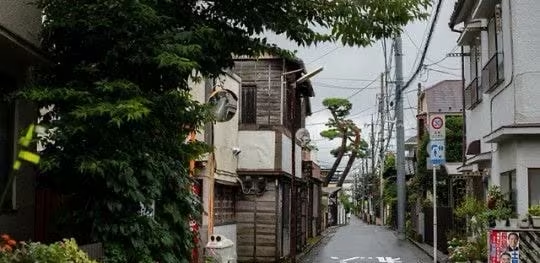
Japan Beyond the Aesthetic: Harmony, Silence, and the Human Cost
Follow
4 min read
·
Just now
Listen
Share
A reflective and evidence-based look at the tension between Japan’s polished image and lived realities
I once stood on a residential street at night where nothing seemed to be happening. A vending machine hummed; a bicycle leaned against a wall. The street was calm, orderly, and impossibly safe, but I have never fully trusted that quiet since.
Japan is often described as harmonious, polite, and efficient. Trains arrive on time. Streets remain quiet. Strangers apologize when you step into them. Harmony explains order, safety, and predictability. And yet, what happens to those who cannot, or will not, fit inside this harmony?
Politeness, Harmony, and the Cost of Silence
Japanese society values social harmony (wa / 和), indirect communication, and conflict avoidance. Silence is not absence; it is a form of speech. A pause can signal refusal, a smile can end a conversation without confrontation.
This orientation produces calm and courtesy but also discourages confrontation, dissent, and disclosure. Problems that threaten social cohesion are often managed through silence rather than addressed openly.
In matters of sexual violence, this silence has been particularly damaging. Until 2017, Japanese law defined rape by proof of physical resistance, placing an extraordinary burden on victims. Reporting rates remain low, and survivors often face disbelief, minimization, or the quiet suggestion that endurance is preferable to disclosure.
The 1988 murder of 17-year-old Junko Furuta remains a grim example. Kidnapped and held for 44 days, she was raped, tortured, and murdered while neighbors heard noises and noticed signs, but intervention failed to arrive in time. The case haunts public discourse not only for its brutality but because it exposed a collective failure to act.
Gender Inequality and Structural Constraint
Japan consistently ranks near the bottom among OECD nations on gender equality, particularly in political representation and corporate leadership. While women’s education is high, opportunities in senior roles remain limited.
Traditional expectations reward men for endurance and corporate loyalty while women are often expected to prioritize domestic responsibilities after marriage or childbirth. Although reforms such as parental leave policies and Womenomics initiatives exist, implementation is uneven.
Declining birth rates are often framed as a demographic puzzle, yet long working hours, limited childcare, and rigid career paths make reconciliation between autonomy, security, and family life difficult. For many women, withdrawal from traditional expectations is less a rejection of culture than an act of self-preservation.
Body Norms, Conformity, and Social Worth
Society enforces narrow standards of appearance, particularly for women. Thinness, youthfulness, and uniformity are idealized; difference, physical, emotional, or ideological, is often treated as disruption rather than diversity.
These norms are reinforced through schools, workplaces, and media. While younger generations and activist movements challenge these expectations, institutional habits remain slow to change.
Get Elin Mouvitz’s stories in your inbox
Join Medium for free to get updates from this writer.
Subscribe
Subscribe
Media, Sexualization, and Normalization
Japanese media, including anime, manga, and idol culture, has faced criticism for sexualizing women and minors. While defenders cite artistic freedom or cultural specificity, the scale and normalization of these portrayals raise ethical concerns.
Postwar entertainment industries helped redirect national identity away from militarism and trauma toward fantasy and aesthetic escapism. While this produced globally beloved art forms, it also contributed to softening or obscuring historical and social violence.
Racism, Xenophobia, and Conditional Belonging
Despite a reputation for hospitality, Japan remains largely ethnically homogeneous. Foreign residents, including those born and raised in Japan, often face social exclusion. Legal protections against racial discrimination are comparatively weak, and belonging is frequently framed as conditional. Politeness does not guarantee inclusion.
Work Culture, Emotional Suppression, and Human Cost
Japan’s work culture is associated with extreme hours, unpaid overtime, and the pressure to prioritize company loyalty. The phenomenon of karōshi ( death by overwork ), is officially recognized.
Mental health struggles are often internalized. Awareness campaigns exist, but expectations of endurance quietly shape what suffering is socially acceptable, contributing to high suicide rates and chronic stress.
History, War Crimes, and Selective Memory
Japan’s imperial actions in East Asia, including colonial rule, forced labor, and coercion of “comfort women”, remain contested aspects of national identity. Unlike Germany’s postwar reckoning, Japan’s postwar reconstruction prioritized stability. Wartime elites retained influence, and public education and political discourse have often softened or reframed imperial violence.
Visits by political leaders to Yasukuni Shrine, where convicted war criminals are honored alongside war dead, continue to provoke regional outrage. The issue is not only historical but ongoing: whether harm has been fully recognized and integrated into national memory.
Youth Marginalization and Hidden Economies
Groups like the Toyoko Kids, marginalized youth gathering under neon towers in Tokyo, highlight the consequences of structural pressures, familial estrangement, and social silence. Some are exploited, others are simply exhausted by societal demands.
Similarly, hostess and host clubs operate in systems that often exploit emotional labor and gendered vulnerability. These are not anomalies but structural outcomes of a society that prioritizes image and harmony over confronting harm.
Conclusion: Between Image and Reality
Japan is not uniquely cruel. It is not uniquely unjust. But it is unusually skilled at making violence, exclusion, and suffering quiet.
Beauty, innovation, and creativity coexist with systems that silence victims, restrict autonomy, marginalize difference, and privilege endurance over care. To see Japan clearly is to resist romanticization and engage honestly with its complexity.
The truth lies neither in cherry blossoms nor dystopia, but in the uncomfortable, human space in between.