The Mercosur Deal: Why Supporting Farmers Means Supporting Progress
Medium | 21.01.2026 16:06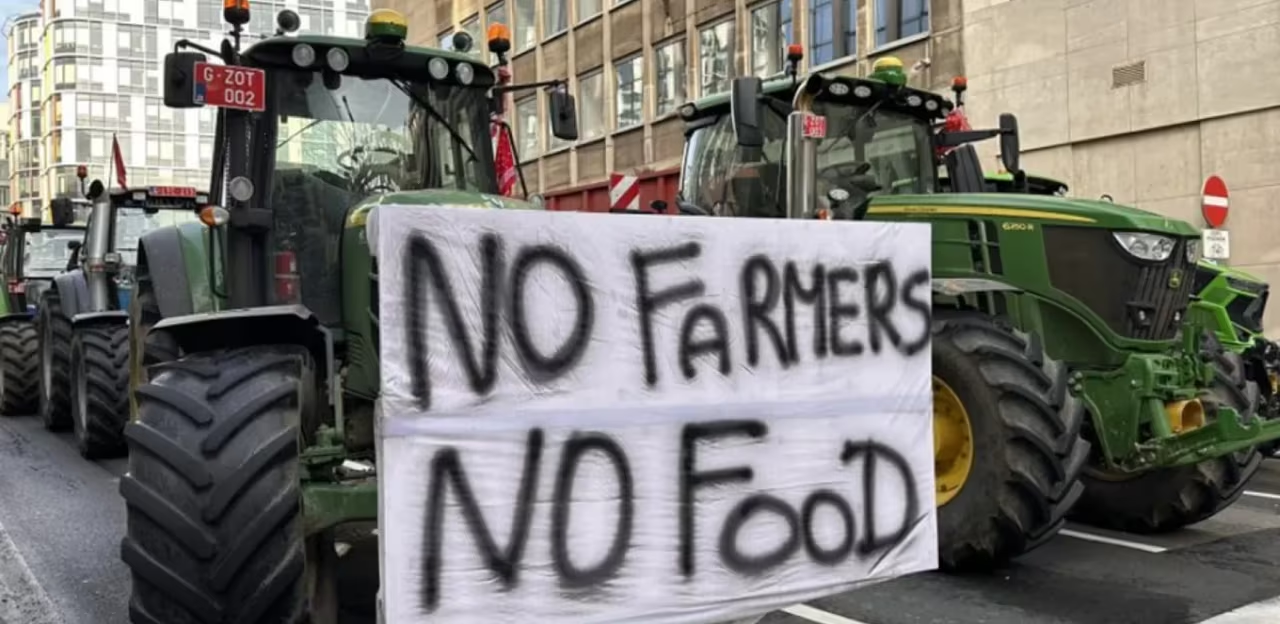
The Mercosur Deal: Why Supporting Farmers Means Supporting Progress
6 min read
·
Just now
--
Listen
Share
The images are striking: thousands of tractors blocking the streets of Brussels, fires burning in the night, farmers clashing with police amid clouds of tear gas. Across Europe, agricultural workers have taken to the streets in protest, and their message is clear: the EU-Mercosur trade agreement threatens their very survival. But this isn’t just about economics or politics as usual. This is about what kind of future we’re building and whether we have the courage to protect progress when it’s inconvenient.
Understanding Mercosur
The EU-Mercosur trade agreement has been in negotiation for over 25 years. It would create a free-trade zone between the European Union and the South American trading bloc Mercosur, which includes Brazil, Argentina, Paraguay, Uruguay, and Bolivia. Combined, this would be the world’s largest free-trade area, encompassing 780 million people and roughly 25% of global GDP.
The economic logic seems straightforward: Europe would export vehicles, machinery, wines, and spirits to Latin America, while Mercosur countries would send beef, sugar, rice, honey, and soybeans to Europe. Current tariffs of up to 35% on EU goods entering Mercosur and around 15% on agricultural products entering the EU would be eliminated or drastically reduced. Proponents argue this would boost trade, lower consumer prices, and provide the EU with geopolitical leverage to counterbalance China’s growing influence in Latin America.
After massive farmer protests in late 2024, the deal was delayed. However, on January 10, 2026, a majority of EU member states provisionally approved it, despite strong opposition from France, Italy, Ireland, Poland, and Austria. The agreement still requires European Parliament ratification, and the battle is far from over.
Why Are Farmers So Upset?
European farmers aren’t protesting out of simple self-interest or fear of competition. They’re responding to what they see as a fundamentally unfair system that punishes those who play by the rules.
The core issue is regulatory asymmetry. European farmers operate under some of the world’s strictest environmental, animal welfare, and food safety standards. Many pesticides used freely in South American agriculture are banned in the EU. Animal welfare regulations in Europe far exceed those in Mercosur countries. Environmental protections, including restrictions on deforestation and carbon emissions, add significant costs to European production.
Meanwhile, South American producers face far less stringent requirements. They can use chemicals that European farmers cannot. They can raise animals in conditions that would be illegal in Europe. They can produce on recently deforested land without penalty. This isn’t about South American farmers being more efficient or innovative. It’s about them operating under a completely different set of rules.
The result is predictable: South American agricultural products can be sold at prices European farmers simply cannot match, not because European farmers are less productive, but because they’ve been required to invest in higher standards. As one French farmer put it: “Our cows follow the rules, why don’t theirs?”
The timing makes this even more painful. European farmers are already dealing with disease outbreaks like lumpy skin disease forcing mass culls in France, proposed cuts of €90 billion to the Common Agricultural Policy budget, and the ongoing pressure of climate change. Now they face the prospect of being undercut by competitors who don’t have to meet the same standards they do.
Many farmers feel they’re being sacrificed for industrial interests. The EU’s push for the Mercosur deal is largely driven by manufacturers who want access to South American markets for cars and machinery. Agriculture, once considered the backbone of European society, is being treated as an acceptable loss in pursuit of other economic gains.
The MHD Position: Supporting Farmers Means Supporting Progress
At MHD, we reject the false binary that dominates this debate. This isn’t about protectionism versus free trade. It’s not about nationalism versus globalization. It’s about fair trade versus exploitative trade. It’s about whether we create a global system that elevates standards or demolishes them.
We support the farmers, and here’s why.
European agricultural standards represent real progress. They’re the result of decades of scientific research, ethical evolution, and democratic decision-making. When Europe banned certain pesticides, it was because evidence showed they harmed human health and ecosystems. When Europe implemented animal welfare standards, it was because societies decided that sentient beings deserve humane treatment. When Europe required environmental protections, it was because we recognized that short-term profits shouldn’t come at the cost of long-term sustainability.
These standards are expensive to implement. They require investment, adaptation, and sacrifice. European farmers made those investments in good faith, believing that society valued the progress these standards represented. They transformed their operations, often at great personal cost, to meet these higher expectations.
Now, the Mercosur deal tells them that progress doesn’t matter. It says that all the investment in better practices, all the commitment to higher standards, all the sacrifice to do things the right way, counts for nothing in the face of cheaper alternatives. It forces farmers who elevated their practices to compete with those who didn’t, and calls this “fair competition.”
This is worse than unfair. It’s a betrayal of progress itself.
The issue goes beyond individual farmers. When you force high-standard producers to compete directly with low-standard ones without any harmonization of rules, you don’t get a healthy market equilibrium. You get a race to the bottom. Farmers face an impossible choice: abandon the standards they worked so hard to meet, or abandon farming altogether.
The consequences extend far beyond farm gates. This affects food sovereignty, the ability of nations to feed themselves without complete dependence on global supply chains. It affects rural communities, the social fabric that holds together entire regions. It affects our collective ability to maintain ethical production practices in the face of economic pressure.
And let’s be honest about the economics. South American beef might appear cheaper at the checkout counter, but that price doesn’t reflect true costs. Those “savings” come from externalized costs: deforestation in the Amazon, contamination from banned pesticides, greenhouse gas emissions from longer supply chains, and lower animal welfare standards. When you account for these hidden costs, the apparent efficiency advantage disappears. European farmers aren’t less efficient. They’re just being honest about the real costs of production.
The Mercosur deal also reveals whose interests matter in current trade policy. Industrial exporters who want to sell cars and machinery to South America benefit enormously. European farmers pay the price. This isn’t about creating broadly shared prosperity. It’s about sacrificing one sector for the benefit of another, and doing so in a way that undermines the very standards we claim to value.
A Path Forward
MHD doesn’t advocate closing borders or rejecting trade. We advocate for trade that makes humanity different, trade that elevates rather than eliminates.
The solution isn’t protectionism in the traditional sense. It’s insisting on reciprocal standards. If countries want access to European markets, they should meet comparable environmental, safety, and welfare standards. This isn’t asking for special treatment. It’s asking for a level playing field.
Trade should be a force for raising standards globally, not a tool for punishing those who raised their standards first. If the EU-Mercosur deal is to move forward, it must include enforceable mechanisms to ensure that imported products meet the same standards as domestic ones. Not through tariffs alone, but through genuine harmonization of practices.
This isn’t about nationalism. South American farmers aren’t the enemy. The system that pits farmers against each other in a race to the bottom is the problem. A better trade agreement would help South American farmers transition to higher standards while protecting European farmers who already made that transition. It would create incentives for progress rather than penalties for it.
Supporting farmers in this fight isn’t about resisting change. It’s about defending the principle that progress shouldn’t be sacrificed for convenience, that standards matter, and that competition should reward those who do things better, not just cheaper.
The tractors in Brussels aren’t blocking the future. They’re fighting to protect it. And that’s a fight worth supporting.
This article reflects the perspective of MHD (Make Humanity Different), a movement beyond traditional left-right divisions. We believe in policies that elevate human civilization rather than optimize for narrow economic metrics. The farmer protests aren’t just about agriculture. They’re about what kind of world we’re building and whether we have the courage to protect progress when it’s tested.